Mera Peak Elevation | Altitude, Climbing Route & Trek Guide
Introduction to Mera Peak Elevation
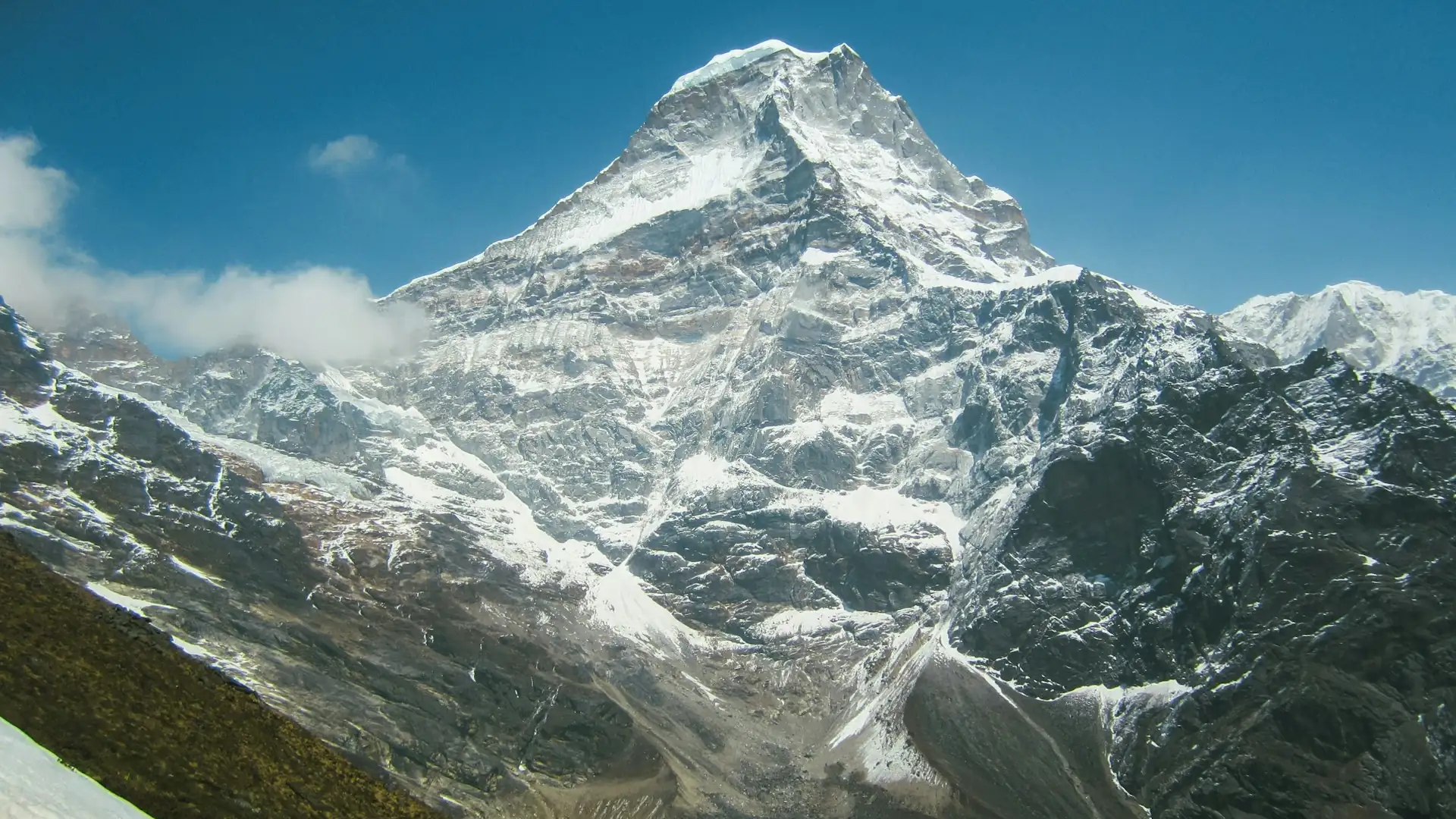
Mera Peak rises to 6,476 meters (21,247 feet) at its highest point, the North Summit, which makes it the highest trekking peak in Nepal. That single number is why the mountain is so popular: it offers a genuine six-thousand-meter summit, a glaciated but largely non-technical route, and a panorama that includes five of the world's six highest mountains, yet it can be climbed by strong, well-prepared trekkers with no previous mountaineering experience.
Mera Peak elevation also hides a few details that matter for planning, because the mountain has three separate summits, and the figures quoted by different operators are not always the same.
This guide explains exactly how high Mera Peak is, what each summit's altitude means for your climb, how the route builds in height day by day, how the permits and costs work for 2027, and how to prepare for the thin air. Wherever sources differ slightly, we say so, and we recommend confirming final details with your agency before you book.
Mera Peak at a Glance
Fact | Detail |
|---|---|
Highest summit (Mera North) | 6,476 m (21,247 ft) |
Mera Central | 6,461 m (21,198 ft) |
Mera South | 6,065 m (19,898 ft) |
Location | Hinku Valley, Solukhumbu District, Nepal, south of Everest |
Classification | Trekking peak (permit issued through the Nepal Mountaineering Association) |
Typical expedition length | 16 to 20 days, including the approach trek |
High camp | About 5,780 m (sources range from 5,770 to 5,800 m) |
Last village before the climb | Khare, about 5,045 m |
First ascent | 20 May 1953, by Jimmy Roberts and Sen Tenzing (Mera Central) |
Best seasons | Autumn (late September to November) and spring (March to May) |
Mera Peak Elevation Explained: Three Summits, Three Numbers
Ask "how high is Mera Peak?" and you will see slightly different answers online. The reason is that Mera is a ridge with three distinct summits, and each has its own height.
Summit | Elevation | Notes |
|---|---|---|
Mera North | 6,476 m (21,247 ft) | The true high point, reached by skirting the Central Summit on its north side and following a snow ridge |
Mera Central | 6,461 m (21,198 ft) | Where the 1953 first ascent is believed to have been made; steeper snow to reach |
Mera South | 6,065 m (19,898 ft) | Lowest of the three |
According to Wikipedia's entry on Mera Peak, the standard route from the north is a high-altitude glacier walk, while the west and south faces offer far more technical climbs. The standard commercial route targets Mera North, so when an operator quotes 6,476 meters, that is the summit you are aiming for. Some itineraries have in the past promoted Mera Central as "the summit," so it is worth confirming with your operator which top they plan to reach and what height they quote. The difference is only 15 meters, but it is a fair question to ask.
You may also see a handful of other figures, such as 6,461 meters or a conversion that lists 21,246 feet instead of 21,247. These come from rounding and from the fact that the Central Summit was the original first-ascent point. For practical purposes, 6,476 meters (21,247 feet) is the number to use for the highest point.
How Mera Peak's Height Compares With Other Well-Known Points
Numbers become meaningful when you compare them with places you may already know or plan to visit.
Place | Elevation | Difference from Mera North (6,476 m) |
|---|---|---|
Island Peak (Imja Tse) | 6,189 m | 287 m lower |
Kala Patthar (viewpoint above Everest Base Camp) | 5,644 m | 832 m lower |
Thorong La Pass | 5,416 m | 1,060 m lower |
Everest Base Camp (Nepal side) | 5,364 m | 1,112 m lower |
Mera High Camp | About 5,780 m | About 696 m lower |
Lhotse | 8,516 m | 2,040 m higher |
Mount Everest | 8,848.86 m | 2,372.86 m higher |
In practical terms, the summit of Mera Peak is more than a kilometer higher than Everest Base Camp. You can read more about the altitude of the classic Everest trek in our guide to Everest Base Camp's elevation, and about a high pass in our guide to the Thorong La Pass altitude and route. Mera's high camp alone sits above both of those points, and the summit pushes you above them again.
At 6,476 meters, each breath delivers less than half the oxygen available at sea level. That is why an acclimatization schedule, not athletic strength, determines who reaches the top.
Where Is Mera Peak?
Mera Peak stands in the Hinku Valley of Solukhumbu District, east of the main Everest trekking corridor and south of Mount Everest itself. The mountain dominates the remote Hinku and Hongu valleys and sits in the Mahalangur section of the Himalaya.
The approach starts with a flight to Lukla, but instead of turning north toward Namche Bazaar and Everest Base Camp, climbers head east and south into forest, high pastures, and remote villages that very few Everest trekkers ever see. The route passes through Makalu Barun National Park territory in the lower Hinku Valley, which is why that park's permit is required.
This isolation is one of Mera's biggest appeals. The trails are quieter than the Everest Base Camp route, the lodges are simpler, and the scenery changes from rhododendron forest to rocky moraine to glacier within a few days.
The View From the Top
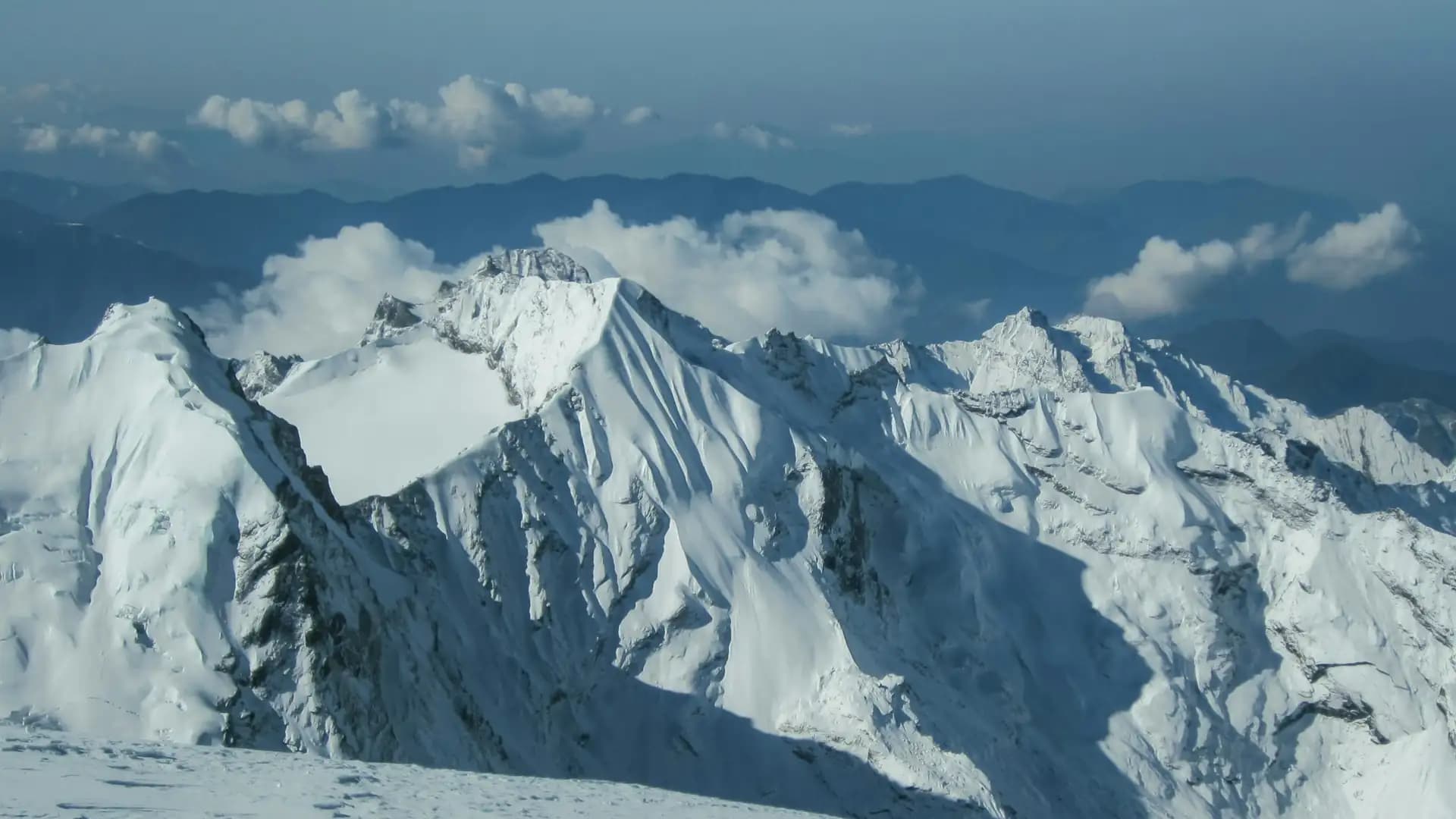
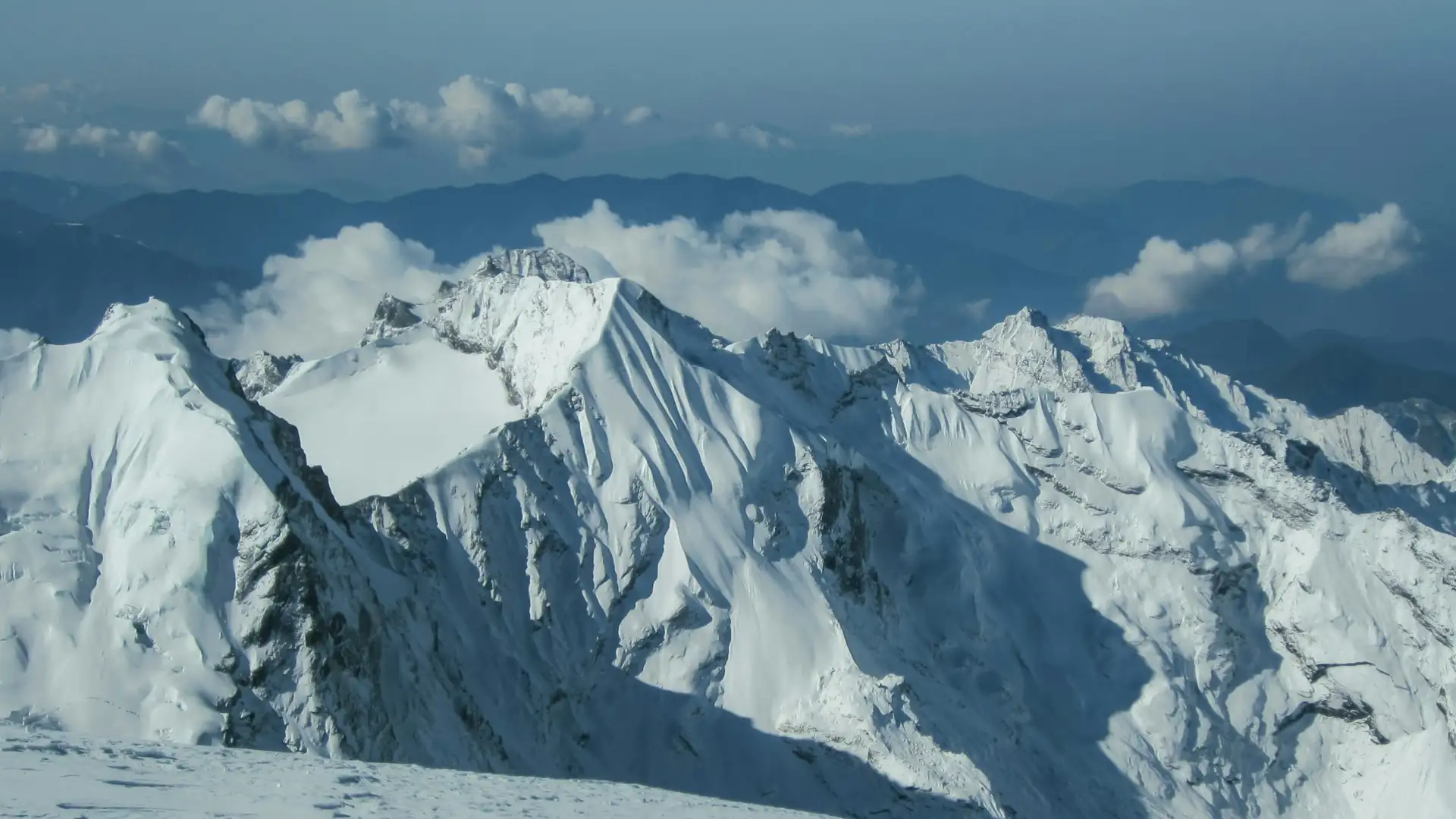
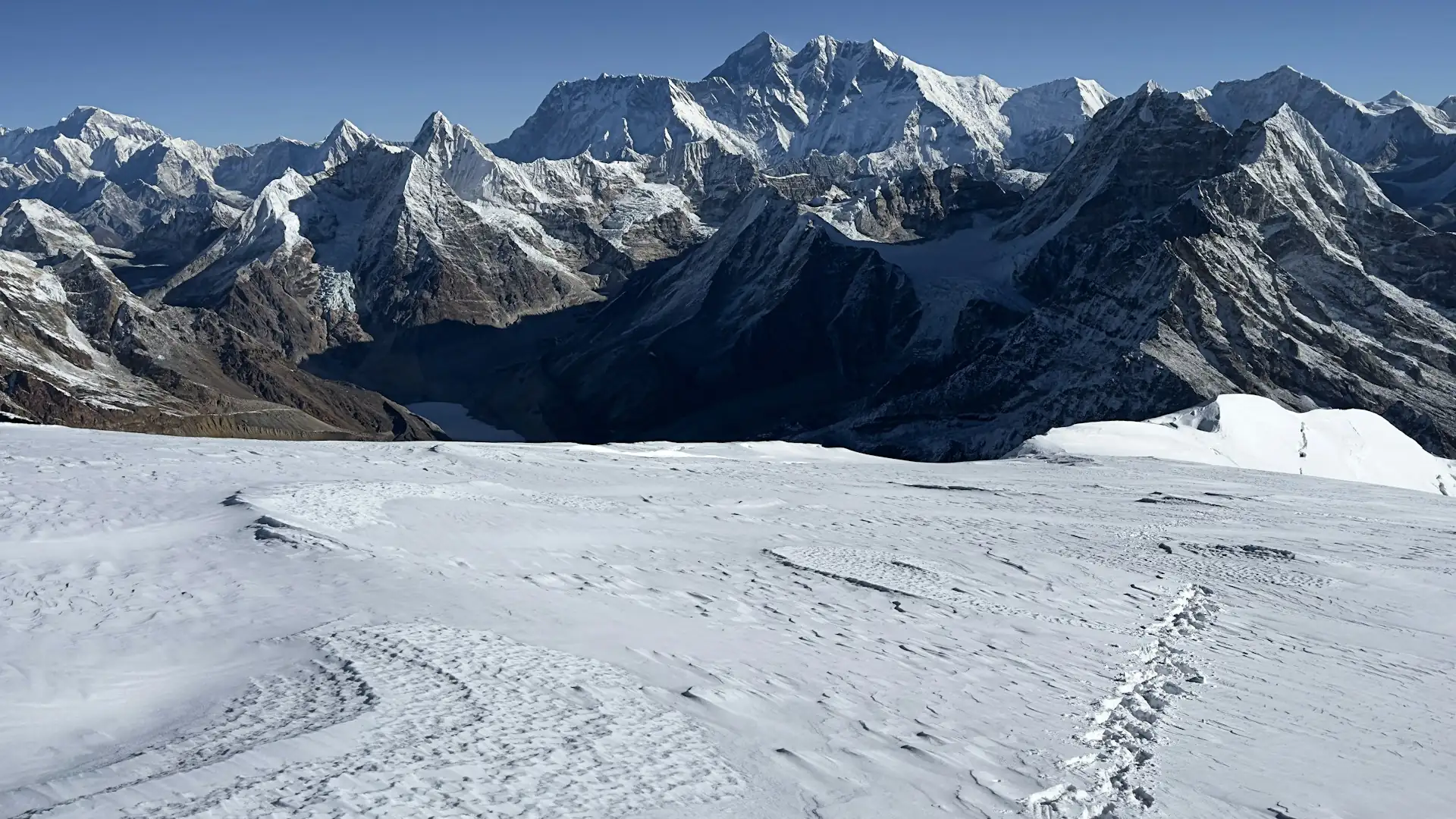
The summit panorama is the reason many climbers choose Mera over other trekking peaks. From the top you can see five of the world's six highest mountains.
Peak | Height | World rank |
|---|---|---|
Mount Everest | 8,848.86 m | 1st |
Kanchenjunga | 8,586 m | 3rd |
Lhotse | 8,516 m | 4th |
Makalu | 8,485 m | 5th |
Cho Oyu | 8,188 m | 6th |
Only K2, the world's second-highest peak, is out of sight. Even from Mera High Camp at sunset, the faces of Nuptse, Everest, Lhotse, and Lhotse Shar fill the horizon. If you enjoy learning about the mountains you can see, our guide to the Lhotse Face on Everest explains the steep ice wall climbers follow above Camp 2, and our overview of peaks near Everest helps you identify neighbouring summits.
A Short History of Mera Peak
The first recorded ascent of Mera was made on 20 May 1953 by Colonel Jimmy Roberts and Sen Tenzing, nine days before Tenzing Norgay and Edmund Hillary reached the summit of Everest. The region had been explored extensively by British expeditions in the early 1950s, before and after the Everest climb.
Modern accounts believe that Roberts and Sen Tenzing reached the Central Summit, and the North Summit is believed to have been first climbed in 1975 by the French climbers Marcel Jolly and G. Baus, along with L. Honills. In 1986, Mal Duff and Ian Tattersall made the first ascent of the south-west pillar, a far more technical route than the standard one.
You can read more about the first ascent in Wikipedia's biography of J. O. M. Roberts, who also led early exploration of the valleys south of Everest.
Is Mera Peak a Trekking Peak, and How Hard Is It?
Yes. Mera is classed as a trekking peak, a Nepal Mountaineering Association designation for mountains that require a climbing permit but are considered less technical than expedition peaks. In a sense, the name can be misleading. Mera is not a hike you can complete in running shoes. You will wear mountaineering boots and crampons, walk roped together on a glacier, use an ice axe, and in places climb with fixed ropes. But it does not demand advanced rock or ice climbing skills, and many first-time climbers reach the summit with proper guidance.
Difficulty factor | Reality |
|---|---|
Technical climbing | Low to moderate; glacier walking with crampons and rope |
Altitude | High; the real challenge |
Summit day length | About 8 to 13 hours round trip from High Camp, depending on pace and conditions |
Cold | Severe; pre-dawn departure at well below freezing |
Remoteness | High; fewer services than the Everest Base Camp route |
Fitness required | Strong endurance and prior experience at altitude |
The ease of reaching this elevation is also its biggest hazard. Good weather and snow conditions make the climb straightforward, but a sudden storm, a hidden crevasse, or altitude sickness can turn it into a serious situation quickly. For more about how trekking peaks differ from other mountaineering objectives, see our overview of peak climbing in Nepal.
Mera Peak Route: Elevation Profile by Stage
The climb begins with a trek of about a week to ten days, followed by the glacier approach and summit push. Elevations are approximate and vary slightly between sources.
Stage | Approximate elevation | Notes |
|---|---|---|
Lukla | 2,860 m | Flight from Kathmandu; start of the trek |
Chutanga | About 3,400 m | First night in forest |
Zatrwa La pass | About 4,600 m | Crossing into the Hinku Valley |
Thuli Kharka | About 4,300 m | High pasture camp |
Kothe | About 3,600 m | Descent into Hinku Valley forest |
Thangnak | About 4,350 m | Last settlement before the glaciers |
Khare | About 5,045 m | Last lodge village; usual acclimatization stop |
Mera Base Camp | About 5,300 to 5,400 m | Glacier approach begins |
Mera High Camp | About 5,780 m | Rocky outcrop; staging for the summit |
Mera North Summit | 6,476 m | Summit day, pre-dawn start |
Sample 18-day itinerary
Day | Plan | Sleeping altitude |
|---|---|---|
1 | Arrive in Kathmandu | 1,400 m |
2 | Permits, gear check, briefing | 1,400 m |
3 | Fly to Lukla; trek to Chutanga | About 3,400 m |
4 | Cross Zatrwa La; reach Thuli Kharka | About 4,300 m |
5 | Descend to Kothe | About 3,600 m |
6 | Trek to Thangnak | About 4,350 m |
7 | Rest and acclimatization day at Thangnak | About 4,350 m |
8 | Trek to Khare | About 5,045 m |
9 | Acclimatization and glacier skills training at Khare | About 5,045 m |
10 | Climb to Mera Base Camp or on to High Camp | About 5,300 to 5,780 m |
11 | Move to High Camp (if not already there) | About 5,780 m |
12 | Summit day: Mera North (6,476 m), descend to Khare | About 5,045 m |
13 | Spare day for weather | About 5,045 m |
14 to 16 | Trek back via Kothe or Thangnak toward Lukla | Descending |
17 | Fly to Kathmandu | 1,400 m |
18 | Departure or buffer day | 1,400 m |
Itineraries from different operators vary, and some use extra acclimatization days or crossing alternatives. The important feature is that sleeping altitude rises gradually, with at least two or three rest or spare days built in.
Summit Day on Mera Peak
Summit day begins very early, typically between 1:00 and 2:00 a.m., when climbers leave High Camp by headlamp. The reason is practical: snow is firmer and winds are usually calmer in the early hours, and you want to be descending before the afternoon cloud builds.
The route climbs a broad glacier bay and a long snow ridge above High Camp, with some sections that are steeper and may be fixed with ropes. You travel roped to your guide, wearing crampons, with an ice axe in hand. Reaching Mera Central involves steeper snow than Mera North, which is reached by skirting the Central Summit on its north side and following a snow ridge to the top.
At the summit you typically stay only a few minutes for photographs, because it is extremely cold and thin. Climbers then descend to High Camp and often continue down to Khare the same day, which makes for a long and tiring day. Allow roughly 8 to 13 hours in total, depending on pace, conditions, and which summit you attempt.
Altitude and Acclimatization on Mera Peak
Everything about Mera depends on how well you adapt to altitude. Acute mountain sickness (AMS) is driven mainly by how fast you ascend, not by how fit you are, and Mera takes you well above the altitude most trekkers have experienced.
Key facts to internalize before you go:
Above 3,000 meters, sleeping altitude should rise by no more than roughly 300 to 500 meters per day, with a rest day about every 1,000 meters of gain.
"Climb high, sleep low" works well: hike to a higher point during the day, then return to sleep lower.
Mera High Camp, at about 5,780 meters, is higher than Everest Base Camp, so you spend a night at an altitude that many trekkers never reach.
Early symptoms include headache, nausea, dizziness, loss of appetite, and poor sleep. HAPE and HACE, the severe forms, are life-threatening and require immediate descent.
Drink three to four liters of water daily and eat well, even when appetite drops.
Preventive medication such as acetazolamide requires a doctor's advice, so discuss it four to six weeks before departure.
For more on how altitude is managed on high routes, see our guide to the Annapurna Circuit acclimatization, whose principles apply directly to the Hinku Valley, and our Nepal elevation guide for a broader picture of how altitude changes across the country.
A final point is easy to miss: the descent. The most common mistake on high peaks is celebrating at the summit and forgetting that you are still at extreme altitude. Keep drinking, keep eating, and descend steadily.
The Mera Peak Trek: How Much of the Journey Is Hiking?
Many people picture Mera as a single summit day, but in reality most of the expedition is a trek. The approach covers roughly a week to ten days, crossing forest, high passes, and remote valleys before you ever put on crampons. That walking time is what builds your fitness and acclimatization, so it is not something to rush.
Phase | Approximate duration | What it involves |
|---|---|---|
Fly to Lukla and approach trek | 6 to 8 days | Forest trails, passes such as Zatrwa La, remote Hinku Valley villages |
Acclimatization and skills at Khare | 1 to 2 days | Rest, short hikes, crampon and rope practice |
High Camp and summit push | 2 to 3 days | Glacier travel, early start, summit day |
Descent and trek out | 3 to 5 days | Return via the Hinku Valley and fly to Kathmandu |
The mix of trekking and climbing is one reason Mera suits strong hikers who want a taste of mountaineering without committing to a technical peak.
Life on the Trail: Lodges, Food, and Facilities
The Hinku Valley is far less developed than the Everest Base Camp trail, and that shapes daily life.
Accommodation: Depending on the operator and season, you will stay in simple lodges at lower stages, and in some itineraries in fully supported camps higher up. Rooms are basic, usually with shared bathrooms, and heating is limited.
Food: Expect dal bhat, noodles, soups, eggs, and simple Western dishes. Menus shrink with altitude, and fresh produce becomes scarce.
Water: Use purification tablets or a filter, and carry insulated bottles because water can freeze overnight.
Showers and charging: Hot showers and device charging are limited or unavailable at higher stops, so bring a power bank.
Connectivity: Mobile signal and Wi-Fi are patchy, so plan to be offline for much of the trek.
These conditions are part of the appeal for many climbers, who value the quiet, but they are worth knowing before you go.
Weather and Temperature Planning
Weather on Mera is as important as altitude. Mornings are usually clear and cold, with cloud and wind building later in the day, which is why summit pushes begin before dawn. At Khare and High Camp, nights are bitterly cold and well below freezing even in the best seasons, and wind on the glacier can make it feel colder still.
Plan for a full cold-weather layering system, keep spare batteries warm inside your clothing, and always leave room in the schedule for a weather delay. A spare day between High Camp and your planned summit date is not a luxury, because it can be the difference between success and turning back.
What 6,476 Meters Means for Your Body
It is worth thinking about Mera Peak elevation in physical terms, because it shapes how you should train and pace yourself. At sea level the air contains about 21 percent oxygen at full atmospheric pressure. As you climb, the percentage stays similar but the pressure drops, so each breath delivers less. At the summit of Mera, that supply is less than half of what you would get at sea level.
What that means in practice:
Your pace slows dramatically, often to a few steps per breath on steeper sections.
Your heart rate rises, and recovery after exertion takes longer.
Sleep is lighter and more broken at High Camp.
Appetite drops even though your body is burning more energy.
Small mistakes, such as forgetting to drink or letting your hands get cold, have outsized consequences.
Training can improve your endurance, but only gradual acclimatization allows your body to adapt. That is why the best itineraries use rest days and a slow ascent profile, rather than relying on strength alone.
Combining Mera Peak With Other Objectives
Some operators combine Mera Peak with other trips, which can make sense for climbers with extra time and strong acclimatization.
Mera and Island Peak: A combined itinerary of three weeks or more lets you climb both of Nepal's most popular trekking peaks, usually starting with Mera in the Hinku Valley and finishing with Island Peak near the Everest Base Camp trail.
Mera La crossing: Instead of returning the same way, some groups cross Mera La, at roughly 5,400 meters, into the Hongu Valley, which adds remote scenery and a further high pass.
Everest region treks: If you want to add the classic Everest experience, the classic Everest Base Camp trek can be paired with a peak climb by arrangement.
Combinations demand more time, more rest days, and a higher level of fitness, so discuss them carefully with your agency.
Best Time to Climb Mera Peak
Season | Months | Conditions | Verdict |
|---|---|---|---|
Autumn | Late September to November | Clear skies, stable weather, post-monsoon visibility | Best overall; lower NMA permit fee |
Spring | March to May | Warmer, longer days, slightly more cloud and wind later in the season | Very good; higher permit fee |
Winter | December to February | Extreme cold and strong winds | Not recommended for most climbers |
Monsoon | June to August | Rain, cloud, poor visibility | Not recommended |
October and November are widely considered the best months, because skies are clear after the monsoon and weather is stable. March to May is a strong second option, with warmer temperatures and long days. If you are planning for 2027, remember that spring carries a higher climbing permit fee than autumn, which we explain below.
Permits and Fees for 2027
Mera Peak requires several permits, and the figures changed in September 2025, so older articles may show lower numbers.
Permit or fee | Approximate cost for foreigners | Notes |
|---|---|---|
NMA climbing permit, spring (March to May) | USD 350 | Revised on 1 September 2025; earlier figure was USD 250 |
NMA climbing permit, autumn (September to November) | USD 175 | Revised on 1 September 2025; earlier figure was USD 125 |
NMA climbing permit, winter and summer | Lower rates apply | Confirm with your agency |
Makalu Barun National Park entry permit | NPR 3,000 (about USD 22 to 25) | Required for the Hinku Valley route |
Local rural municipality fee | NPR 2,000 to 3,000 | Varies by route and municipality |
Sagarmatha National Park permit | NPR 3,000 | Applies on some approach routes through Lukla |
Garbage deposit | Refundable; quoted figures vary | Required by the NMA, per group |
The climbing permit must be arranged through a licensed Nepali trekking agency, and a licensed guide is part of the standard arrangement. Our guide to the Nepal trekking guide requirement explains how the rules work in practice.
Fees and enforcement are updated from time to time, so confirm the final numbers with your agency before departure, and check official information from the Nepal Tourism Board for national park entry fees.
How Much Does a Mera Peak Climb Cost?
Guided Mera Peak expeditions vary by operator, season, group size, and service level. Most 2026 and 2027 listings fall in the following range.
Cost item | Typical range |
|---|---|
Guided package (about 16 to 20 days) | Roughly USD 2,100 to 3,500 per person |
Licensed climbing guide (if hired separately) | USD 30 to 40 per day |
Porter (if hired separately) | USD 20 to 25 per day |
Kathmandu to Lukla return flights | Often included; roughly USD 400 to 500 if separate |
Travel insurance with climbing cover | USD 100 to 250 or more |
Tips for guide and porters | Customary; budget separately |
Packages typically include permits, the guide, porters, lodge or camp accommodation, meals, technical group equipment, and airport transfers. They usually exclude international flights, visas, personal gear, insurance, and tips. Autumn departures are often cheaper than spring, mainly because of the lower NMA permit fee.
Training and Fitness for Mera Peak
Mera is achievable for fit trekkers, but it is not a beginner hike. Aim to start training 12 weeks before departure.
Endurance: four to five sessions a week of cardio, including long hikes with a loaded pack.
Strength: squats, lunges, step-ups, and core work to protect knees and back on steep descents.
Back-to-back days: long hikes on consecutive days, because the expedition is a multi-day effort.
Altitude experience: a previous trek above 4,500 or 5,000 meters, such as Everest Base Camp or the Annapurna Circuit, is a big advantage.
Skills: practice walking in crampons and using an ice axe, which many agencies teach at Khare.
Our guide on how to prepare for the Annapurna Circuit outlines a high-altitude training plan that translates well to Mera, and a general overview of trekking routes, permits, and preparation helps if this is your first Himalayan trip. See a doctor before booking if you have heart, lung, or blood-pressure conditions.
Gear You Will Need
Category | Essentials |
|---|---|
Layers | Base layers, fleece, insulated jacket, hard shell jacket and trousers |
Extreme cold | Expedition-weight down jacket, warm hat, insulated gloves or mittens, balaclava |
Footwear | Insulated mountaineering boots (high-altitude rated), warm socks, gaiters |
Technical gear | Crampons, ice axe, harness, helmet, carabiners, ascender and belay device |
Sleep | Sleeping bag rated for very low temperatures; liner |
Eyes and skin | Glacier glasses with side protection, high-SPF sunscreen, lip balm |
Trek gear | Trekking poles, headlamp with spare batteries, daypack, dry bags |
Health | First-aid kit, personal medicines, water purification, hand sanitizer |
Many agencies supply technical equipment, and you can rent boots, down jackets, and sleeping bags in Kathmandu. Bring items where fit matters most, such as base layers and gloves.
Safety, Insurance, and Emergencies
Crevasses: The glacier approach has hidden crevasses, which is why you travel roped and follow your guide's line precisely.
Weather: Storms can arrive quickly at altitude. Be prepared to delay or abandon a summit attempt if conditions deteriorate.
Altitude illness: Report symptoms immediately and descend if they worsen.
Remoteness: The Hinku Valley has fewer services and slower rescue access than the main Everest trail.
Insurance: Choose a policy that explicitly covers mountaineering or peak climbing to at least 6,500 meters and emergency helicopter evacuation.
Buffer days: Build in spare days for weather and flight delays at Lukla.
Mera Peak vs Island Peak
Mera and Island Peak are Nepal's two most popular trekking peak climbs, and travelers often compare them.
Factor | Mera Peak | Island Peak |
|---|---|---|
Elevation | 6,476 m | 6,189 m |
Character | Long glacier walk, remote approach | Shorter approach with a steeper headwall near the summit |
Technical level | Lower | Somewhat higher |
Crowds | Quieter | Busier, near the Everest trail |
Approach | Hinku Valley, 7 to 10 days | Via Namche Bazaar and Chhukung |
Best for | Altitude and wilderness | A slightly shorter trip with more technical climbing |
Mera is higher but generally less technical, while Island Peak is lower but includes a steeper final section. Both demand good fitness and careful acclimatization.
Common Mistakes to Avoid
Underestimating altitude. The summit is more than a kilometer higher than Everest Base Camp, so treat it seriously.
Choosing a compressed itinerary. Less than two or three rest days is a risk factor for altitude illness.
Skipping skills practice. Crampon and rope skills make summit day safer and more enjoyable.
Assuming "trekking peak" means "easy." It is non-technical compared with expedition peaks, but still a serious high-altitude climb.
Not checking which summit your operator targets. Confirm whether the plan is for Mera North (6,476 m) or Mera Central (6,461 m).
Ignoring the cold. Pre-dawn temperatures on summit day are severe, so pack the right gear.
Skipping insurance. Make sure it covers climbing and evacuation.
Quick Planning Checklist for 2027
Before you book, run through these points so nothing surprises you later.
Pick your season: autumn for the lowest permit fee and clearest skies, or spring for warmer days.
Choose an itinerary with spare days: at least two rest or buffer days for acclimatization and weather.
Confirm the target summit: ask whether the plan is for Mera North at 6,476 meters.
Check what is included: permits, guide, porters, technical gear, lodging, meals, and transfers.
Arrange insurance early: cover for climbing to at least 6,500 meters and helicopter evacuation.
Start training 12 weeks out: endurance, strength, and long back-to-back hikes.
Test your gear: boots, gloves, and layers should be worn before you travel.
Frequently Asked Questions about Mera Peak Elevation
1. What is the elevation of Mera Peak? The highest point, Mera North, is 6,476 meters (21,247 feet). Mera Central is 6,461 meters and Mera South is 6,065 meters.
2. Is Mera Peak the highest trekking peak in Nepal? Yes, it is widely recognised as the highest of Nepal's trekking peaks, though it is still a serious high-altitude climb.
3. Why do some sources say 6,461 meters instead of 6,476 meters? Because 6,461 meters is the height of Mera Central, where the first ascent is believed to have been made. The true high point is Mera North at 6,476 meters.
4. How high is Mera High Camp? About 5,780 meters, with sources quoting between 5,770 and 5,800 meters. It is higher than Everest Base Camp.
5. How long does it take to climb Mera Peak? Most expeditions take 16 to 20 days including the trek in and out, with summit day itself lasting roughly 8 to 13 hours from High Camp.
6. Do I need technical climbing experience for Mera Peak? No advanced experience is needed, but you must be comfortable in crampons, on a rope, and at high altitude. Many agencies teach the basic skills at Khare.
7. How difficult is Mera Peak? It is a strenuous trek and climb with moderate technical demands. The main difficulty is altitude, cold, and the length of summit day.
8. What is the best time to climb Mera Peak? October and November offer the clearest, most stable weather. March to May is also good, though permit fees are higher in spring.
9. How much does the Mera Peak climbing permit cost in 2027? The NMA permit is listed at USD 350 in spring and USD 175 in autumn, following a revision on 1 September 2025. Additional park and local fees also apply. Confirm current figures with your agency.
10. What other permits do I need? A Makalu Barun National Park entry permit (NPR 3,000), a local rural municipality fee (NPR 2,000 to 3,000), and in some routes a Sagarmatha National Park permit.
11. Do I need a guide? Yes. The climbing permit is arranged through a licensed agency, and a licensed guide is part of the standard arrangement.
12. How much does a Mera Peak expedition cost? Guided packages typically range from roughly USD 2,100 to USD 3,500 per person, depending on operator, season, and group size.
13. What can I see from the summit? Five of the world's six highest mountains: Everest, Kanchenjunga, Lhotse, Makalu, and Cho Oyu. K2 is not visible.
14. When was Mera Peak first climbed? On 20 May 1953 by Jimmy Roberts and Sen Tenzing, believed to have reached the Central Summit. The North Summit was first climbed in 1975.
15. How does Mera Peak compare with Island Peak? Mera is higher (6,476 meters versus 6,189 meters) and generally less technical, with a longer, more remote approach. Island Peak has a steeper headwall.
16. Can beginners climb Mera Peak? First-time climbers can succeed with proper training, an experienced guide, and a well-paced itinerary, but previous trekking at altitude is strongly recommended.
17. What gear do I need? Insulated mountaineering boots, crampons, an ice axe, a harness, a helmet, an expedition down jacket, a warm sleeping bag, and glacier glasses. Many agencies provide technical equipment.
18. How cold is summit day? Very cold. Climbers leave around 1:00 to 2:00 a.m., and temperatures are well below freezing, with wind making it feel colder.
19. Do I need travel insurance? Yes. Choose a policy covering mountaineering to at least 6,500 meters and emergency helicopter evacuation.
20. How early should I book for 2027? For autumn and spring departures, four to six months ahead is sensible, which gives time for training, gear, and permit arrangements.
Final Thoughts on Mera Peak Elevation
Understanding Mera Peak elevation is about more than a number. At 6,476 meters, the mountain sits high enough to deliver a true Himalayan summit and a view of five of the world's six highest peaks, yet its standard route is accessible to well-prepared trekkers.
The key to success is respect for altitude: choose the right season, build in rest and spare days, train for endurance, and climb with an experienced guide and a licensed agency. Do those things, and the numbers on the map become a very achievable goal.
Plan Your Mera Peak Climb With Adventure Life Nepal
Choosing the right season, itinerary length, and level of support makes the difference between a stressful climb and a memorable one. Adventure Life Nepal helps climbers plan Mera Peak with proper acclimatization days, experienced guides, and clear advice on permits, gear, and insurance, so you can focus on the mountain.
Message an expert on WhatsApp at +977 9841248242, or reach the team through the Adventure Life Nepal contact page. Tell us your experience, dates, and fitness level, and we will recommend the right plan for your Mera Peak elevation goal in 2027.
Written by Dil Bahadur Karki