Camp 2 Everest 2027 | Altitude, Location & Climbing Guide
Introduction to Camp 2 Everest
Most people picture Everest in two places: the base camp tents beneath the Khumbu Icefall, and the summit. Between those two sits a place that almost never makes the postcards, and yet it is where the climb is actually won or lost. It is a flat, sun-blasted basin at the head of a glacial valley, ringed by the walls of Nuptse, Everest and Lhotse, with a small tent village at its far end. Climbers call it Camp 2, or Advanced Base Camp, and many of them spend more nights there than at any other high camp.
This guide explains what Camp 2 Everest actually is, how high it sits, where it is, how climbers get there, what life is like once they arrive, which hazards matter, and why the answer to "Can I go there?" is more complicated than a simple yes or no. If you have come here because you are planning an Everest Base Camp trek and wondered whether Camp 2 is part of it, the short answer is no, and the long answer is below.
If you are considering a real climbing objective, the sections on programs, costs and preparation are for you. For the broader picture of the climb, our guides on how hard it is to climb Everest and how long it takes to climb Mount Everest are good companions.
What Is Camp 2 Everest? The Quick Answer
On the standard south-side route from Nepal, Camp 2 is the second high camp above Base Camp, positioned in the upper Western Cwm at about 6,400 m (21,000 ft). It sits at the foot of the Lhotse Face and is also known as Advanced Base Camp. It is the main staging point for everything higher on the mountain: acclimatization rotations, storage of oxygen and supplies, and the push to Camp 3, the South Col and the summit.
Quick fact | Detail |
|---|---|
Also known as | Advanced Base Camp (ABC), Camp II |
Route | South Col route from Nepal (the north side from Tibet has a different camp layout) |
Altitude | About 6,400 m (21,000 ft); sources report 6,400 to 6,550 m |
Location | Upper Western Cwm, at the base of the Lhotse Face |
Access | Through the Khumbu Icefall, then across the Western Cwm from Camp 1 |
Typical role | Acclimatization hub, supply depot, summit-push staging camp |
Typical stay per rotation | Often 2 to 4 nights |
Reachable on an Everest Base Camp trek? | No, it is a mountaineering camp above the Icefall |
Altitudes for Everest camps vary a little between expedition operators and published guides, because camp positions shift from season to season with ice and snow conditions. Treat any single figure as approximate.
Which Camp 2? South Side vs North Side
Search results for this topic blur two different mountains' worth of logistics, so it helps to separate them. Everest has two main climbing routes, and each has its own camps.
Camp | South side (Nepal) | North side (Tibet) |
|---|---|---|
Base Camp | About 5,364 m | About 5,150 m (Tibet) |
Advanced Base Camp | Camp 2 at about 6,400 m | ABC at about 6,340 to 6,400 m |
Camp 1 | About 6,065 m, beyond the Khumbu Icefall | About 7,000 m, on the North Col |
Camp 2 | About 6,400 m, in the Western Cwm | About 7,500 m, on the northeast ridge |
Camp 3 | About 7,162 m, on the Lhotse Face | About 8,300 m |
Camp 4 | About 7,900 m at the South Col | None; Camp 3 is the last camp |
The key point is that "Camp 2" means about 6,400 m on the south side and a much higher camp, roughly 7,500 m, on the north side. Most English-language searches for Camp 2 Everest are about the Nepal side, which is where this guide focuses. For the Tibet side, see the dedicated section below and our guide to Mount Everest North Base Camp.
Where Camp 2 Sits: A Walk Through the Western Cwm
To picture the location, start at Everest Base Camp (about 5,364 m), where the climb begins. Above it lies the Khumbu Icefall, a jumbled, moving section of the glacier that every south-side climber must cross. Beyond the Icefall, the terrain flattens into the Western Cwm.
The Western Cwm is a broad, gently undulating glacial valley that ends at the foot of the Lhotse Face. It was named by George Mallory when he saw it during the 1921 British reconnaissance expedition, and the word cwm is Welsh for a valley enclosed by mountains. Climbers also call it the Valley of Silence, a name that fits its still, cupped atmosphere. The Cwm is bounded by Everest's Southwest Face, Nuptse and Lhotse.
At a narrow passage called the Nuptse corner, climbers get their first view of the upper part of Everest since leaving Base Camp. You can read more in the Wikipedia entry on the Western Cwm.
The route up to Camp 2
Stage | Approx. altitude | What it is like |
|---|---|---|
Base Camp | About 5,364 m | Tent village on the Khumbu Glacier |
Khumbu Icefall | Base Camp to about 6,000 m | Ladders, fixed ropes and crevasses; commonly reported as roughly 4 to 9 hours depending on pace and conditions |
Camp 1 | About 6,065 m | A staging camp on the flat Cwm floor, mostly used for a first night or two |
Western Cwm | Camp 1 to Camp 2 | A long, relatively gentle walk, often reported as roughly 3 to 6 hours |
Camp 2 | About 6,400 m | The main acclimatization camp at the foot of the Lhotse Face |
The Icefall section is the hardest and most dangerous part of getting to Camp 2. The Western Cwm section is far gentler, but not trivial: it crosses crevasses on fixed lines or ladders, and the glare and heat make it tiring. One climber's recent diary described the walk from Camp 1 to Camp 2 as covering about 2.6 miles with roughly 1,370 feet of vertical gain in just under four hours, a stark contrast to the grueling Icefall day before.
The South Side Camps at a Glance
Seeing Camp 2 in context helps explain its job.
Camp | Approx. altitude | Main purpose |
|---|---|---|
Base Camp | 5,364 m | Expedition home; start of the climb |
Camp 1 | About 6,065 m | First night above the Icefall |
Camp 2 (ABC) | About 6,400 m | Main hub for acclimatization, storage and summit staging |
Camp 3 | About 7,162 m | On the Lhotse Face; high acclimatization point |
Camp 4 (South Col) | About 7,900 m | Last camp before the summit push |
Summit | 8,848.86 m | Official height agreed by Nepal and China in 2020 |
Camp 3 altitudes are reported anywhere between about 7,100 and 7,300 m, and the South Col is commonly given as roughly 7,900 to 8,000 m, so treat those numbers as ranges. For a closer look at what happens above Camp 2, our guide to the Lhotse Face on Everest explains the wall that climbers must cross next.
Camp 2 Everest Altitude: What 6,400 Metres Actually Feels Like
Numbers on a page do not convey what altitude does to a body. A helpful way to think about it is air pressure. Using a standard-atmosphere estimate, the air at 6,400 m holds roughly 44 percent of the oxygen available at sea level, compared with about half at Everest Base Camp and about 40 percent at Camp 3. That is a large difference, and it is why Camp 2 is described as the place where the body starts experiencing significant physiological stress. Sleep becomes harder, appetite fades and recovery slows.
It helps to compare Camp 2 with places trekkers and climbers know:
Place | Altitude | How it compares with Camp 2 |
|---|---|---|
Everest Base Camp | 5,364 m | About 1,000 m lower |
Island Peak summit | 6,189 m | Slightly lower |
Lobuche East summit | 6,119 m | Slightly lower |
Camp 2 | About 6,400 m | Reference point |
Mera Peak summit | 6,476 m | Almost identical |
Camp 3 | About 7,162 m | Roughly 760 m higher |
This comparison explains why experienced guides recommend climbing a 6,000 m peak before attempting Everest. Standing on Mera Peak or Island Peak gives you a direct feel for what Camp 2 altitudes demand, but with an easier retreat. If you want to explore that path, our guide to peak climbing in Nepal explains how those peaks work.
What Camp 2 Looks Like: Tents, Heat and Cold
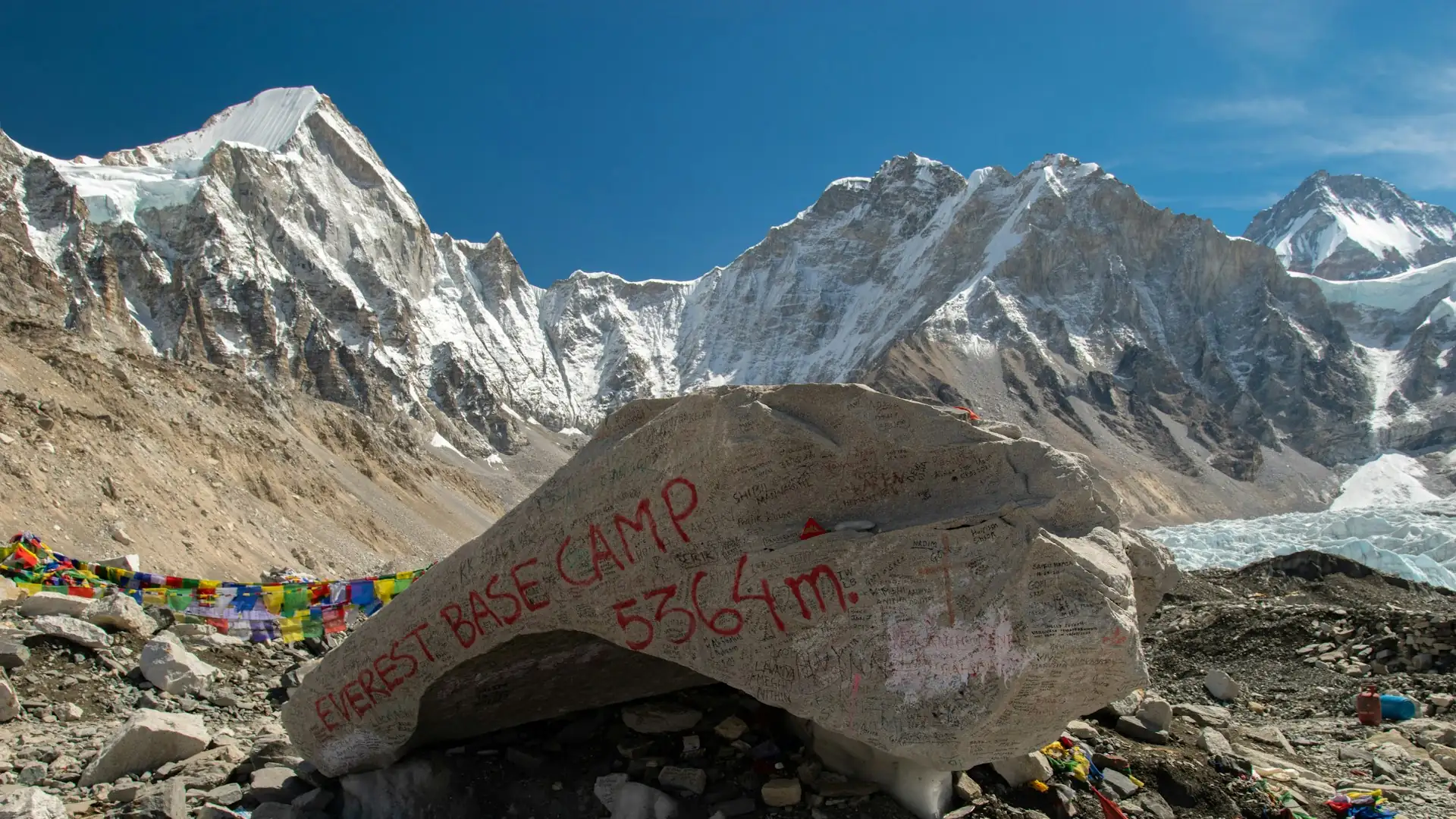
Imagine a small village of tents pitched on a glacier at the top of a bowl. At Camp 2, expedition teams typically set up large tents for cooking and dining and a number of smaller tents for sleeping. Sherpa staff establish the camp early in the season, stock it with supplies and, as the season progresses, bring up bottled oxygen for the higher camps.
In early May 2026, for example, Sherpa teams had established Camp 2 with tents and supplies and were preparing to stock it with oxygen while rope fixers moved on to Camp 3.
Three features define daily life there:
Intense daytime heat. The Cwm channels sunlight between the walls and reflects it off ice, so the valley can feel hot in the sun even when the air temperature is around freezing. Climbers often strip off layers by mid-morning.
Bitter cold at night. Once the sun drops behind the walls, temperatures plunge, and the contrast with daytime heat is part of what makes the camp tiring.
A relatively protected position. Camp 2 is often described as the most comfortable of the high camps, with relatively flat ground and a dining tent where teams gather. Comfort is relative, though. Sleep is poor, appetite is low and everything takes longer.
The setting is spectacular. Everest's Southwest Face, Nuptse and the Lhotse Face all frame the camp, with the Lhotse Face rising directly above it like a wall of blue-white ice.
Why Camp 2 Matters: The Engine Room of an Everest Expedition
If Base Camp is the home of an expedition, Camp 2 is its workshop. Climbers do not walk from Base Camp to the summit in one push. They build up gradually through rotations, short trips to higher camps followed by descents to recover, and Camp 2 sits at the centre of that system.
A typical rotation pattern
Every expedition is different, and operators adapt their plans to weather and climbers' condition, but a simplified pattern looks like this:
Phase | What happens |
|---|---|
First rotation | Base Camp to Camp 1 or Camp 2, a night or two, then return to Base Camp |
Second rotation | Climb to Camp 2, rest there, touch Camp 3 and return to sleep at Camp 2, then descend |
Rest | A period at Base Camp or lower to recover, waiting for a weather window |
Summit push | Climb through Camp 2, Camp 3 and the South Col, then attempt the summit |
Descent | Back through the camps to Camp 2, then to Base Camp |
Most expeditions include at least two rotations to Camp 2 before the summit push, and climbers typically spend two to four nights there each time. Camp 3 is now rarely slept at unless a climber is attempting the mountain without bottled oxygen, which means Camp 2 often serves as the highest sleeping camp for acclimatization.
Three jobs in one camp
Acclimatization. Time at 6,400 m trains the body to cope with thin air.
Logistics. Tents, food, fuel and oxygen bottles are stored here for the higher camps.
Summit staging. When a weather window opens, teams move up to Camp 2 first, then continue to Camp 3 and the South Col.
Oxygen at Camp 2
Policies vary by operator, and it is worth understanding them before you join an expedition. Supplemental oxygen has become standard on Everest. In the 2025 season, according to one respected annual review, nearly every climber used bottled oxygen, and only four did not.
Approach | What it means at Camp 2 |
|---|---|
Oxygen from Camp 2 | Many teams now use supplemental oxygen from Camp 2 upwards, including for sleeping, which helps recovery before the Lhotse Face |
Oxygen from Camp 3 | Some expeditions begin using oxygen at Camp 3 and climb the lower sections without it |
No supplemental oxygen | Climbers attempting Everest without bottled oxygen usually tag or sleep at Camp 2 and return lower before the summit bid, accepting much higher risk |
Alan Arnette's comparison of the routes of Everest for 2026 summarises how oxygen use and camp logistics differ between the north and south routes, and it is a useful reference if you are comparing expeditions.
Hazards at Camp 2: Beautiful, Remote and Not Risk-Free
Camp 2 is less exposed to icefall and rockfall than Camp 1 or the Icefall itself, but it is not safe in any absolute sense. The main risks are:
Hazard | What it looks like | How teams manage it |
|---|---|---|
Avalanches from surrounding faces | The faces of Nuptse, Lhotse and Everest's Southwest Face can release avalanches that reach the Cwm; in 2021, an avalanche from Nuptse flattened tents at Camp 2 overnight, damaging gear but injuring no one | Careful camp placement; tent platforms; monitoring conditions |
Wind | Strong gales have blown tents away at the lower camps in some seasons, damaging storage and delaying set-up | Secure anchoring; storing supplies carefully; flexible schedules |
Altitude illness | At 6,400 m, headache, nausea, poor sleep and breathlessness are common; severe forms are dangerous | Gradual rotations, rest days, oxygen strategy and willingness to descend |
Crevasses and glare | The Cwm is crevassed, and glare can cause snow blindness or sunburn | Fixed lines and ladders; goggles; sun protection |
Heat and dehydration | Intense sun and dry air cause fluid loss | Deliberate hydration; layering |
Isolation | Camp 2 is far from help | Strong team planning; radios and satellite communications |
Rescue is possible but not guaranteed
On the Nepal side, helicopters have rescued climbers from high on the mountain, and one 2026 route guide notes that rescue is possible from as high as Camp 3 when conditions allow. In 2015, helicopters evacuated more than 170 people from the Western Cwm after the earthquake-triggered avalanche damaged the Icefall route. But rescue depends on weather, and cloud or wind can ground flights for days. Treat it as a last resort rather than a safety net.
Camp 2 and the Lhotse Face
Camp 2 sits at the base of the Lhotse Face, and the face is the next test. Climbers rotate up the face to Camp 3 at about 7,162 m, usually after a rest day at Camp 2, and many use Camp 2 as their base while they do so.
The face is a long, steep ice slope with rock bands near its top, and climbing it demands endurance and careful rope work. If you want to understand what lies directly above Camp 2, our detailed guide to the Lhotse Face on Everest covers its altitude, hazards and route.
Can You Climb to Camp 2 Everest? Trekkers, Climbers and the Real Options
Trekkers cannot reach Camp 2
Camp 2 Everest is part of a mountaineering route. The Everest Base Camp trek ends at Base Camp (5,364 m) and the viewpoint of Kala Patthar, and the Icefall lies between trekkers and everything above. Crossing the Icefall requires a climbing permit, fixed ropes, ladders and technical skills. It is not part of any standard trek, and it is not something you can add on casually.
What trekkers can do instead
You can get close to the atmosphere of the mountain without a climbing permit:
Walk to Everest Base Camp and watch the Icefall tumble out of the Cwm. Our Everest Base Camp Trek follows the classic route with time for acclimatization.
Climb Kala Patthar for the best view of Everest, Nuptse and Lhotse together. Our guide to Everest Base Camp elevation explains the altitude profile along the trail.
Add the Gokyo valley for a wider panorama, with our Everest Base Camp with Gokyo Lakes Trek.
Learn to identify the skyline with our guide to the peaks near Everest.
Climbers: "Camp 2 programs"
Some international operators run partial Everest programs that take clients through the Icefall to Camp 2, sometimes with a touch of Camp 3, without attempting the summit. These programs are marketed as a way to experience Everest at a fraction of a full expedition's price, time and commitment.
Feature | What operators typically describe |
|---|---|
Duration | About 30 days, including a trek to Base Camp |
Price points | Published prices for these programs run from roughly US$15,500 to US$20,000, or about £16,200 for a 2027 departure from one UK operator; Nepal-based operators may price differently |
Inclusions | Climbing permit, expedition logistics, Base Camp and Camp 2 support and meals; check the details carefully |
Acclimatization | Often built around a trek and a 6,000 m peak such as Island Peak or Lobuche East before the Icefall |
Experience | Prior high-altitude experience is recommended, typically above 6,000 m |
Limitation | These programs do not include a summit attempt |
An honest caution: a Camp 2 program is a serious mountaineering trip, not a trek with extra steps. You will cross the Khumbu Icefall, which is the most dangerous section of the standard route, and you will spend time above 6,000 m. Choose an operator with a strong safety record, experienced Sherpa support and clear emergency plans, and read the fine print about permits, insurance and what happens if conditions close the Icefall.
Permits and Costs for Camp 2
Because Camp 2 lies beyond the Icefall, a climbing permit is required, in addition to the Sagarmatha National Park entry permit and the local Khumbu entry fee that apply to all visitors. Operators typically bundle these into the price, along with the Icefall route-fixing fee paid to the local pollution control committee.
For context, the royalty for the full Everest permit on the standard south route was raised to US$15,000 per foreign climber in spring from 1 September 2025, with US$7,500 in autumn and US$3,750 in winter and monsoon, according to The Kathmandu Post. How permits are structured for a Camp 2-only program can vary by operator, so ask exactly which permit is being used and what is included in the price. Fees and rules change often, so confirm everything with a registered operator before booking.
The North Side: Where Camp 2 Is Much Higher
On the Tibet side of Everest, the camp numbering differs. Advanced Base Camp sits at about 6,340 to 6,400 m, roughly the same height as Camp 2 on the south. North Col, or Camp 1, is around 7,000 m, and Camp 2 is far higher at about 7,500 m, which is the "Camp 2" many climbers on that route refer to. Camp 3 is around 8,300 m.
Two other differences matter for planning:
Rescue options. As of 2026, Alan Arnette reports there are no helicopter rescues or evacuations on the north side or anywhere in Tibet, though that may change in future.
Access. Entry into Tibet depends on Chinese permits and rules, which change frequently.
Our guide to Mount Everest North Base Camp explains the route and access in more detail.
How to Prepare If Camp 2 Is Your Goal
Nobody should treat Camp 2 as a first big mountain. A sensible progression looks like this:
Trek at altitude. The Everest Base Camp or Three High Passes routes show how you respond above 5,000 m.
Climb a trekking peak. Island Peak (6,189 m), Lobuche East (6,119 m) or Mera Peak (6,476 m) introduce crampons, ascenders and glacier travel at an altitude close to Camp 2.
Build technical skills. Learn fixed-rope handling, crampon technique and crevasse rescue on a proper mountaineering course.
Train for endurance. Long days with a pack, repeated over weeks, matter more than short, intense workouts.
Choose a reputable operator. Look for experienced Sherpa guides, clear oxygen and emergency policies, and honest communication about risk.
Skipping steps is the most common source of avoidable trouble on big mountains. If you want help planning a progression, our team can suggest routes that build experience at the right pace.
How a Spring Season Unfolds Around Camp 2
Camp 2 only exists as a working camp for a few weeks each year, so timing matters. The pattern below is general, and every season differs with weather and conditions.
Phase | What typically happens |
|---|---|
Early to mid April | Teams arrive at Base Camp, hold a puja ceremony and begin acclimatization hikes |
Mid to late April | Icefall route is opened and maintained by specialist Sherpa teams; first rotations to Camp 1 and Camp 2 begin |
Early May | Sherpa teams establish Camp 2 with tents and supplies, then begin stocking it with oxygen while rope fixers work on the Lhotse Face and above; in 2026, the route to Camp 2 was in by early May, with ropes expected to reach the summit around 14 May |
Mid May | Teams rest at lower altitude and wait for a stable weather window |
Mid to late May | Summit pushes pass through Camp 2, then Camp 3, the South Col and the summit |
Late May | The season winds down, camps are cleared and the Icefall route eventually closes as it becomes too unstable |
Understanding this calendar explains why Camp 2 is so busy in some weeks and almost empty in others, and why schedules built around a fixed summit date rarely survive contact with the weather.
A Rest Day at Camp 2: What Climbers Actually Do
It surprises many people that a rest day is one of the hardest days on the mountain. At 6,400 m your body is working just to stay alive, so a rest day is not a day off. Typical routines include:
Eating and drinking constantly. Appetite is poor at altitude, yet fluids and calories are essential. Teams often rely on soup, tea and simple, familiar food.
Melting snow for water. Water is not free-flowing, so staff and climbers melt snow and ice, which takes time and fuel.
Short walks and gear checks. Light movement helps circulation and gives the team a chance to check crampons, harnesses and radios.
Health checks and communication. Guides watch for signs of altitude illness, and teams report in by radio or satellite phone.
Sleeping as much as possible. Sleep is often broken at this altitude, so climbers rest whenever they can.
Rest days at Camp 2 are therefore about managing energy. One climber's recent account describes a day of rest after gaining roughly 3,750 feet of elevation in just 48 hours, specifically to let the body adjust. That is the pattern: climb, rest, climb again.
Health and Medical Considerations at 6,400 Meters
Anyone going this high needs to think seriously about health. The main concerns are the altitude illnesses, which range from mild to life-threatening.
Condition | Typical signs | What to do |
|---|---|---|
Acute mountain sickness (AMS) | Headache, nausea, dizziness, fatigue, poor sleep | Stop ascending, rest, hydrate; descend if symptoms worsen |
High-altitude pulmonary oedema (HAPE) | Breathlessness at rest, persistent cough, reduced exercise tolerance | An emergency; immediate descent and medical treatment |
High-altitude cerebral oedema (HACE) | Confusion, loss of coordination, severe headache | An emergency; immediate descent and medical treatment |
Because there is no hospital at Camp 2, prevention and early action are everything. Practical points:
See a doctor before you go. Get a medical check-up and discuss any existing conditions and whether preventive medication is appropriate for you.
Choose insurance carefully. Make sure your policy explicitly covers mountaineering at your maximum altitude and includes emergency helicopter evacuation. Many standard travel policies exclude climbing or cap altitude at much lower levels.
Be honest about symptoms. Hiding symptoms to stay on schedule is one of the commonest and most dangerous mistakes.
Respect turnaround decisions. A guide who tells you to descend is protecting you, not ruining your trip.
The People Behind the Camp
Camp 2 exists because of the work of Sherpa climbers and high-altitude staff. They establish the camp, carry loads through the Icefall repeatedly, set tents, cook, melt snow and fix the ropes that make the Lhotse Face climbable. They also carry a disproportionate share of the risk, because they make more trips through the Icefall than any client.
When you choose an operator for a Camp 2 program or a bigger expedition, ask how its Sherpa staff are paid, insured and equipped. Fair treatment of mountain workers is a good indicator of a well-run operation.
Common Mistakes When Planning a Trip Toward Camp 2
Mistake | Why it matters | A better approach |
|---|---|---|
Treating it as a trek | The Icefall and the Cwm are mountaineering terrain, not a trail | Build proper glacier and fixed-rope skills first |
Skipping a 6,000 m peak | You learn how your body handles Camp 2-type altitude before committing a large budget | Climb Island Peak, Lobuche East or Mera Peak beforehand |
Choosing on price alone | A cheaper program may cut safety margins, staffing or oxygen | Compare inclusions, guide ratios and emergency plans |
Ignoring insurance limits | Many policies exclude climbing or cap altitude well below 6,400 m | Confirm cover for mountaineering and helicopter evacuation in writing |
Planning with no buffer days | Weather and Icefall conditions can delay rotations | Allow slack in both time and budget |
Confusing the two sides of Everest | South-side and north-side camps differ in height, access and rescue options | Be clear which route a program uses |
Key Takeaways
Camp 2 on the south side of Everest sits at about 6,400 m in the Western Cwm, at the foot of the Lhotse Face.
It is the main acclimatization, storage and staging camp for the rest of the climb.
It is above the Khumbu Icefall, so it is not part of the Everest Base Camp trek.
On the north side, the equivalent camp is much higher, at about 7,500 m.
Reaching it demands a climbing permit, experience at altitude and an operator you trust.
Myths About Camp 2
Myth | Reality |
|---|---|
"Camp 2 is on the Everest Base Camp trek." | It is above the Khumbu Icefall and is a mountaineering camp |
"Camp 2 is just a short walk from Base Camp." | The Icefall alone can take many hours and is the most dangerous section of the south route |
"It is the same height on both sides of Everest." | South-side Camp 2 is about 6,400 m; north-side Camp 2 is about 7,500 m |
"Camp 2 is safe." | It is calmer than the Icefall, but avalanches, wind, altitude and isolation are all real risks |
"You need to be a summit climber to go there." | Some programs go only to Camp 2, but they still require serious experience and fitness |
Frequently Asked Questions About Camp 2 Everest
1. What is Camp 2 Everest? It is the second high camp on the standard south-side route, also called Advanced Base Camp, located in the upper Western Cwm at about 6,400 m.
2. How high is Camp 2 on Everest? About 6,400 m (21,000 ft) on the south side. Some sources report up to roughly 6,550 m because camp positions vary.
3. Where is Camp 2 located? In the upper Western Cwm, at the base of the Lhotse Face, on the Nepal side of Everest within Sagarmatha National Park.
4. Is Camp 2 the same as Advanced Base Camp? On the south side, yes. On the north side, Advanced Base Camp is a different, lower camp at about 6,340 to 6,400 m, while Camp 2 is much higher.
5. How far is Camp 2 from Base Camp? The route passes through the Khumbu Icefall to Camp 1, then across the Western Cwm to Camp 2. The Icefall section is commonly reported as roughly 4 to 9 hours and the Cwm section as roughly 3 to 6 hours, depending on conditions.
6. How long do climbers stay at Camp 2? During rotations, typically about two to four nights, and expeditions usually make at least two trips there before the summit push.
7. Can trekkers go to Camp 2? No. It lies above the Khumbu Icefall and requires a climbing permit and technical skills. The Everest Base Camp trek ends at Base Camp and Kala Patthar.
8. Can I climb to Camp 2 without climbing Everest? Yes, some international operators run programs that go to Camp 2 and sometimes touch Camp 3 without a summit attempt. They require significant experience and cost far more than a trek.
9. How much does a Camp 2 climb cost? Published prices for such programs run from roughly US$15,500 to US$20,000, or about £16,200 from one UK operator for 2027. Always check what is included.
10. What is the Camp 2 Everest altitude in feet? About 21,000 ft, with some sources giving figures up to roughly 21,500 ft.
11. Is Camp 2 dangerous? It is less exposed than the Icefall, but avalanches from surrounding faces, strong wind, altitude illness and isolation are real risks.
12. Do climbers use oxygen at Camp 2? Many teams now use supplemental oxygen from Camp 2 upwards, while others begin at Camp 3. Climbers attempting Everest without bottled oxygen usually tag or sleep at Camp 2 and return lower before the summit bid.
13. What does Camp 2 look like? A small tent village on the glacier with large dining and cooking tents and smaller sleeping tents, set beneath the walls of Nuptse, Everest's Southwest Face and the Lhotse Face.
14. Why is Camp 2 so hot? The Western Cwm channels sunlight between the surrounding walls and reflects it off ice, so the valley can feel very warm in the sun even when air temperatures are low. Nights are bitterly cold.
15. Is there a hospital or medical help at Camp 2? There is no hospital at Camp 2. Teams rely on their own medical plans, radios and satellite communications, and evacuation depends on weather.
16. Can helicopters rescue climbers from Camp 2? Helicopter rescue is possible on the Nepal side, including from higher camps, but weather can delay it for days.
17. How high is Camp 2 on the north side? About 7,500 m, much higher than the south-side Camp 2 at about 6,400 m.
18. What comes after Camp 2? Climbers move up the Lhotse Face to Camp 3 at about 7,162 m, then to the South Col (Camp 4) at about 7,900 m before the summit push.
19. What is the best time to be at Camp 2? Spring, from April to May, is the main climbing season on the Nepal side, and expedition teams establish Camp 2 in the early weeks of that window.
20. How do I prepare for a Camp 2 climb? Build up through altitude trekking, a trekking peak of around 6,000 m, technical skills training and long endurance days, and choose an experienced operator. Our guide to peak climbing in Nepal explains the stepping stones.
Ready to Plan Your Everest Region Adventure?
Camp 2 is a place few people ever see, but the mountains around it are within reach of any well-prepared trekker. If you would like to walk to Everest Base Camp, understand the climb from below, or build a plan toward a bigger mountaineering goal, our team can help you choose a route, a season and a pace that fits your experience and ambitions.
Talk to an expert on WhatsApp: +977 9841248242
You can also reach us through our contact page, and we will reply with route options, permit guidance and a clear, itemised quote.