Mount Everest North Base Camp | Altitude, Permits & Guide
Introduction to Mount Everest North Base Camp
There is a moment on the road to Rongbuk when the Tibetan plateau seems to run out of horizon. The last pass drops away, the barren valley opens, and there it is: the north face of Everest, wide and almost improbably close, with the long grey tongue of the Rongbuk Glacier pointing straight at it. No tea-house trail, no week of walking. Just a road, thin air and a mountain that fills the windshield.
That is the appeal of the Mount Everest North Base Camp. It is the side of Everest that is reached by vehicle rather than on foot, the side the 1920s British expeditions approached, and the side that most travelers still know far less about than its Nepali counterpart.
It is also the side where the rules are tighter and conditions change faster. In 2026 especially, access on the Tibet side has been shaped by floods, border closures and permit pauses. This guide gives you the stable facts (altitude, permits, routes, costs, seasons, health) and is honest about what is currently uncertain, so you can plan with your eyes open.
Status Check: What We Know About Access Right Now
Before anything else, a note about timing. Travel conditions on the Tibet side have shifted repeatedly this year, so treat this section as a snapshot rather than a promise.
Topic | What was reported as of autumn 2026 |
|---|---|
Flash flood | A flood on 26 August 2026 hit the Rasuwa corridor in Nepal, including the Bhote Koshi river and the Rasuwagadhi (Kyirong/Gyirong) border area |
Nepal–Tibet land crossing | The Kyirong/Gyirong crossing was reported as unavailable for normal tourist crossings after the flood; the Zhangmu (Kodari) crossing was not confirmed as an open tourist alternative |
Everest region permits | Local operators reported that permit applications for North Base Camp itineraries reopened in mid-September, then that access became temporarily unavailable again days later |
Flights | Kathmandu to Lhasa flights were reported as operating regularly |
Everest climbing (north side) | The Tibet side was effectively closed to climbing expeditions in spring 2026 |
What this means in practice: do not book non-refundable flights or hotels until your operator confirms that permits for your dates are approved. If your plan involves crossing the border by road between Nepal and Tibet, ask for a confirmed alternative before you commit. Many travelers are choosing to fly into Lhasa instead.
These conditions can change at short notice. Always confirm the current situation with a licensed operator before paying.
What Is Mount Everest North Base Camp?
Mount Everest North Base Camp is the staging area on the Tibetan (Chinese) side of the mountain, at the end of the Rongbuk valley in Tingri County, Shigatse Prefecture. It sits inside a protected area and looks straight at Everest's north face, known in Tibetan as Chomolungma and in Chinese as Qomolangma.
There are really two things people mean by the name:
The tourist camp. A small settlement of tents and basic guesthouses near Rongbuk Monastery, where visitors stay or visit for sunrise and sunset. Since the late 2010s, this is where regular visitors are allowed to go.
The climbers' base camp. The working camp used by mountaineering expeditions, a short distance further up the valley, which is restricted to permitted climbing teams. Beyond it, Advanced Base Camp sits at around 6,400 m and is used only by climbers.
For most travelers, "Everest Base Camp Tibet" or "Tibet side EBC" means the tourist camp near Rongbuk. That is what this guide focuses on.
For wider context on the two base camps, the Everest base camps overview is a useful reference.
Altitude, Location and Quick Facts
Fact | Detail |
|---|---|
Location | End of the Rongbuk valley, Tingri County, Shigatse Prefecture, Tibet Autonomous Region |
Tourist camp elevation | About 5,150 to 5,200 m (commonly quoted as around 5,200 m) |
Rongbuk Monastery | Roughly 5,000 m; often described as one of the highest monasteries in the world |
Climbers' Advanced Base Camp | Around 6,400 m (climbers only) |
Everest summit | 8,849 m |
Typical access | Road from Lhasa via Shigatse and Tingri, with a final shuttle or walk from the Rongbuk area |
Permits | Tibet Travel Permit plus additional border-area permits, arranged through a registered agency |
Independent travel | Not permitted for foreign visitors; guide and agency required |
Best known for | Unobstructed north face views, sunrise light, Rongbuk Monastery |
For comparison, the Nepal-side base camp sits at 5,364 m, and our guide to Everest Base Camp elevation explains how it compares along the trail. The north side camp is slightly lower, but you reach it much faster, which makes altitude management more important, not less.
North or South: Which Everest Base Camp Is Right for You?
Factor | North Base Camp (Tibet) | South Base Camp (Nepal) |
|---|---|---|
How you get there | Drive from Lhasa, short final stretch | Fly to Lukla, then trek about 8 to 9 days up |
Typical trip length | About 8 to 10 days from Lhasa | About 12 to 16 days from Kathmandu |
Elevation of camp | About 5,150 to 5,200 m | 5,364 m |
View of Everest | Full north face from close range, clear and unobstructed | Everest is hidden behind Nuptse; the classic view comes from Kala Patthar (about 5,545 m) |
Experience | Cultural and scenic road journey across the plateau | Classic Himalayan trek through Sherpa villages |
Permits | Complex Chinese permits via registered agency | Simpler Nepal permits |
Acclimatization | Rapid altitude gain, needs careful planning | Gradual gain built into the trek |
Physical demand | Low walking effort, high altitude exposure | Sustained trekking fitness |
Flexibility | Rules tight, set itineraries | More flexible, many routes |
The honest summary. If you want to walk to Everest, meet Sherpa communities and earn the view, the Nepal side is the classic experience, and our Everest Base Camp trek is built around it. If you want the most dramatic uninterrupted view with the least walking, and you are drawn to Tibetan culture, the North Base Camp is hard to beat. Some travelers do both, usually in separate trips.
How to Get to Mount Everest North Base Camp
Foreign travelers cannot simply drive themselves. You travel as part of an organized tour with a licensed guide and driver, but the route itself is straightforward.
Route | How it works | Notes |
|---|---|---|
Fly into Lhasa | Fly from mainland China, or from Kathmandu, to Lhasa; then drive west | The most common and currently most reliable approach |
Train to Lhasa | Qinghai–Tibet Railway from mainland cities | Scenic, slower, and good for gradual acclimatization |
Overland from Kathmandu | Drive to the Nepal–Tibet border, cross, then continue to Tingri and Everest | Subject to border availability; check current status |
Reverse (Tibet to Nepal) | Everest first, then cross into Nepal | Same border caveats |
From Lhasa, the road typically follows the Friendship Highway toward Shigatse and Tingri, then turns south toward Rongbuk. The drive from Lhasa to Tingri takes a long day (around 8 to 10 hours of driving in total), and from Tingri to the Rongbuk area takes roughly 3 hours on a rougher road. Most itineraries break this into two or three days with overnight stops in Shigatse and Tingri or nearby.
From the Rongbuk area, regular visitors typically use a shuttle for the last stretch to the tourist camp, or walk part of it, depending on current rules. Ask your operator what the arrangement is for your dates.
If you are interested in the overland experience of crossing into Tibet from Nepal, our Kailash Mansarovar overland tour from Kathmandu runs on a similar permit logic, and you can see more of our Tibet and China options on our China destinations page.
A Typical 8-Day Itinerary and Why the Altitude Profile Matters
Itineraries differ, but a well-designed trip follows the same principle: spend time in Lhasa first, then climb slowly.
Day | Where | Approximate altitude | Purpose |
|---|---|---|---|
1 | Arrive Lhasa | About 3,650 m | Rest, hydrate |
2 | Lhasa sightseeing | About 3,650 m | Acclimatize while exploring |
3 | Lhasa to Gyantse via Yamdrok Lake | Yamdrok about 4,400 m; Gyantse about 4,000 m | Higher passes, lower sleep |
4 | Gyantse to Shigatse | About 3,840 m | Drop slightly for sleep |
5 | Shigatse to Tingri | About 4,300 m | Long road day |
6 | Tingri to Rongbuk and North Base Camp | Tourist camp about 5,150 to 5,200 m | Sunset and overnight, or day visit |
7 | Sunrise, then drive back toward Shigatse or Tingri | Descend | Early descent helps recovery |
8 | Return to Lhasa | About 3,650 m | Departure or onward travel |
The key point is that the final push from roughly 4,300 m to about 5,200 m happens in a single day, so the nights before matter. Spending the first two nights at Lhasa's elevation, and sleeping lower than your highest point, is not a luxury. It is what keeps the trip enjoyable.
Permits, Visa and Paperwork for Mount Everest North Base Camp
This is the part that surprises most first-time visitors. You need several layers of paperwork, and you cannot apply for most of it yourself.
Document | What it is | Who arranges it |
|---|---|---|
Chinese visa (or valid visa-free entry) | Entry to China; rules vary by nationality | You, with guidance from your operator |
Tibet Travel Permit | Required for foreign visitors entering the Tibet Autonomous Region | Registered Tibet travel agency |
Alien's Travel Permit (border-area permit) | Required for areas outside Lhasa, including the Everest region | Registered agency or guide, often after arrival |
Additional frontier or restricted-area permits | Required in some border zones near Everest | Registered agency |
Entry fee for the Everest protected area | Reported at about CNY 360 per person, usually bundled into tour costs | Included by agency |
Key rules to know
Foreign visitors must travel on an organized itinerary with a licensed guide and driver in Tibet. Independent travel is not permitted.
Your operator typically needs your passport details well in advance, and processing can take days to weeks depending on the season and current policies.
Some countries have visa-free entry to mainland China for short stays, but this does not remove the need for the Tibet permits.
Travelers who enter Tibet from Nepal have historically needed a Chinese group visa arranged in Kathmandu, and the rules vary by nationality and can change. Confirm in advance.
Permit approval is not automatic, and policies can change quickly, as 2026 has shown.
A practical tip: do not book international flights until you have written confirmation that your permits are approved for your dates. If you are traveling to Mount Everest North Base Camp as part of a longer Nepal and Tibet trip, build in flexible dates.
How Much Does Mount Everest North Base Camp Cost?
Costs depend on group size, season and how much of Tibet you want to see.
Item | Typical range (per person) | Notes |
|---|---|---|
Short Lhasa to Everest group tour (about 8 days) | From roughly USD 900 and up | Usually includes permits, guide, transport, accommodation |
Longer itinerary (10 days with extra sights) | Roughly USD 1,200 and up | Adds Namtso or other destinations |
Kathmandu to Lhasa overland tour (about 8 days) | Roughly USD 1,100 to 1,500 | Depends on border availability |
Flights to Lhasa | Variable | Not usually included |
Chinese visa | Variable | Depends on nationality |
Tips, personal gear, oxygen cans, snacks | Variable | Budget separately |
These are broad market ranges reported by Tibet operators and may change with permits and season. Treat them as planning guidance rather than quotes.
What is usually included: permits, guide, driver and vehicle, hotel and guesthouse stays, entrance tickets. What is usually not included: international flights, visa fees, travel insurance, meals in some packages, tips, and personal items.
If you are comparing Tibet costs with the Nepal side, our Everest Base Camp with Gokyo Lakes trek gives a different type of Everest experience.
Best Time to Visit the Tibet Side of Everest
Season | Months | What to expect |
|---|---|---|
Spring | April to May | Cold but often clear, increasingly popular, longer days; may be busy |
Summer | June to August | Warmer, but more cloud and rain risk in the Himalaya; some road disruption possible |
Autumn | September to October | Often the clearest and most stable weather, with crisp views |
Late autumn to winter | November to March | Very cold, wind, limited facilities at the tourist camp |
Most travelers aim for late April to May, or September to October. Clear mornings give the best chance of seeing the summit without cloud, and sunrise and sunset are the highlights. The tourist camp is largely seasonal, so confirm whether overnight stays are available on your dates.
On the Tibetan side the climate is drier than on the southern slopes in Nepal, but this is not a guarantee of clear skies. Mountains generate their own weather, and you should build a spare day into any plan.
Altitude Sickness: The Real Risk on This Trip
The North Base Camp gives you a view of Everest with very little walking, which makes people underestimate it. The danger is not the effort. It is the speed at which you reach about 5,200 m.
Why it matters. Acute mountain sickness (AMS) can occur at any elevation above roughly 2,500 m. By the time you reach Tingri and the Rongbuk area, you are sleeping in some of the highest places most people have ever slept. Fit, young travelers are not immune.
Symptoms to watch for
Persistent headache, nausea or vomiting
Dizziness, unusual fatigue, poor sleep
Shortness of breath at rest
Confusion, loss of coordination (an emergency)
How to reduce the risk
Spend at least two nights in Lhasa before heading west.
Move slowly and avoid heavy exertion on arrival days.
Drink water regularly and avoid alcohol.
Tell your guide about any symptoms early.
Descend if symptoms worsen. Descent is the most effective treatment.
Talk to your doctor before you travel about preventive medication such as acetazolamide.
Medical facilities near the Everest area are very limited, so descent and a good itinerary are your main protection. Travel insurance should explicitly cover high-altitude travel and emergency evacuation. For a broader explanation of how elevation affects the body across the Himalaya, our Nepal elevation guide is a helpful companion.
What You Will See and Do at the North Base Camp
The north face. The main reason to come. With clear weather, the north face and the Rongbuk Glacier are visible from the camp and monastery. Light at sunrise and sunset is spectacular, so most visitors try to be there for at least one of them.
Rongbuk Monastery. A small monastery near the camp, often described as one of the highest in the world, in a stark valley setting. It was damaged in the past and has since been partially rebuilt, and visitors can walk through the courtyard and see the surrounding prayer flags.
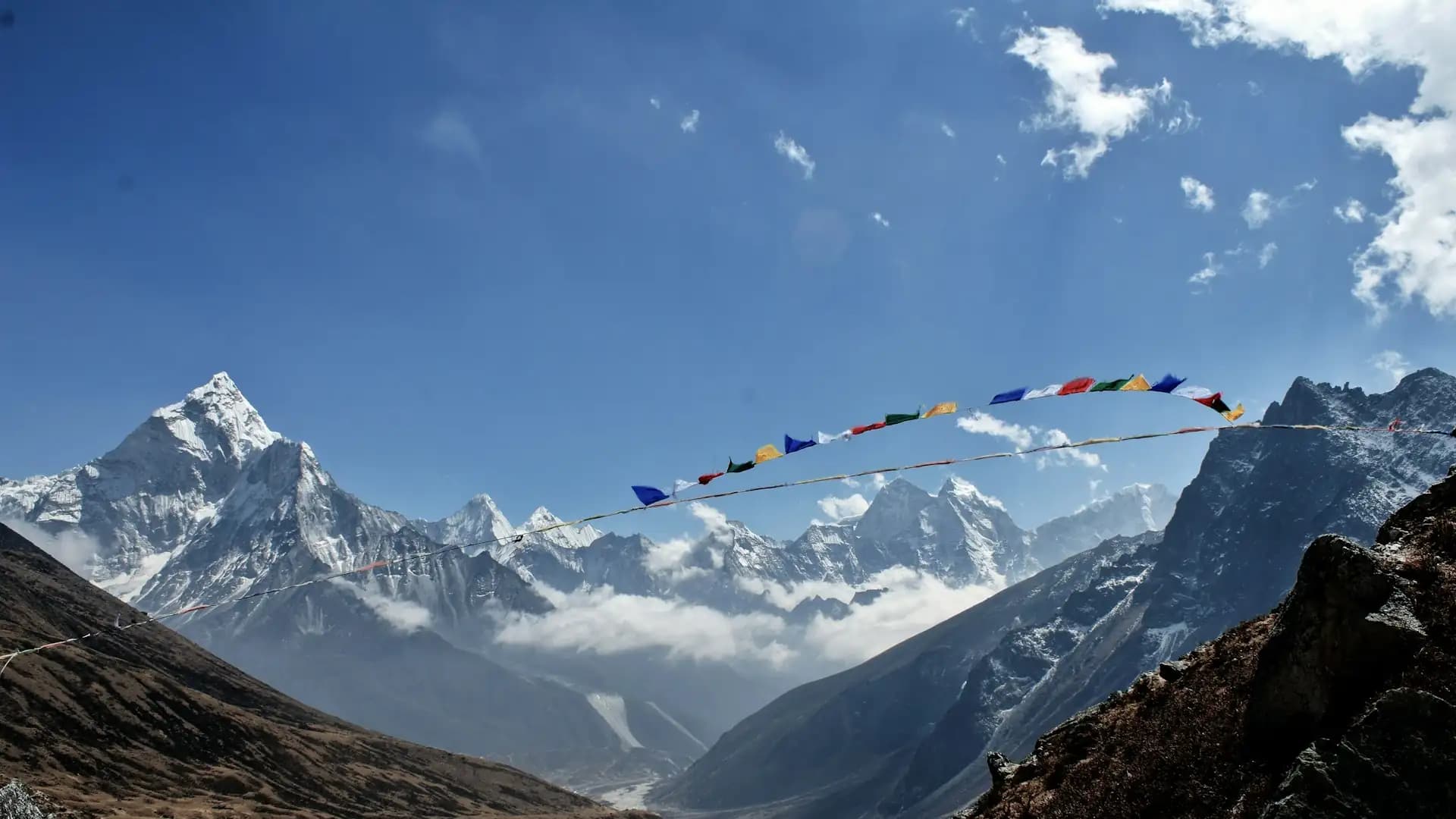
Prayer flags and viewpoints. Strings of prayer flags fly from viewpoints and cairns around the area. The scenery changes with the light, and the silence at dawn is part of the experience.
The road itself. The drive across the plateau passes high passes, glaciers, turquoise lakes and monastery towns. On a clear day from a high pass near Tingri, several of the world's great 8,000 m peaks can be seen across the horizon, including Everest, Lhotse, Makalu and Cho Oyu.
History. The 1920s British Everest expeditions, including the 1924 attempt by George Mallory and Andrew Irvine, approached from this northern side, which gives the Rongbuk valley a special place in mountaineering history. For background on the monastery, the Rongbuk Monastery overview is a good starting point.
Can You Trek to North Base Camp?
For regular visitors, the experience is mostly overland rather than a trek. Rules about how far visitors can walk, and whether a short walk from the Rongbuk area is allowed, can vary by year and by current regulations. Some itineraries include a walk of a few kilometers on the final stretch if conditions and rules permit.
If you want a multi-day walk to Everest, the Nepal side is the answer, with the classic route through Namche Bazaar, Tengboche and Gorak Shep. Our Everest Base Camp trek covers that experience in depth. If you are curious about what else rises around the mountain, see our guide to peaks near Everest.
Climbing Everest From the North Side
A small note for ambitious readers. The Tibet side is also a major climbing route, usually via the North Col and the northeast ridge, with Advanced Base Camp at around 6,400 m. It is a different level of commitment, and access for climbing teams depends on decisions by Chinese and Tibetan authorities. For spring 2026, the north side was effectively closed to climbing expeditions, which pushed most teams to Nepal.
If you are thinking about climbing Everest rather than visiting its base camp, our article on how hard it is to climb Everest gives a realistic view of the commitment involved.
What to Pack
Category | Essentials |
|---|---|
Clothing | Warm base layers, fleece, insulated down jacket, windproof shell, warm hat, gloves, warm socks |
Footwear | Sturdy, broken-in walking shoes or boots |
Sun protection | High-SPF sunscreen, lip balm, sunglasses, sun hat (UV is intense at altitude) |
Health | Personal medication, basic first aid, altitude medication if prescribed, hand sanitizer |
Documents | Passport, visa, permit copies, insurance details |
Electronics | Power bank, adaptors, spare camera batteries (cold drains them quickly) |
Other | Water bottle, snacks, headlamp, small daypack |
Nights at the tourist camp are very cold even in warmer months, and basic guesthouses may not be well heated, so bring warm layers for sleeping.
Rules, Etiquette and Practical Notes
Follow your guide closely. Tibet has frequent checkpoints, and your guide and permits are checked repeatedly.
Respect religious sites. Walk clockwise around monasteries and stupas, dress modestly, and ask before photographing people or inside buildings.
Photography and drones. Rules about drones and photography near sensitive areas can be strict. Ask your guide before flying a drone or photographing checkpoints.
Avoid sensitive topics. Be mindful in conversations and avoid carrying politically sensitive material.
Connectivity. Mobile and internet access can be limited, and some foreign apps and sites may not work. Plan accordingly and download what you need.
Waste. Take your rubbish with you. The Everest area has struggled with waste in the past, and the rules exist for a reason.
Be flexible. Weather, road work and permit checks can change your schedule at short notice.
Common Mistakes to Avoid
Booking flights before permits are confirmed. This is the most expensive mistake.
Skipping acclimatization. A rushed itinerary is the main cause of altitude trouble.
Expecting a trek. The experience is mostly by vehicle, so manage expectations.
Underpacking for cold. Nights at 5,000 m are bitterly cold.
Assuming the Nepal border is open. Check the current status first.
Travelling without altitude-appropriate insurance. Check the wording.
Ignoring weather buffer. Cloud can hide the summit for days.
Combining Tibet and Nepal in One Trip
Many travelers want to see Everest from both sides, and with careful planning it can be done in a single trip, though not always overland. A common pattern is to fly into Kathmandu, spend time on Nepal's side (a trek or sightseeing), fly to Lhasa for the Tibet portion, then fly out from China or return to Kathmandu.
Because border conditions have been unpredictable in 2026, flying between Kathmandu and Lhasa is currently the more dependable option. If you are planning a longer journey, talk to an operator about flexible dates and have a fallback in case permits or border conditions change.
For travelers whose main goal is simply the best Everest experience in Nepal, the Nepal-side routes offer more flexibility and easier permits.
FAQs about Mount Everest North Base Camp
1. What is Mount Everest North Base Camp? It is the staging area on the Tibetan side of Everest, in the Rongbuk valley, used by climbing expeditions. For regular visitors, the term usually refers to the tourist camp near Rongbuk Monastery, with views of the north face.
2. How high is Mount Everest North Base Camp? The tourist camp sits at about 5,150 to 5,200 m, and the Advanced Base Camp used by climbers is around 6,400 m. Everest itself is 8,849 m.
3. Is the North Base Camp higher than the South Base Camp? No. The Nepal-side base camp is at 5,364 m, higher than the tourist camp on the Tibet side.
4. Can foreigners visit Everest North Base Camp? Yes, with the right permits, through a registered agency and with a licensed guide. Independent travel is not permitted.
5. What permits do I need? A Chinese visa (or valid visa-free entry), a Tibet Travel Permit, and additional border-area permits for the Everest region, all arranged through your operator.
6. Can I get the permits myself? No. Foreign visitors must book through a registered Tibet travel agency, which arranges the permits.
7. How do I get to Everest North Base Camp from Lhasa? By road along the Friendship Highway to Shigatse and Tingri, then south toward Rongbuk. Most tours take two to three days each way.
8. How long does the trip take? Most itineraries are about 8 to 10 days from Lhasa, including time to acclimatize.
9. Can I travel from Kathmandu to Everest North Base Camp? Yes in principle, either overland through a Nepal–Tibet border crossing or by flying to Lhasa. In 2026, overland crossings were disrupted after the August floods, so flying to Lhasa is the more dependable option. Confirm the current status before booking.
10. Is Everest North Base Camp open in 2026? Access has changed more than once this year. Permit availability and road conditions have shifted since the August floods, so confirm with a licensed operator for your exact dates.
11. What is the best time to visit? Late April to May and September to October usually offer the best balance of weather and visibility. Winter is very cold with limited facilities.
12. How much does it cost? Group tours from Lhasa typically start from around USD 900 and up, depending on length and inclusions. International flights, visa fees and insurance are usually extra.
13. Do I need a guide? Yes. Foreign visitors to Tibet must travel with a licensed guide and driver as part of an organized tour.
14. Can I sleep at North Base Camp? Many itineraries include a night at the tourist camp in basic tent guesthouses, depending on season and rules. Confirm availability for your dates.
15. Is altitude sickness a serious risk? Yes. You reach about 5,200 m quickly by road, so spending time in Lhasa first and moving slowly are essential. Descend if symptoms worsen.
16. Can I trek to Everest North Base Camp? Regular visitors mostly arrive by vehicle, with limited walking depending on current rules. For a multi-day trek, the Nepal side is the classic route.
17. Which side has the better view of Everest? The north side offers a closer, more open view of the north face from the camp. On the south side, Everest is hidden behind Nuptse from base camp, and the classic view comes from Kala Patthar.
18. Can I see Everest from Rongbuk Monastery? Yes, on clear days. The monastery is near the tourist camp and offers a view of the north face.
19. What should I pack? Warm layers, windproof clothing, sun protection, personal medication, documents and spare batteries. Nights are very cold.
20. Can I visit both the North and South Base Camps? Yes, though usually on separate itineraries. Border conditions can make a combined overland route uncertain, so many travelers fly between Kathmandu and Lhasa and plan flexible dates.
Plan Your Everest Journey With Adventure Life Nepal
Choosing between the Tibet and Nepal sides of Everest, or deciding how to combine them, is easier with someone who can tell you honestly what is possible right now. Our team at Adventure Life Nepal can help you compare routes, think through timing and altitude, and plan the Nepal portion of your journey.
If the Mount Everest North Base Camp is on your list, we will help you understand permits, flexibility and the best way to approach it, and we will tell you plainly when the Nepal side is the better fit. For general entry and tourism information for Nepal, the Nepal Tourism Board is a handy official starting point.
Chat with an expert on WhatsApp: +977 9841248242