Kathmandu Pokhara Tour – 5 Days
Trip Duration: 5 Days
Trip Grade: Easy
Group Size: 10
Meals: Breakfast daily; welcome and farewell dinners
Best Season: October to April
Start Point: Kathmandu
Accomodation: 3-star hotels in Kathmandu and Pokhara
Ending Point: Kathmandu
Max Altitude: 1,600m (Sarangkot)
Transportation: Return flights Kathmandu–Pokhara; private vehicle
Permits Required: None (sightseeing fees included)
Overview
The Kathmandu Pokhara Tour is a short, comfortable way to see Nepal's two best-known cities when you don't have time for a trek. Over five days, you'll see the stupas, temples and royal squares of the Kathmandu Valley, then fly 25 minutes west to Pokhara for a boat ride on Phewa Lake and sunrise over Dhaulagiri, Annapurna and Machhapuchhre from Sarangkot hill.
Flying both ways keeps the trip easy. There's no 7-hour road journey through the hills, no altitude, and no walking beyond stairs and short paths, so it works for children, grandparents and anyone with a few spare days before or after a trek or business trip. You travel with a private guide and vehicle, sleep in 3-star hotels, and have time in each city to wander on your own.
Below you'll find the day-by-day plan, what each site is like, the best months to go, what's included, and what the tour costs.
Trip at a Glance
Detail | Information |
|---|---|
Duration | 5 days, 4 nights, Kathmandu to Kathmandu |
Route | Kathmandu – Pokhara – Kathmandu |
Nights | 2 in Kathmandu, 2 in Pokhara |
Transport | Return flights Kathmandu–Pokhara (about 25 minutes each way); private vehicle for transfers and sightseeing |
Highest point | Sarangkot viewpoint, about 1,600 m |
Grade | Easy |
Accommodation | 3-star hotels in Kathmandu and Pokhara |
Meals | Breakfast daily, plus welcome and farewell dinners |
Group size | 1 to 10 people, private tour |
Best months | October to April |
Price | From US$550 per person |
Why This 5-Day Itinerary?
Kathmandu and Pokhara are only about 200 km apart, but the Prithvi Highway between them is narrow, winding and full of trucks. By road, the trip usually takes 6–8 hours, and longer when there are road works or landslides. Done both ways, that's almost two full days in a vehicle on a five-day trip. Flying turns each transfer into a morning.
We start in Kathmandu with a short afternoon visit to Swayambhunath, so the arrival day isn't wasted, and save the bigger Kathmandu sites for the end of the trip. That order has two advantages. First, if your arrival flight is late, you don't miss the main sightseeing day. Second, the Pokhara flight runs most reliably in the morning, and having it on Day 2 leaves a spare day in Kathmandu at the end if bad weather delays your return.
Two nights in Pokhara is the minimum for a sunrise at Sarangkot. One morning may be cloudy, and the second gives you another chance. If you can add a day, a third night in Pokhara lets you paraglide, hike to a viewpoint or simply sit by the lake. A sixth day in Kathmandu covers Patan or Bhaktapur.
If you have a week, the Kathmandu Pokhara Chitwan Tour adds two nights of wildlife safari in Chitwan National Park.
Kathmandu's World Heritage Sites
The Kathmandu Valley is one UNESCO World Heritage Site made up of seven monument zones. This tour visits four of them, chosen to show the range of the valley's history: one Buddhist hilltop shrine, one royal palace square, the holiest Hindu temple in Nepal and the centre of Tibetan Buddhism in Kathmandu.
Swayambhunath
Swayambhunath sits on a forested hill west of the city. It is one of the oldest religious sites in the valley. Its white dome is topped by a gilded tower painted on all four sides with the eyes of the Buddha. Around the stupa are shrines, prayer wheels, small monasteries and a Hindu temple to Harati, the protector of children, which shows how closely the two religions sit together in Nepal.
The east side has a long stone staircase of about 365 steps. Our vehicle can drop you near the western entrance instead, which has far fewer stairs. Be careful with bags and food: the macaques that give the site its nickname, the Monkey Temple, are quick to grab anything.
Kathmandu Durbar Square
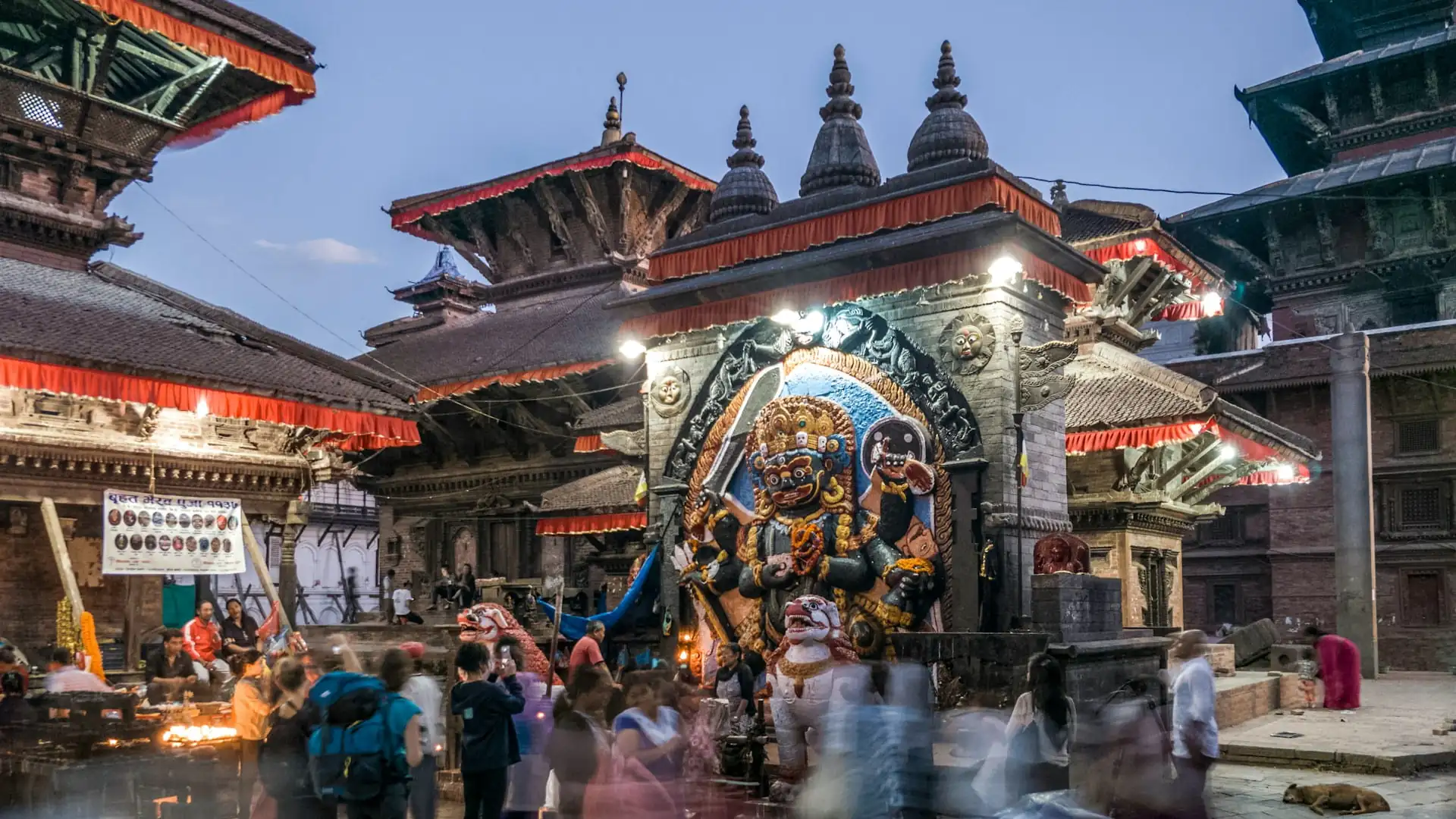
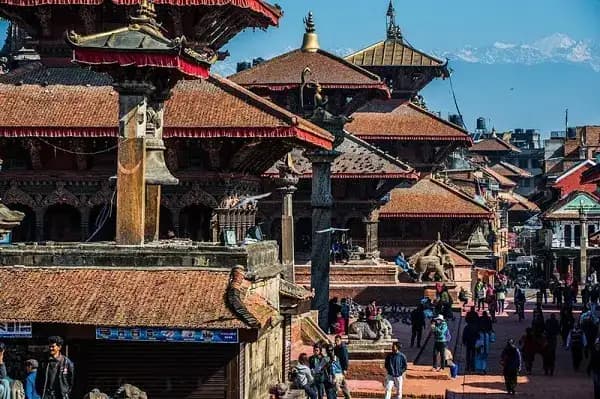
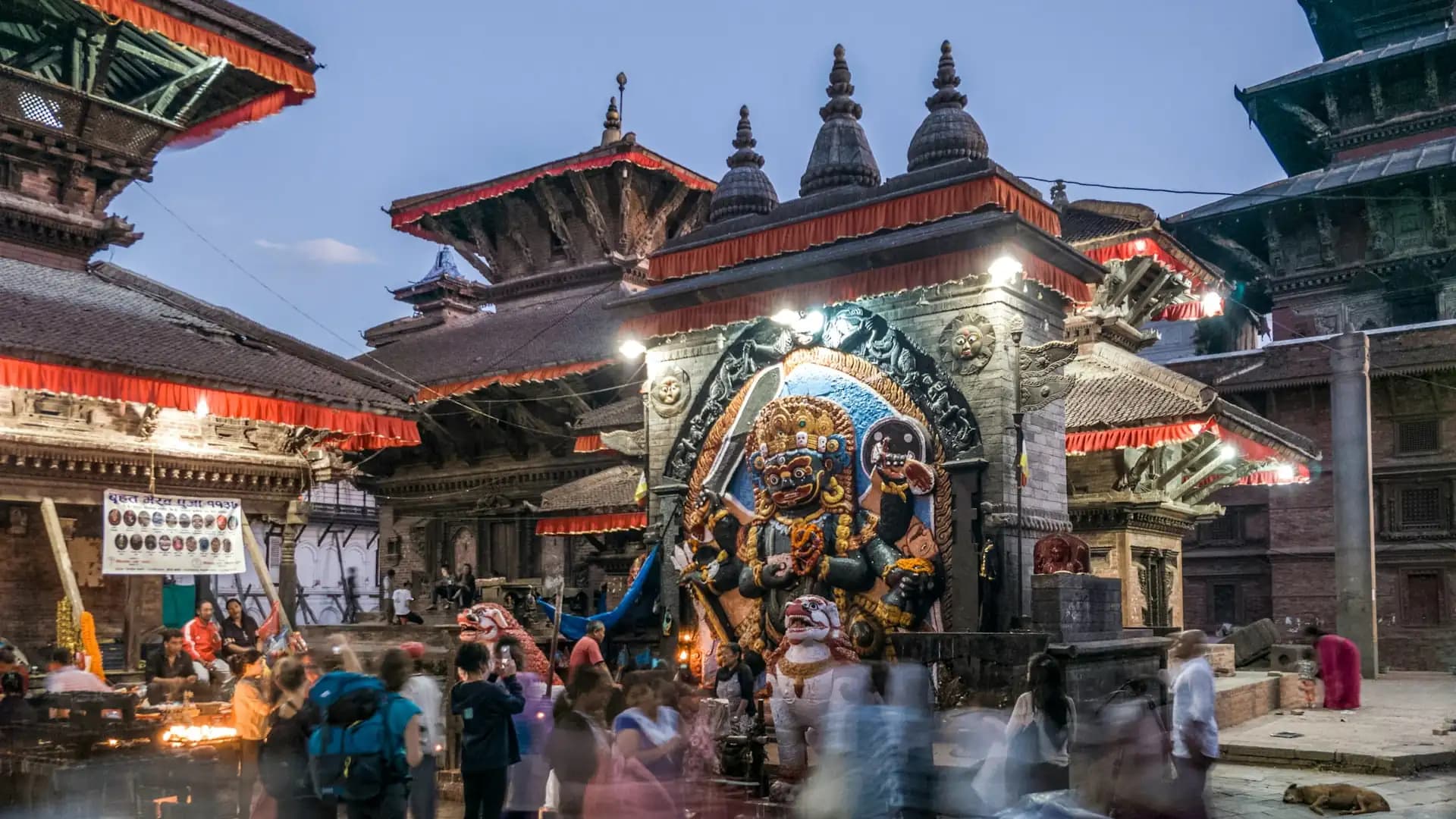
Durbar Square, also known as Hanuman Dhoka, was the royal palace of the Malla kings and then of the Shah dynasty. It has courtyards, temples with tiered roofs, carved wooden windows and the statue of Hanuman that gives the palace its name. Some buildings collapsed in the 2015 earthquake, and many have been restored or are still under repair.
On one side of the square stands the Kumari Ghar, home of the Kumari, a young girl chosen from the Newar Shakya community and worshipped as a living goddess until she reaches puberty. Visitors can enter the courtyard, and she sometimes appears briefly at a window. Photographs of the Kumari herself are not allowed.
Pashupatinath
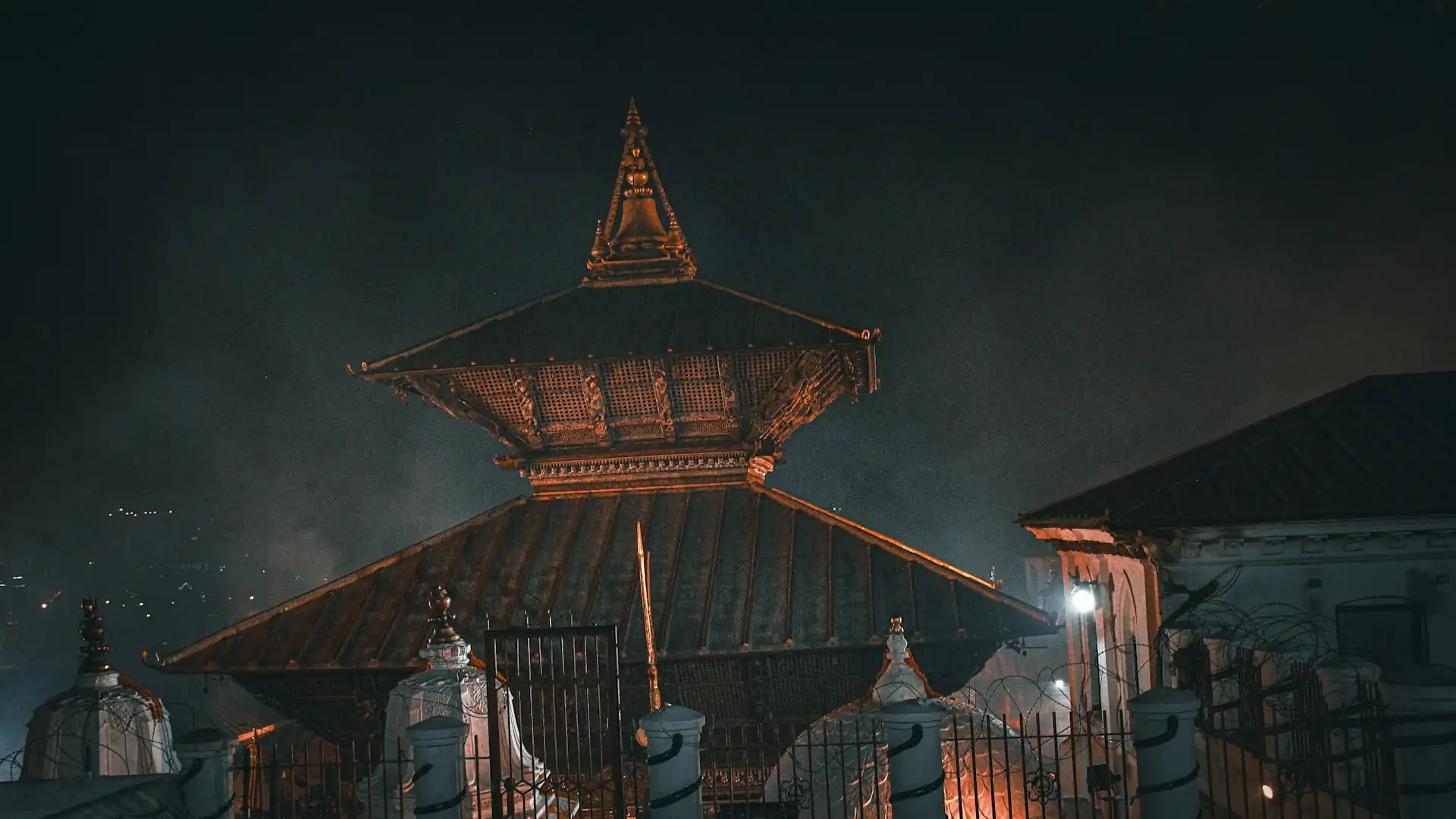
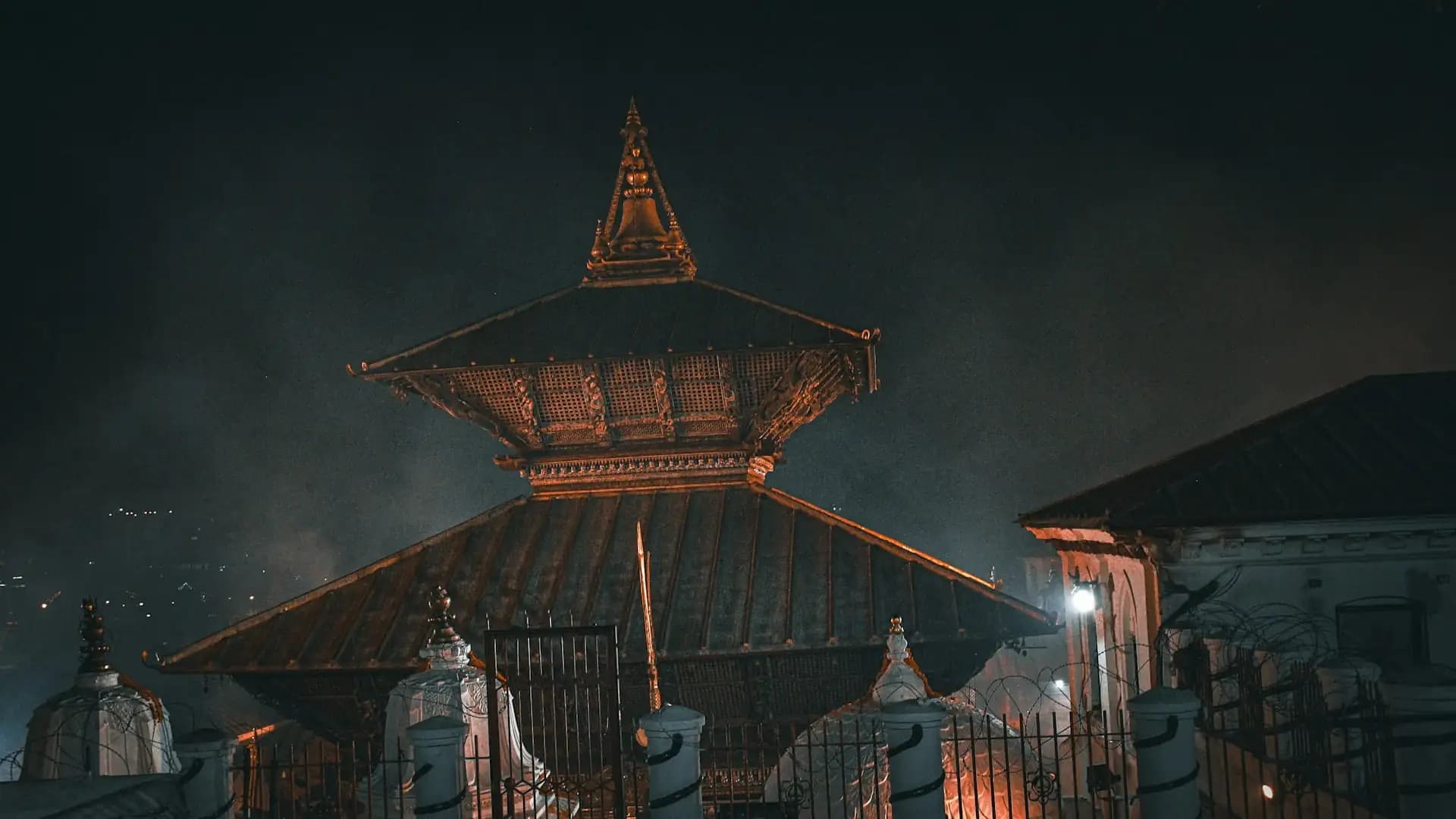
Pashupatinath is Nepal's most important temple to Shiva and one of the most sacred Hindu sites in South Asia. Pilgrims come from all over Nepal and India, especially during the Maha Shivaratri festival. The main temple has a gilded roof and silver doors, and only Hindus can enter, but visitors can see much of the complex from the terraces on the opposite bank.
Along the Bagmati River are the cremation ghats. Families bring their dead here to be cremated in the open, which can be a powerful and moving sight. Please keep a respectful distance and don't photograph the families. In the evening, priests perform an aarati ceremony with lamps and chanting by the river.
Boudhanath
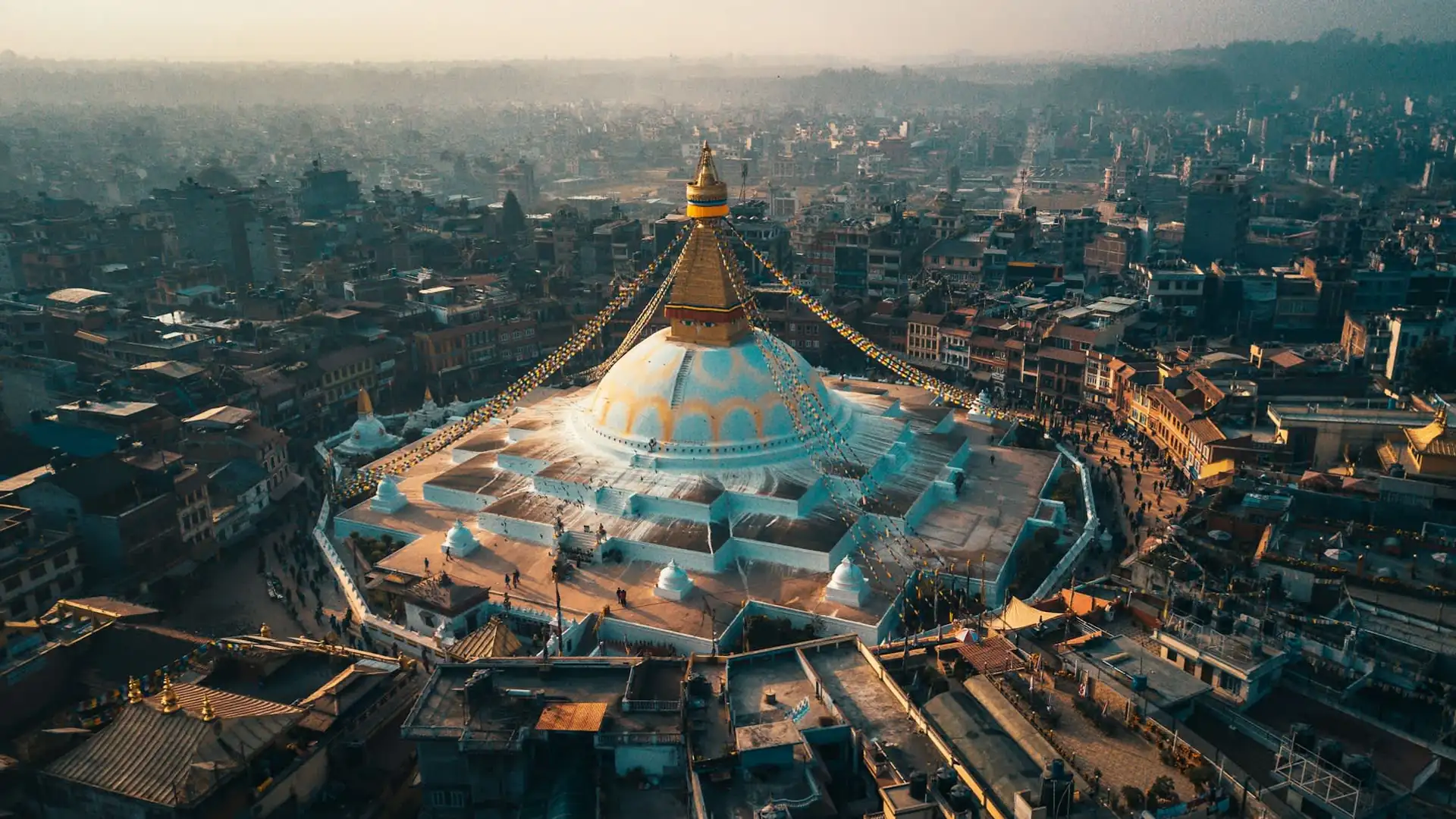
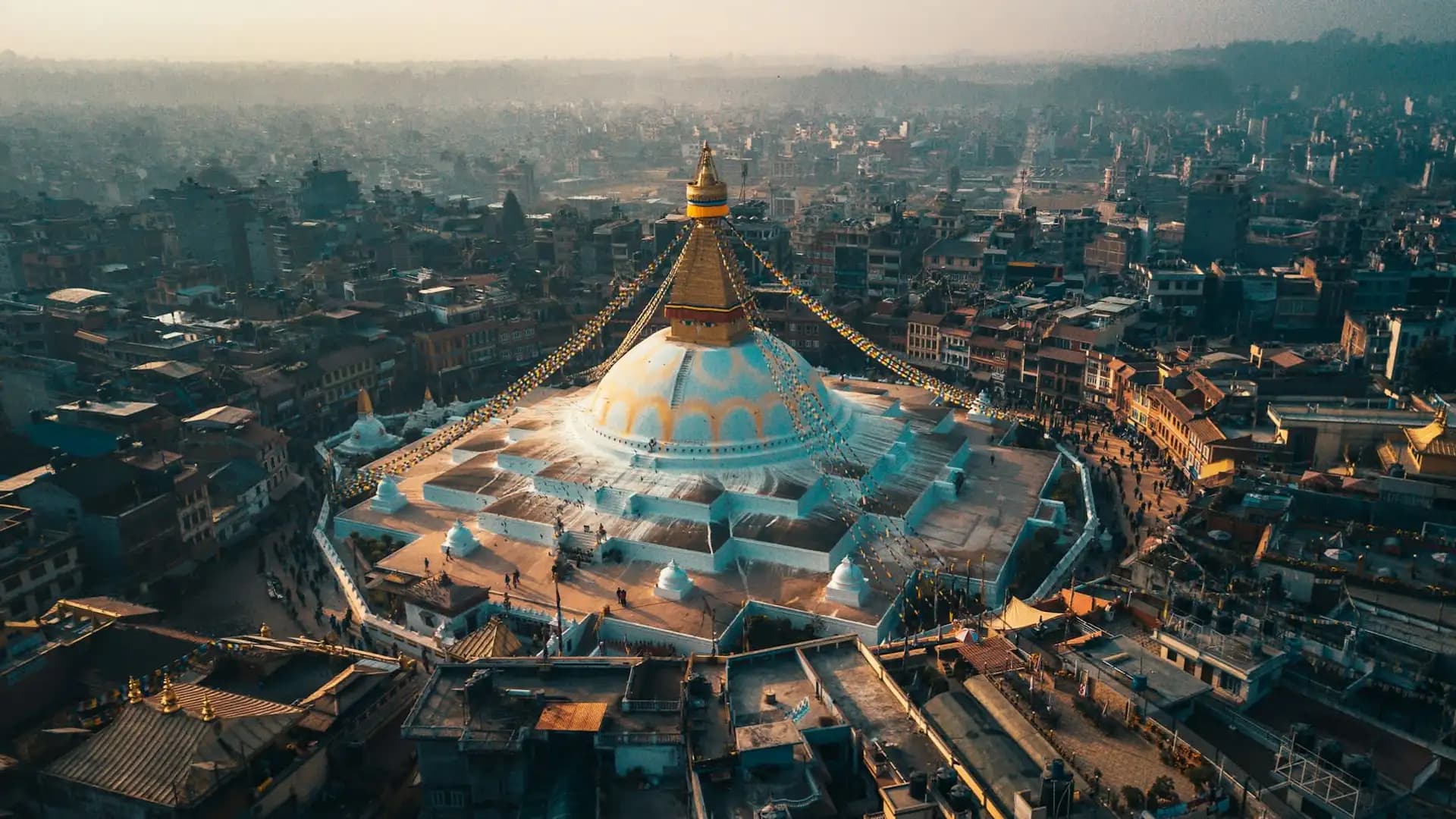
Boudhanath is one of the largest stupas in the world and the heart of Tibetan Buddhist life in Kathmandu. Many Tibetan refugees settled around it after 1959, and today it is surrounded by monasteries, shops selling prayer flags and singing bowls, and rooftop cafés. Pilgrims walk clockwise around the stupa all day, spinning prayer wheels and reciting mantras, with the busiest times at dawn and dusk.
To see more of the valley on a free day, read our Kathmandu day tour guide or the list of top sightseeing places in Nepal.
Pokhara: The Lake City Under the Annapurnas
Pokhara is Nepal's second-largest city and the capital of Gandaki Province. It sits at about 800 m, roughly 600 m lower than Kathmandu, so it's warmer, and in autumn and winter the air is often clearer. Machhapuchhre's summit, almost 7,000 m high, is only about 25–30 km from Lakeside, and the 8,000 m peaks of Annapurna I and Dhaulagiri are not much farther. Few places on Earth rise so steeply from low valley to high peaks, which is why the mountains look so close from Pokhara.
Phewa Lake and Tal Barahi
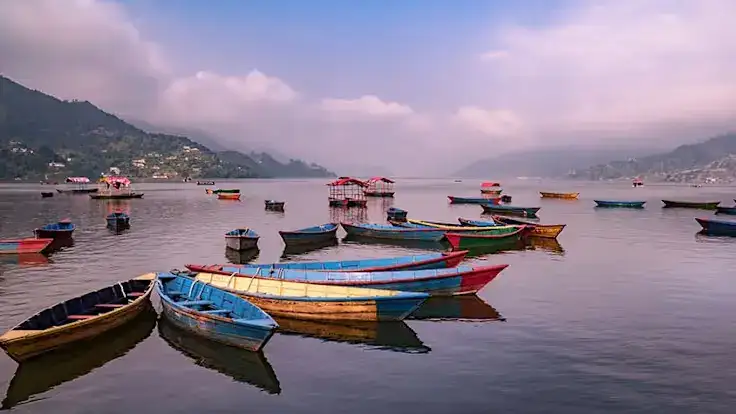
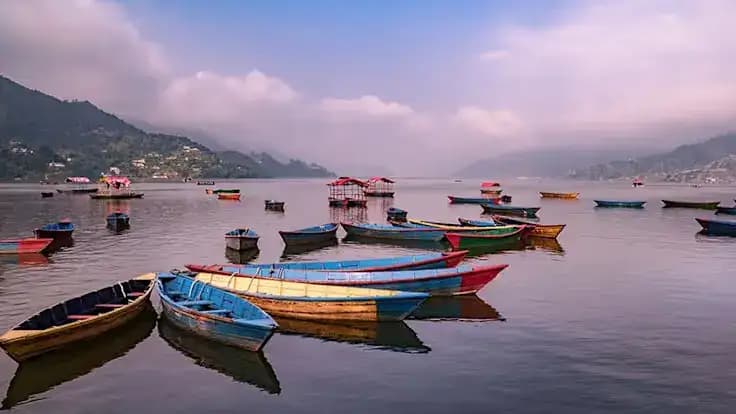
Phewa is the second-largest lake in Nepal and the centre of Pokhara's tourist life. On still mornings, Machhapuchhre is reflected in the water. Brightly painted wooden boats (doongas) can be hired by the hour from the Lakeside shore. The short crossing to Tal Barahi is the most popular trip, especially on Saturdays, when local families visit the temple to make offerings. The southern shore is forest, part of the Raniban woods that climb to the World Peace Pagoda.
Sarangkot
Sarangkot is the classic viewpoint above Pokhara and one of the most popular paragliding launch sites in the world. From the top, you face the whole western Annapurna range. Roads now lead almost to the top, and the last part is a short walk up steps to the viewing area. Mornings from October to March give the best chance of a clear view. Later in the day, cloud usually builds over the peaks.
The World Peace Pagoda
The World Peace Pagoda (Shanti Stupa) is a large white Buddhist stupa built by monks of the Japanese Nipponzan Myohoji order on Ananda Hill, south of the lake. From its terrace, you look across Phewa to the city and the mountains behind. You can drive almost to the top, or take a boat across the lake and hike up through the forest in about 45 minutes to an hour.
International Mountain Museum
The International Mountain Museum tells the story of the Himalaya: the 14 peaks over 8,000 m, the geology of the range, the history of mountaineering, and the people who live in the mountains, from Sherpas and Gurungs to Thakalis. It's a good place to spend an hour if you're thinking of trekking in Nepal one day.
Davis Falls and Gupteshwor Mahadev Cave
Davis Falls is where the stream from Phewa Lake drops into a narrow channel and disappears underground. It is most powerful in the monsoon and late summer, and much smaller in the dry months. Across the road, steps lead down into Gupteshwor Mahadev Cave, a Hindu cave shrine to Shiva, and further on you can see the underground stream from inside the cave.
Tibetan settlements
Tibetan refugees arrived in Pokhara in the 1960s, and several settlements remain around the city. At Tashi Ling, south of the lake, families still make carpets on hand looms and sell handicrafts. A visit is a gentle introduction to Tibetan culture without crossing the border.
Other Pokhara sights
If you have free time, other places worth a visit are the Bindhyabasini Temple on a small hill in the old bazaar, the deep gorge of the Seti River, which cuts through the city in places only a few metres wide, the Gurkha Museum, which tells the story of Nepal's famous soldiers, and the Mahendra and Bat caves north of the city. Begnas and Rupa lakes, about 30–40 minutes east, are quieter alternatives to Phewa.
The Mountains You'll See
Peak | Height | Where to see it |
|---|---|---|
Dhaulagiri | 8,167 m | Sarangkot, far west; also from the flight |
Annapurna I | 8,091 m | Sarangkot, partly hidden behind Annapurna South |
Annapurna South | 7,219 m | Sarangkot and Lakeside |
Hiunchuli | 6,441 m | Next to Annapurna South |
Machhapuchhre | 6,993 m | Above the city from almost everywhere |
Annapurna II | 7,937 m | Sarangkot, east |
Lamjung Himal | 6,983 m | Sarangkot, east |
Manaslu | 8,163 m | Far east from Sarangkot on very clear days; from the flight |
Machhapuchhre, "the fishtail", is named for the split shape of its summit seen from the Annapurna Sanctuary. It is closed to climbers and has no recorded official ascent to the top. You'll see it from nearly every point in Pokhara.
If you want to get closer to these peaks, the Ghorepani Poon Hill Trek and the Mardi Himal Trek both start from Pokhara.
Local Customs Worth Knowing
A few habits will make your visit smoother. People greet each other with "namaste", palms together, rather than a handshake, especially with older people. Use your right hand to give and receive money or food, because the left is considered unclean. Don't point the soles of your feet at people or shrines, and don't step over someone sitting on the floor.
At temples, walk around shrines clockwise, remove your shoes where you see others doing so, and don't touch offerings. Some Hindu temples, including the inner part of Pashupatinath, are open only to Hindus; a sign or a guard will tell you. Public displays of affection are frowned upon outside tourist areas. If you're invited into a home, it's polite to accept tea, even if you only take a sip.
Shopping in Kathmandu and Pokhara
Thamel in Kathmandu and Lakeside in Pokhara are full of shops, and both are good places to buy souvenirs. Popular things to take home include pashmina and yak-wool shawls, singing bowls, thangka paintings, Tibetan carpets, prayer flags, handmade lokta paper, tea from Ilam, and trekking gear. Quality varies a lot, especially for pashmina and "antique" pieces, so your guide can point you to reliable shops. Prices are usually open to polite bargaining in small shops and stalls, but fixed in larger stores.
Flights Between Kathmandu and Pokhara
Several Nepali airlines fly between Tribhuvan International Airport and Pokhara International Airport many times a day. The flight takes about 25 minutes. On the way to Pokhara, the mountains are on the right side of the aircraft, and on the way back they're on the left.
A few practical points:
Morning flights are the most reliable. Cloud and haze build up in the afternoon, especially in spring and the monsoon. Delays of an hour or two are common and full cancellations happen on some days.
Baggage allowance on domestic flights is usually about 15–20 kg plus a small carry-on. Leave extra luggage at your Kathmandu hotel if needed.
If a flight is cancelled, your guide will rebook you on the next available flight or, if needed, take you by private vehicle on the Prithvi Highway.
Security checks at Kathmandu's domestic terminal can be slow, so we leave in good time.
Altitude and Climate
Place | Altitude | Feels like |
|---|---|---|
Kathmandu | 1,400 m | Mild, warm days, cold winter nights |
Pokhara (Lakeside) | about 800 m | Warmer and more humid than Kathmandu; very wet in the monsoon |
Sarangkot | about 1,600 m | Cold at dawn in winter |
There's no risk of altitude sickness on this tour. Kathmandu and Sarangkot are well below the height where altitude illness usually begins.
Map Overview
Kathmandu lies in a bowl-shaped valley in central Nepal. Pokhara is about 200 km to the west by road, or 150 km in a straight line. The flight follows the line of the Himalaya, with the Ganesh Himal, Manaslu and Annapurna ranges to the north. The tour is a simple out-and-back between the two cities. Our route map image is shown in the gallery.
How Difficult Is the Kathmandu Pokhara Tour?
It is one of the easiest tours we run. The most physical parts are the stairs at Swayambhunath (avoidable using the western entrance), the short walk up to the viewing area at Sarangkot, and the steps down into Gupteshwor Cave. Everything else is level ground and short walks.
The tour does involve early starts: before dawn on Day 3 for Sarangkot, and early on Days 2 and 4 for the flights. If you have limited mobility, tell us when you book, and we'll plan the sightseeing so the vehicle can take you as close as possible to each site.
Best Time for the Kathmandu Pokhara Tour
October and November: the best season. Skies are clear after the monsoon, the mountains are sharp, and the temperature is comfortable. Dashain and Tihar festivals often fall in these months. It's also the busiest time for flights and hotels, so book early.
December to February: cool, dry and usually clear, with cold mornings and evenings. Some days in Kathmandu begin with fog or smog that lifts by late morning. Fewer visitors.
March to April: warm and pleasant, with rhododendrons flowering in the hills. Haze increases through April and mountain views become less reliable.
May: hot and hazy before the monsoon. Fine for the cities, but mountain views are often poor.
June to September: monsoon. Rain falls mostly in the afternoons and at night, and the landscape is very green. Flights to Pokhara are more often delayed, and clear views from Sarangkot are rare. Pokhara is one of the wettest cities in Nepal at this time of year.
Read more in our guide to the best time to go to Kathmandu.
Weather by Season
Season | Kathmandu | Pokhara |
|---|---|---|
Oct–Nov | about 12–25°C, dry | about 14–27°C, dry |
Dec–Feb | about 2–19°C, dry, foggy mornings | about 7–20°C, dry |
Mar–May | about 10–30°C, hazy by May | about 13–31°C, afternoon storms in May |
Jun–Sep | about 18–29°C, monsoon rain | about 20–30°C, heavy monsoon rain |
These are rough night-to-day ranges. Bring a warm layer for Sarangkot at dawn in any season.
Accommodation
Kathmandu: a 3-star hotel in or near Thamel, the main tourist district, with private bathroom, hot water and Wi-Fi. It's close to restaurants and shops, and within walking distance of Durbar Square.
Pokhara: a 3-star hotel in Lakeside, a few minutes' walk from Phewa Lake.
All rooms are twin or double with private bathrooms. We can upgrade you to 4- or 5-star hotels in both cities, or book a lake-view room in Pokhara, for an extra cost.
Meals and Drinking Water
Breakfast is included every day, along with a welcome dinner on Day 1 and a farewell dinner with a cultural show on Day 4. For other meals, both cities have a huge range of restaurants. Try dal bhat (rice, lentil soup, vegetable curry and pickles), momos, Newari specialities like bara and choila in Kathmandu, and Thakali set meals in Pokhara. A meal in a tourist restaurant usually costs about US$8–20.
Don't drink tap water. Hotels provide filtered water, and many cafés in Thamel and Lakeside will refill your bottle for a small fee.
Internet, Mobile Signal and Charging
Both hotels have Wi-Fi, and so do most cafés. A local SIM card from Nepal Telecom or Ncell with a data plan is cheap and gives good coverage in both cities; you'll need your passport to buy one, and the airport has counters. Sockets are mostly Type C, D and M (round pins) at 230 V, so bring a universal adapter.
Permits, Visa and Fees
No trekking permits are needed. Entrance fees for the sites on the itinerary are included in the price and paid by your guide.
Most nationalities can get a Nepal tourist visa on arrival at Tribhuvan International Airport or apply online before travel. The fee is US$30 for 15 days or US$50 for 30 days. Indian citizens don't need a visa. Check the current rules on the Department of Immigration website.
Kathmandu Pokhara Tour Cost
Our price is from US$550 per person, based on two people sharing a twin room.
What the price covers | Notes |
|---|---|
Accommodation | 4 nights in 3-star hotels: 2 in Kathmandu, 2 in Pokhara |
Flights | Kathmandu–Pokhara–Kathmandu with taxes |
Private transport | Airport transfers and all sightseeing by private vehicle |
Guide | English-speaking licensed guide |
Sightseeing | Entrance fees, Phewa Lake boat to Tal Barahi, Sarangkot sunrise trip |
Meals | Daily breakfast, welcome dinner and farewell dinner with cultural show |
Extra money to budget
Nepal visa: US$30 for 15 days or US$50 for 30 days
Lunches and dinners not included: about US$8–20 a meal
Drinks, snacks and souvenirs
Optional activities such as paragliding
Tips for your guide and driver
Travel insurance
Solo travellers pay a supplement for a single room and private vehicle, and larger groups pay less per person. Contact us for a quote. For a wider look at costs, see our Nepal travel cost guide.
Optional Add-ons
Paragliding from Sarangkot. A tandem flight of about 20–30 minutes over Phewa Lake, usually in the late morning.
Extra night in Pokhara. For a second chance at the sunrise, a hike or a quiet day by the lake.
Patan or Bhaktapur. The valley's other two Durbar Squares, each worth half a day or more.
Nagarkot sunrise. A night on the valley rim, with views as far as the Langtang and Everest ranges on clear days; see our Nagarkot hiking guide and whether you can see Everest from Kathmandu.
Everest mountain flight. An early-morning sightseeing flight from Kathmandu along the Himalaya.
Chitwan safari. Two nights in Chitwan National Park; see the Kathmandu Pokhara Chitwan Tour.
Travel Tips
Book the earliest flight available to Pokhara; morning flights are the most reliable.
Visit Boudhanath and Pashupatinath in the late afternoon for the evening rituals.
Always walk clockwise around stupas and prayer wheels.
Take off your shoes before entering temples and ask before taking photos inside.
Carry small notes; many shops and taxis can't change large ones.
Bargain politely in markets, but not in restaurants or shops with fixed prices.
Leave valuables in your hotel safe and keep an eye on bags in crowded places.
Photography Tips
Sarangkot at sunrise: bring a zoom lens for Machhapuchhre and Annapurna South.
Phewa Lake from the World Peace Pagoda, in the late afternoon, looking north.
Boudhanath at dusk, from a rooftop café, when butter lamps are lit.
Kathmandu Durbar Square in the early morning, before the crowds.
The Kathmandu Valley from Swayambhunath at sunset.
Avoid photographing cremations and always ask before photographing people.
Responsible Travel
Dress modestly at religious sites and follow local customs.
Don't feed the monkeys at Swayambhunath or Pashupatinath.
Refill your water bottle instead of buying plastic.
Buy handicrafts from the makers, such as the carpet weavers at the Tibetan settlements.
Respect "no photography" signs and the privacy of worshippers.
Don't give money or sweets to children; support a local school or charity instead.
Is the Kathmandu Pokhara Tour Right for You?
This tour is a good choice if:
You have only five days in Nepal, or a few days before or after a trek
You want to see culture and mountain views without trekking
You're travelling with children, older relatives or people with limited mobility
You prefer comfortable hotels and a relaxed pace
It may not be the best choice if you want to get close to the mountains on foot (a short trek like Short Annapurna Base Camp Trek is better), or if your main interest is wildlife. For more ideas, see our list of things to do in Nepal.
Why Book With Adventure Life Nepal
Adventure Life Nepal was founded by Dil Bahadur Karki, a Himalayan guide with more than 25 years of experience who started as a porter and guide and has led travellers from over 40 countries. We are registered with the Nepal Tourism Board and the Trekking Agencies Association of Nepal (TAAN), and our guides are certified by the Nepal Mountaineering Association. We arrange your flights, hotels, guide and transfers, so you only need to arrive.
For general travel information, see the Nepal Tourism Board.
Booking, Cancellation & Refund Policy
A 30% deposit confirms your booking; the balance is due before the tour starts.
Cancellations 30 days or more before the start date get a full refund minus administration fees.
Cancellations 15–29 days before the start date carry a 50% fee.
Cancellations under 15 days before the start date are not refunded.
Travel insurance is mandatory.
Read the full terms and conditions before booking.
Book Your Kathmandu Pokhara Tour
Ready to plan your Kathmandu Pokhara Tour? Contact us on WhatsApp at +977 9841248242 or email adventurelifenepal@gmail.com with your dates and group size, and we'll send you a full quote with hotels and flight times.
Highlights
Itinerary
Our team meets you at Tribhuvan International Airport and drives you to your hotel. After a rest, your guide takes you to Swayambhunath, the hilltop stupa on the western edge of the city. From its terrace, you can see most of the valley, and at sunset the city lights start to come on below. In the evening, we take you to a welcome dinner of Nepali food.
- Flight: about 25 minutes After breakfast, we drive you to the domestic terminal for the morning flight to Pokhara. Sit on the right side of the plane for the mountains. In Pokhara, you check in at a hotel in Lakeside, the relaxed district along the eastern shore of Phewa Lake. In the afternoon, a wooden boat takes you to Tal Barahi, a small pagoda temple on an island in the lake dedicated to the goddess Barahi. The rest of the day is yours for walking the lakeshore, browsing bookshops and trying the cafés.
- Sightseeing: early start, about 8 hours with breaks We leave about an hour before sunrise for Sarangkot, about 1,600 m, a ridge above the north side of the lake. On a clear morning, the first light hits Dhaulagiri in the west, then moves along the Annapurnas to Machhapuchhre, which rises almost straight above the city. After breakfast back in town, we visit the World Peace Pagoda on the hill south of the lake, Davis Falls and Gupteshwor Mahadev Cave, the International Mountain Museum, and the Tibetan settlement at Tashi Ling. In the evening, you're free in Lakeside.
- Flight: about 25 minutes; sightseeing about 6 hours We fly back to Kathmandu in the morning, and your guide meets you at the airport. The first stop is Kathmandu Durbar Square, the old royal palace complex. After lunch, we visit Pashupatinath, the great Shiva temple on the Bagmati River, and finish at Boudhanath stupa in the late afternoon, when the Tibetan community walks its evening circuit. In the evening, we hold a farewell dinner with a cultural programme.
After breakfast, you have free time until your airport transfer. Our team drives you to the airport about three hours before your international flight. If you're staying on, we can arrange a trek, a day tour or extra nights.
Elevation Profile
Altitude Variation Chart
What's Included
Included
- Airport pick-up and drop-off by private vehicle
- 2 nights in a 3-star hotel in Kathmandu with breakfast
- 2 nights in a 3-star hotel in Pokhara with breakfast
- Domestic flights Kathmandu–Pokhara–Kathmandu with airport taxes
- Private vehicle for all transfers and sightseeing
- English-speaking licensed tour guide
- Swayambhunath visit on Day 1
- Sarangkot sunrise trip and full-day Pokhara sightseeing
- Boat ride on Phewa Lake to Tal Barahi Temple
- Kathmandu Durbar Square, Pashupatinath and Boudhanath sightseeing
- Entrance fees for all sites on the itinerary
- Welcome dinner and farewell dinner with cultural programme
- All government and local taxes
Excluded
- International flights
- Nepal visa fee
- Travel insurance
- Lunches and other dinners
- Drinks, snacks, laundry and personal expenses
- Optional activities such as paragliding, zip-line or ultralight flights
- Tips for guide and driver
- Extra nights or costs caused by flight delays or cancellations
Packing List
Category | Items |
|---|---|
Clothing | Light clothes for the day, a fleece or warm jacket for mornings and evenings (essential from November to February), light rain jacket |
Temples | Trousers or skirts that cover the knees, tops that cover the shoulders, a scarf |
Footwear | Comfortable walking shoes, sandals or slip-on shoes for temples |
Health | Sun cream, sunglasses, hat, personal medicines, hand sanitiser, insect repellent |
Gear | Small day pack, refillable water bottle, camera, power bank |
Documents | Passport, visa, travel insurance details, copies |
Other | Universal adapter, some Nepali rupees in small notes |
Frequently Asked Questions
Five days is enough to see the main sights of both cities if you fly between them. With six or seven days, you can add Patan, Bhaktapur, a third night in Pokhara or paragliding.
Flying takes about 25 minutes, compared with 6–8 hours by road. On a five-day tour, flying saves almost two days. The drive is cheaper and shows you the countryside, so we can arrange it if you prefer.
Your guide rebooks you on the next flight. If flights are grounded for the day, we can drive you by private vehicle. Day 4 is planned with time to spare, so the tour can usually absorb a short delay.
Not from Pokhara. You might glimpse the Everest range from the flight on a very clear day, but the best way to see it is an Everest mountain flight from Kathmandu or a night at Nagarkot.
From October to March, you have a good chance on most mornings. In April and May, haze often hides the peaks, and in the monsoon clear mornings are rare. Two nights in Pokhara give you two chances.
Yes. There's no trekking and no altitude risk, and the private vehicle takes you close to every site. Tell us about any mobility needs and we'll plan around them.
You only need to be able to walk for 20–30 minutes at a time and climb some stairs.
No. The highest point is Sarangkot at about 1,600 m, well below the height where altitude sickness usually starts.
We use clean, comfortable 3-star hotels in Thamel and Lakeside with private bathrooms and Wi-Fi. Upgrades to 4- and 5-star hotels are available.
Yes. It's a private tour, so you can change the order, add days, upgrade hotels or add activities such as paragliding or an Everest mountain flight.
Yes. The tour runs for one person. Solo travellers pay a single-room and vehicle supplement.
October to April, with October, November and February to March giving the most reliable mountain views.
Most visitors need a tourist visa, available on arrival or online. Indian citizens don't need one.
Cover your shoulders and knees, remove your shoes where asked, and take off leather items at some Hindu shrines.
Non-Hindus can't enter the main temple, but they can walk around much of the complex and watch from the far bank of the river.
Tandem paragliding is popular and run by licensed companies with experienced pilots. Like any adventure sport, it carries some risk, and flights are cancelled in poor weather. Check that your travel insurance covers it.
Budget about US$30–60 a day for meals, drinks and small purchases, plus extra for optional activities and tips. ATMs are common in both cities.
Nepal is generally safe for visitors. Take normal city precautions. Women travelling alone might like our guide on whether Nepal is safe for female solo travellers.
Ask your doctor or a travel clinic. Hepatitis A, typhoid and routine vaccinations are commonly advised for Nepal. See the CDC travel health page for Nepal.
Tipping is customary. A common guideline is about US$10–15 a day for the guide and US$5–10 a day for the driver, shared among the group.
Gallery & Video
Customer Reviews
Loading reviews...