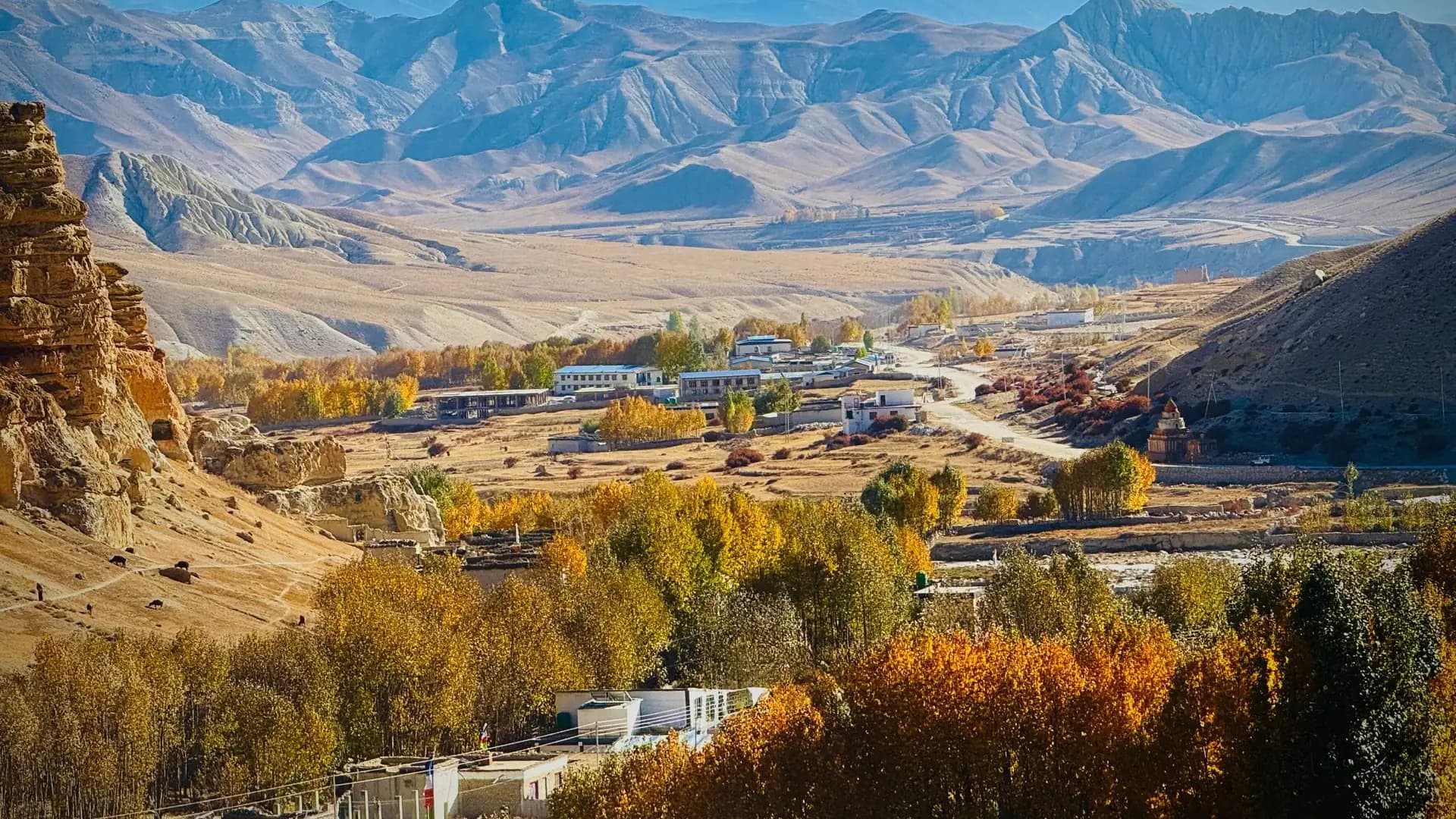
Kingdom of Lo Nepal – History, Culture & Travel Tips
Kingdom of Lo Nepal
The Kingdom of Lo — better known today as Upper Mustang — is a former Himalayan kingdom in northern Nepal, founded in 1380 by Ame Pal and ruled by his direct descendants for over 600 years until Nepal formally abolished the monarchy in 2008.
Tucked behind the Annapurna and Dhaulagiri massifs on the Tibetan Plateau's southern edge, it remains one of the least-altered Tibetan Buddhist cultures anywhere in the Himalayas, protected for decades by its remoteness and, later, by strict government-controlled tourism.
This guide covers where the kingdom came from, what survives of it today, and exactly what you need to know before visiting.
Kingdom of Lo at a glance
Fact | Detail |
|---|---|
Founded | 1380 CE, by King Ame Pal |
Capital | Lo Manthang (walled city) |
Capital elevation | 3,840 m (12,598 ft) |
Monarchy ended | 2008 (formal abolition, alongside Nepal's national monarchy) |
Last King (Lo Gyalpo) | Jigme Dorje Palbar Bista, reigned 1964–2008 |
Dynasty length | 25 generations, over 600 years |
Region today | Upper Mustang, Mustang District, Gandaki Province, Nepal |
Opened to foreign tourism | 1992 |
Status | Restricted Area, permit required |
Where the Kingdom of Lo Sits
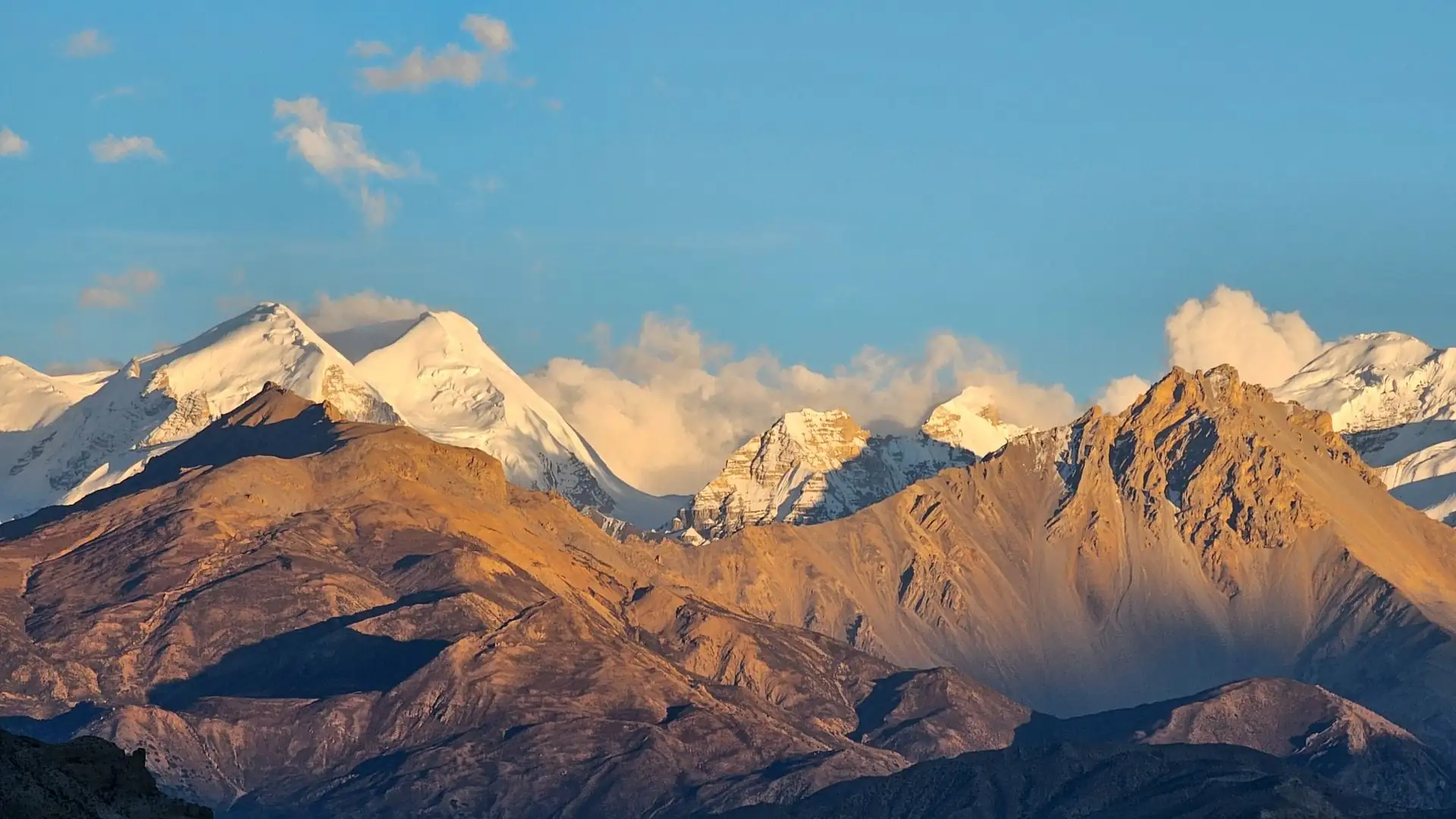
Upper Mustang occupies the northern half of Nepal's Mustang District, wedged into a high-altitude desert valley carved by the Kali Gandaki River between the 8,000-meter giants of Annapurna and Dhaulagiri to the south and the Tibetan Autonomous Region of China directly to the north. Geographically and culturally, it sits on the Tibetan side of the Himalayan divide — the mountains that block the monsoon from reaching it are the same mountains that separate it from the rest of Nepal, which is precisely why Lo developed a culture, language, and landscape that look far more like Tibet than like Kathmandu, despite being entirely within Nepali borders.
The terrain itself is a rain-shadow desert: eroded ochre and grey cliffs, wind-carved canyons, scattered poplar and juniper groves around irrigated villages, and almost no vegetation once you climb above the river valleys. It's often described as looking more like the Tibetan Plateau or parts of the American Southwest than the lush, forested Nepal most travelers picture.
The name "Lo" itself is a Tibetan word, and locals — known as Lobas — speak Loke, a Tibetic dialect closely related to the language spoken in Tibet's neighboring regions, not Nepali as a first language.
The Founding of the Kingdom: Ame Pal and 1380
Tibetan and Ladakhi chronicles reference the Lo region as far back as the 7th century, and Buddhist tradition holds that Guru Rinpoche (Padmasambhava), the figure credited with bringing Buddhism across the Himalayas, passed through the area in the 8th century, leaving behind relics still shown to visitors today, including footprints preserved near the village of Tange.
But Lo's history as a unified, independent kingdom begins specifically in 1380, when Ame Pal — a warrior of Tibetan origin, and by most accounts a descendant of Tibetan royal lineage — defeated the local warlords controlling the valley and unified the territory under his rule.
Ame Pal built a fortress and then, with his son Angun Sangpo overseeing funding and leadership and his minister Kalu Sangpo organizing construction, raised the walled capital of Lo Manthang. He also invited Ngorchen Kunga Sangpo, a respected Tibetan Buddhist teacher of the Sakya tradition, to establish religious life in the new kingdom — a decision that shaped Lo's identity for the next six centuries. Angun Sangpo, Kalu Sangpo, and Ngorchen Kunga Sangpo are still remembered locally as the "Three Holies" credited with building both the walls and the spiritual foundation of the kingdom together.
Every subsequent King of Lo — 25 generations of them — traced an unbroken line back to Ame Pal, a genealogical claim rare even by the standards of Himalayan royal houses. The role was never purely political: each Lo Gyalpo ("King of Lo") also functioned as a spiritual patron of Tibetan Buddhism within the kingdom, funding monasteries, commissioning religious art, and presiding over major festivals, meaning the throne carried temporal and religious authority simultaneously.
From Independent Kingdom to Nepali Vassal State
Lo's location on the trans-Himalayan salt trade route, connecting Tibet to India through the Kali Gandaki corridor, made it genuinely wealthy through the 15th to 17th centuries. That wealth attracted attention. Neighboring powers — most persistently the Kingdom of Jumla to the west — repeatedly pressed on Lo's borders, and by the late 16th century the kingdom had come under pressure from Ladakh as well. Around 1760, Jumla succeeded in making Lo a vassal state, ending its full sovereignty even though the royal line and internal governance continued.
Later in the 1700s, Prithvi Narayan Shah — the Gorkha king who unified the various principalities into what became modern Nepal — absorbed Jumla's vassal territories, including Lo, into the expanding Gorkha kingdom. From that point on, Lo existed as an internally autonomous region under the umbrella of a larger Nepali state, a pattern that continued for well over two centuries: the Lo royal family retained local authority, cultural leadership, and day-to-day governance, while Kathmandu controlled taxation and formal sovereignty.
The 19th century brought a further economic blow when control of the lucrative salt trade along the Kali Gandaki shifted to the Thakali people in 1862, cutting into the income that had sustained Lo's trading economy for centuries. Nepal's move toward constitutional monarchy in 1951 reduced the king's formal powers further, converting Mustang into an administrative district. Even so, the Lo royal family remained the respected cultural and spiritual custodians of the region for another half-century.
The End of the Monarchy: 2008
Nepal abolished its own national monarchy in 2008, ending the centuries-old Shah dynasty and declaring the country a federal democratic republic. As part of the same broader political transition, all vassal and titular kingships within Nepal — including the Kingdom of Lo — were formally abolished. Jigme Dorje Palbar Bista, who had reigned as Lo Gyalpo since 1964, lost his official political status that year, though he continued to be treated with deep respect as a cultural figurehead by the Loba people until his death on December 16, 2016, in Kathmandu.
Today, Upper Mustang is fully governed as Mustang District within Nepal's Gandaki Province, part of the Lo Manthang Rural Municipality's administrative structure. There is no reigning king. What remains is architectural, religious, and cultural: the walled city itself, its monasteries, the royal palace (now largely a heritage site open to visitors), and traditions that the Bista family and the broader Loba community have continued to protect even without formal royal authority.
Lo Manthang: The Walled Capital
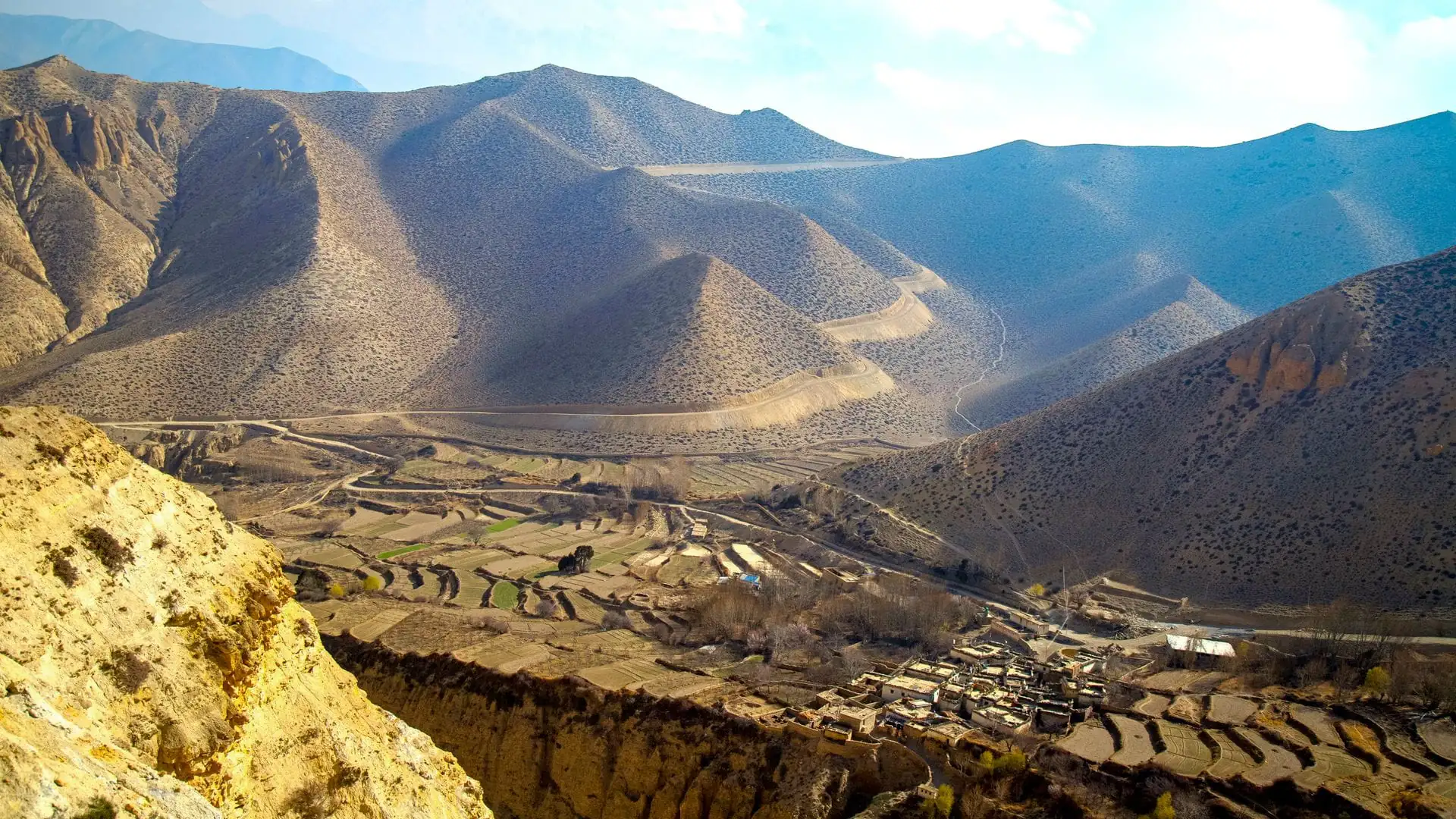
Lo Manthang sits at 3,840 meters (12,598 ft), roughly 700 kilometers from Kathmandu by road, and is typically reached via Pokhara and Jomsom rather than any direct route. It remains, remarkably, close to its original 15th-century footprint — a compact walled town where mud-brick homes, monasteries, and the old royal palace sit inside fortifications originally built for defense against exactly the kind of raids that plagued the kingdom in its early centuries.
The city was historically organized into four quarters within the walls, with residents required to live inside the fortification for protection. As Lo Manthang's population grew and the security threats of earlier centuries faded, homes expanded outside the walls as well, though the old walled core remains the cultural and religious heart of the town. Inside, several major monasteries anchor daily religious life: Jampa Lhakhang, one of the oldest temples in Lo Manthang, houses a large seated statue of Maitreya Buddha and murals dating back centuries; Thubchen Gompa, a large assembly hall known for its scale and its faded but still-striking wall paintings; and Choede Monastery, which serves as the ceremonial center for Lo Manthang's most important annual event.
Beyond the walled city, Ghar Gompa (also called Lo Gekar) is widely regarded as the oldest monastery in the wider Mustang region, with a founding tradition dating to the 8th century and local belief crediting Padmasambhava himself — making it, by tradition, older than comparable monastic sites across the border in Tibet.
The Tiji Festival
Tiji is Upper Mustang's most significant annual religious event and the single biggest draw for cultural travelers. Held over three days in the courtyard of Thubchen/Choede Monastery within Lo Manthang, the festival dramatizes a story from Tibetan Buddhist tradition: the deity Dorje Jono battling and ultimately defeating a demon that had been draining the kingdom's water sources and spreading disease and drought across the land. The name "Tiji" is a shortened form of "Tenpa Chirim," roughly translating to a prayer for world peace.
The festival unfolds across the three days as a sequence: opening rituals and preparation on day one, elaborate masked Cham dances performed by monks — each mask and movement carrying specific symbolic meaning passed down through generations rather than improvised — on day two, and the symbolic expulsion of the demon and closing blessings on the third day. Dates shift year to year because they follow the Tibetan lunar calendar, but the festival consistently falls in spring, generally between March and May, timed to coincide with the traditional end of Mustang's harsh winter and the reopening of the high mountain passes.
For the Loba community, Tiji is not staged for visitors — it's a genuine religious rite that also happens to mark the practical return of trade, travel, and warmer weather to the region, which is part of why it holds such deep communal significance beyond its religious function.
Because Lo Manthang's accommodation is limited and fills up months ahead of the festival, anyone specifically planning a trip around Tiji needs to book significantly earlier than a standard Upper Mustang visit.
The Sky Caves of Mustang
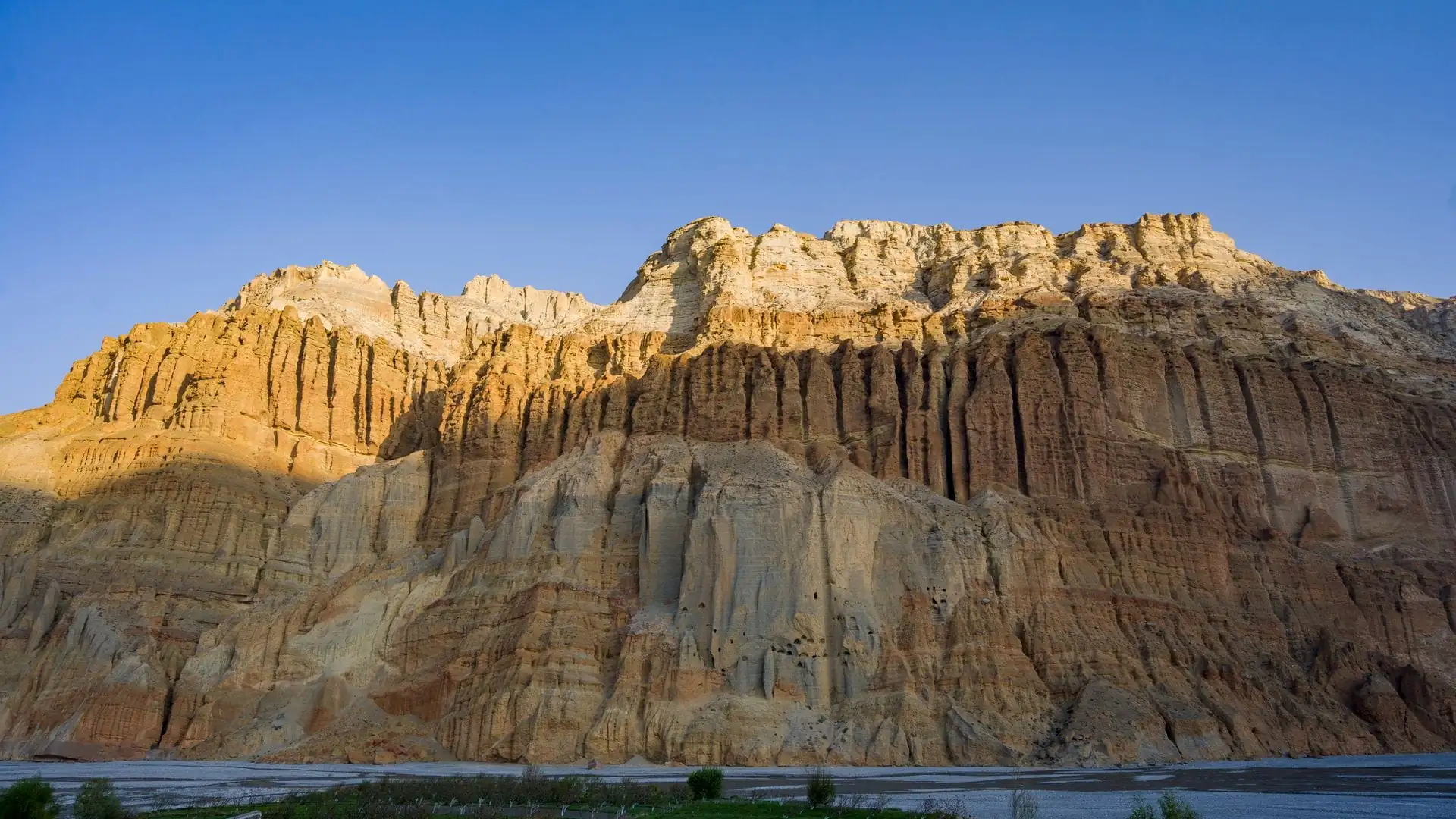
Scattered across the cliffs of Upper Mustang — most famously near the village of Chhoser, not far from Lo Manthang — are thousands of hand-carved caves set high into sheer rock faces, collectively known as the Mustang sky caves. Archaeological work on the cave complexes suggests parts of the system are roughly 2,500 years old, with evidence of use for burial purposes dating back as far as 1000 BCE, and later phases of use as wartime shelters, storage, and Buddhist meditation retreats.
Their placement, often dozens of meters up otherwise unclimbable cliff faces with no obvious access route, remains a genuine engineering and archaeological puzzle — nobody has fully explained how they were built or accessed during construction. A number of the more accessible caves near Chhoser have been developed with walkways and ladders and are open to visitors as part of a standard Upper Mustang itinerary.
Culture and Daily Life in Lo
The Loba people practice Tibetan Buddhism, primarily of the Sakya and Kagyu schools, and daily life is visibly structured around it: mani walls (stone walls carved with Buddhist mantras) line the trails, chortens (stupas) mark village entrances and route junctions, and prayer flags stretch across nearly every settlement. Unlike most of Nepal, which is majority Hindu and celebrates festivals like Dashain, Tihar, and Holi, Upper Mustang's calendar runs on Tibetan Buddhist observances — Tiji being the most prominent, but smaller monastic ceremonies occur throughout the year as well.
Economically, the region has historically depended on trans-Himalayan trade, seasonal agriculture suited to a high-altitude desert (barley, buckwheat, and notably apples — Mustang's apple orchards produce a distinctive local apple brandy and apple products that have become a minor regional specialty), and animal husbandry, including yak and goat herding by some of the last semi-nomadic pastoral communities remaining in Nepal. Since 1992, tourism has become an increasingly important part of the local economy, though the government's restricted-area system has deliberately kept visitor volume far lower than in Nepal's more open trekking regions like the Everest or Annapurna circuits — a policy explicitly designed to protect the culture that makes Upper Mustang distinctive in the first place.
Travel Tips: Visiting Upper Mustang Today
Permits. Upper Mustang is classified as a Restricted Area due to its sensitive location near the Tibetan/Chinese border and Nepal's policy of controlled cultural tourism. As of 2026, the Restricted Area Permit (RAP) costs USD 50 per person, per day, calculated from the point you enter the restricted zone at Kagbeni — a change from the older flat-fee system that charged USD 500 for the first 10 days regardless of trip length.
You'll also need an Annapurna Conservation Area Permit (roughly NPR 3,000, about USD 30), since the approach route passes through the Annapurna Conservation Area before reaching the restricted zone. Permits must be arranged through a registered Nepali trekking agency like Adventure Life Nepal; independent travelers cannot apply for the Restricted Area Permit on their own.
Solo travel. Until March 2026, Nepal required a minimum of two trekkers to be issued a Restricted Area Permit for Upper Mustang. That rule was formally removed on March 22, 2026, and solo travelers can now obtain the permit individually — though a licensed guide from a registered agency remains mandatory regardless of group size.
Requirement | Approx. Cost (2026) | Notes |
|---|---|---|
Restricted Area Permit (RAP) | USD 50/person/day | Counted from Kagbeni onward |
Annapurna Conservation Area Permit (ACAP) | ~USD 30 | Required for the approach route |
TIMS Card | ~USD 20 | May apply depending on route |
Licensed guide | Mandatory | Regardless of solo or group travel |
Best time to visit. Late spring through autumn (roughly March to November) offers the most stable travel conditions, with the Tiji Festival specifically falling in spring. Winter is severe, with temperatures well below freezing and reduced services in some villages; Upper Mustang's rain-shadow position actually makes it one of the more monsoon-friendly trekking destinations in Nepal, since it receives far less rainfall than routes on the southern side of the Himalayas.
Altitude. Lo Manthang sits at 3,840 meters, and most itineraries move between altitudes in this general range for several days in a row, so basic altitude awareness still applies even though this trip is generally less physically strenuous than a high-mountain trek like Everest Base Camp — most travel is by jeep or moderate walking rather than sustained multi-day trekking at extreme elevation.
Getting there. The standard route runs Kathmandu to Pokhara, then Pokhara to Jomsom (by flight or road), followed by jeep or trekking travel north through Kagbeni into the restricted zone toward Lo Manthang. Given the remoteness and permit logistics, nearly all visitors travel as part of an organized itinerary with a registered agency rather than arranging transport independently.
Cultural etiquette. Ask before photographing monks, monastery interiors, or private religious ceremonies, and be aware that Tiji in particular is a living religious rite, not a staged performance — visitors are welcome, but the event exists for the community first. Dress modestly, walk clockwise around chortens and mani walls (the traditional direction of circumambulation in Tibetan Buddhism), and expect basic teahouse-style accommodation outside of Lo Manthang's more developed lodges.
Conclusion to Kingdom of Lo
The Kingdom of Lo is one of the few places in the Himalayas where six centuries of continuous royal and religious history remain physically walkable rather than confined to books and museums. From Ame Pal's founding of Lo Manthang in 1380 through 25 generations of an unbroken dynasty, into the formal end of the monarchy in 2008 and the quieter cultural stewardship that has continued since, Upper Mustang has preserved something genuinely rare: a Tibetan Buddhist kingdom that survived largely intact because it was too remote, and later too carefully protected, to be absorbed into the pace of change reshaping the rest of the Himalayas.
Visiting today means walking the same walled streets Ame Pal's descendants ruled from, watching monks perform Tiji's centuries-old masked dances in the same courtyard they've always used, and standing in front of sky caves that predate the kingdom itself by well over a thousand years. It's not a recreation of the past — for the Loba people who still live there, it's simply how life in Lo has always continued.