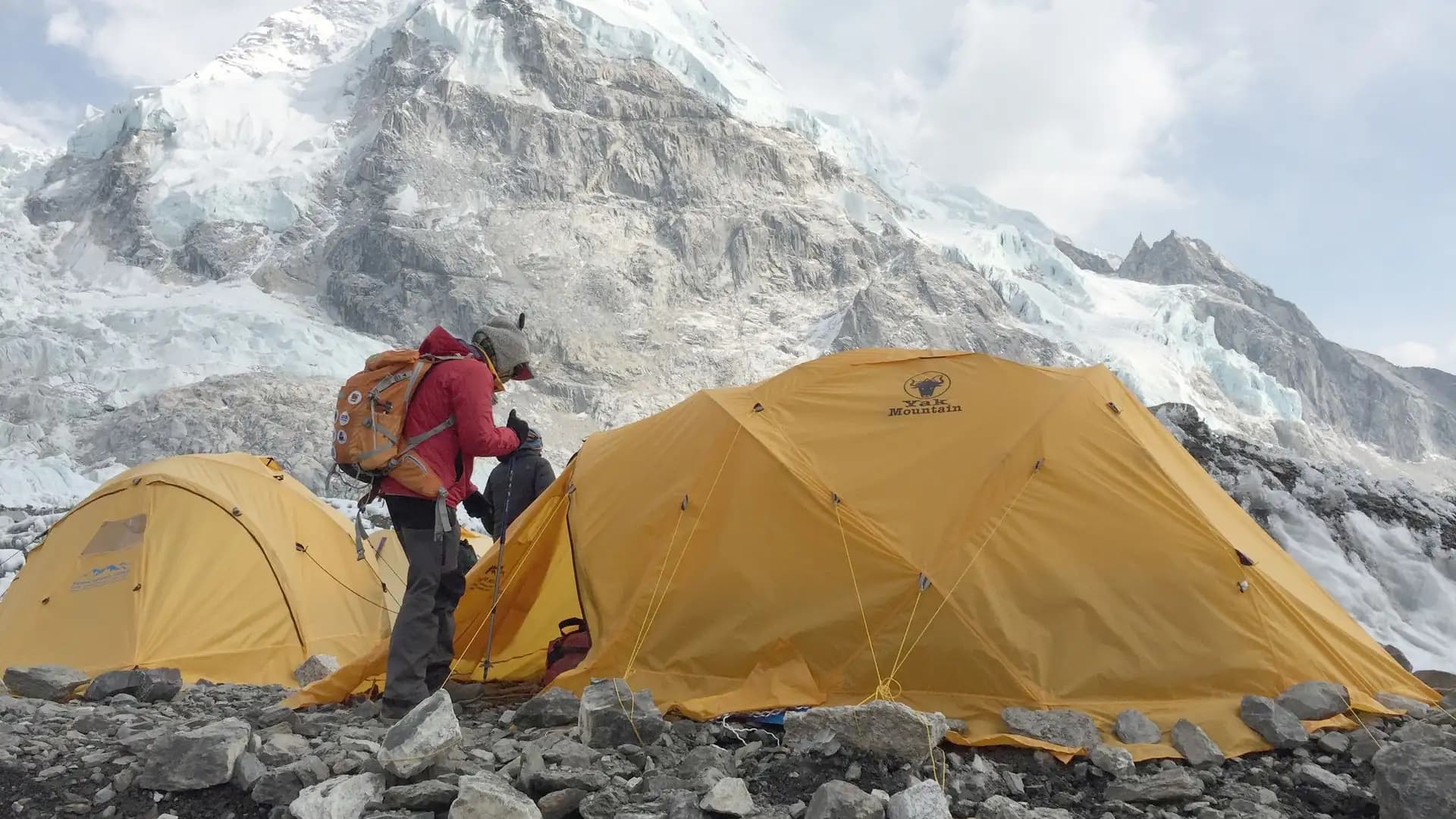
Camp 3 Everest Climb 2027 | Route, Time & Ascent from Camp 2
Introduction to Camp 3 Everest Climb
Every Everest season, a quiet group of climbers walks up the Western Cwm with no plan to stand on the summit. They want something more specific: to put their crampons into the Lhotse Face, clip into a fixed rope above 7,000 metres, and find out whether their body and their nerve belong up there. A Camp 3 Everest climb is that test, and it is the most honest one the mountain offers short of the summit push itself.
If you are reading this, you are probably asking practical questions. How high is Camp 3? How long does the ascent from Camp 2 take? How steep is the ice, and what does it feel like when the air thins out? Is it a sensible goal on its own, or only a stepping stone? This guide answers all of that in plain language, including the parts that brochures tend to skip.
At a Glance: Climbing to Camp 3 on Everest
Detail | What to know |
|---|---|
Route | South Col (Southeast Ridge) route from Nepal |
Camp 3 position | Roughly halfway up the Lhotse Face, on hacked-out ice ledges |
Typical elevation | About 7,100 to 7,300 m (23,300 to 23,950 ft); 7,162 m is a commonly quoted figure |
Starting point for the climb | Camp 2 (Advanced Base Camp), about 6,400 to 6,500 m |
Vertical gain from Camp 2 | Roughly 750 to 850 m |
Typical climbing time | About 3 to 7 hours, usually 4 to 6 on a first rotation |
Terrain | Hard glacial ice and snow, fixed ropes, about 30 to 45 degrees with steeper pitches near the top |
Main season | Spring, March to May |
Main hazards | Bergschrund at the base, falling ice, wind, cold, altitude illness |
Elevation figures differ by a few hundred metres from one source to another. Camps shift from season to season, tent platforms are rebuilt, and handheld GPS devices disagree. Treat any single number as a close estimate, not a surveyed fact.
What Camp 3 on Everest Actually Is
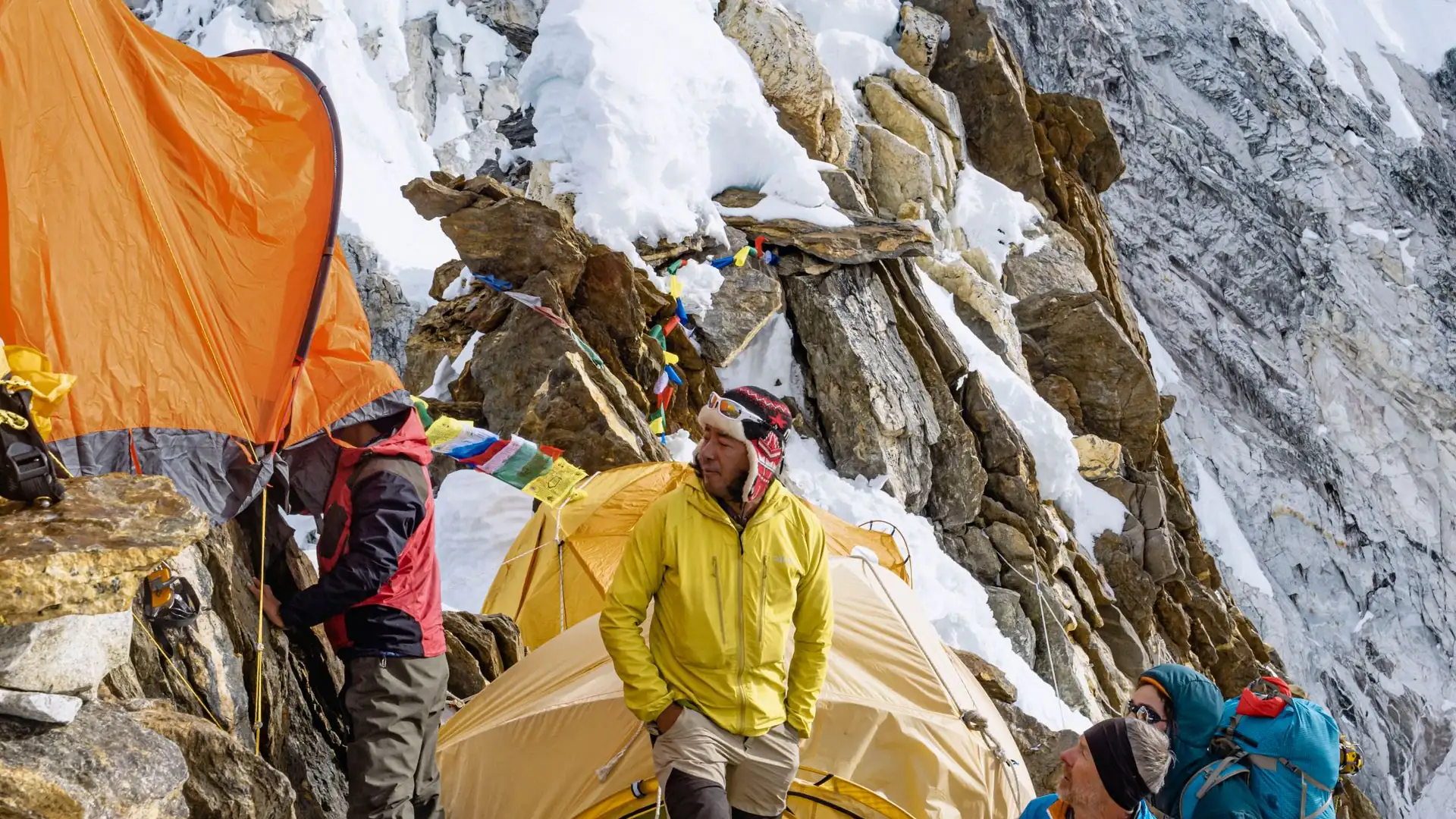
Camp 3 is not a campsite in the usual sense. There is no flat ground on the Lhotse Face, so Sherpa teams chip platforms out of the ice, usually on two or three levels, and pitch small tents on them. Even then, floors tend to slope. Climbers stay clipped to the fixed line while moving around camp, and that includes the trip to the toilet.
The Lhotse Face itself is a wall of hard ice rising roughly 1,125 metres between the Western Cwm and the South Col. It belongs to Lhotse, the fourth-highest mountain on Earth at 8,516 metres, and it is the line the standard south-side Everest route follows to reach the South Col. Camp 3 sits about halfway up it.
The route has a long history. When a Swiss team made the first ascent of Lhotse in 1956, they climbed this same face, and they went on to make the second ascent of Everest. Seventy years later, the line still works the same way: fixed ropes, ice screws, and a lot of patience.
Why climbers go there
Camp 3 has two jobs. For summit climbers, it is the highest point most people reach during acclimatisation rotations, and teams treat a successful visit as a kind of permission slip for the summit bid. For people on partial programmes, it is the entire objective: a high, technical, deeply Himalayan climb that does not require the full cost, time or risk of an 8,000-metre summit attempt.
That second group is growing. Climbers who want to find out how they handle altitude before committing to a full expedition now see an Everest Camp 3 programme as a serious, legitimate goal.
Where Camp 3 Fits Among the Everest South Side Camps
Most guides list the camps like a train timetable. It helps more to see how the altitude changes your day-to-day life.
Camp | Approx. elevation | What it feels like |
|---|---|---|
Everest Base Camp | About 5,300 m | Rocky, noisy, social. A small tent city on the Khumbu Glacier |
Camp 1 | About 5,900 to 6,065 m | Above the Khumbu Icefall. Crevasses, ladders, and the first real thin air |
Camp 2 (Advanced Base Camp) | About 6,400 to 6,500 m | Scorching sun in the Western Cwm, cold nights, a full kitchen and dining tent |
Camp 3 | About 7,100 to 7,300 m | Steep ice, small ledges, fixed ropes, exposure, very little rest |
Camp 4 (South Col) | About 7,900 to 8,000 m | Windy, bare, the launch point for summit night inside the death zone |
The death zone begins at roughly 8,000 metres, so Camp 3 sits below it. That is worth stating clearly. It is a high-altitude environment with real risk, but it is a different category from the summit push. Many people who ask whether Camp 3 is "the death zone" are looking for reassurance, and the answer is that it is not, though it is still a place where your body is working very hard to stay balanced.
How Camp 3 Fits Into an Everest Acclimatisation Rotation
Nobody climbs from Base Camp to Camp 3 in one go. The standard pattern is to go up, sleep high enough to stimulate your body, then come back down to recover. Over a season this usually unfolds in three stages.
First rotation. The team passes through the Khumbu Icefall to Camp 1, sometimes touching Camp 2 before heading back. The goal is to learn the icefall and start building red blood cells.
Second rotation. Climbers sleep at Camp 2 for several nights. Many teams make a short walk to the base of the Lhotse Face to look at it and test their legs.
Third rotation. Climbers go to Camp 2 again, then climb the Lhotse Face to Camp 3. Some teams sleep there one night. Others touch it and descend.
Unexpected delays are part of the pattern. In spring 2026, for example, a large unstable serac blocked the route below Camp 1 and held up operations for weeks. A Camp 3 plan needs slack in it, because the mountain does not follow a timetable.
Why this order matters
The body adapts in steps, not leaps. Sleeping at 6,400 metres teaches it to handle a lower oxygen supply. A single night at 7,200 metres pushes that further, and the descent lets the body consolidate the gain. This is why operators build rest days into the schedule even when climbers are strong. It is also why anyone who skips acclimatisation to save time tends to pay for it later.
The Ascent from Camp 2 to Camp 3, Step by Step
Picture the morning. You wake in the dark at Camp 2, your breath already freezing on the tent roof. Boiling water goes into a thermos, a few bites of breakfast go down with effort, and you pull on your harness and down suit by headlamp. If you want to read more about the camp itself, our guide to Camp 2 on Everest describes the place you are leaving.
Stage 1: The walk to the base of the face
From Camp 2 you walk up the glacier toward the foot of the Lhotse Face. It is not technical, and most people can do it at a slow pace without feeling out of breath, which is part of why the next stage comes as a shock. The walk usually takes about one to two hours, depending on conditions and where the route has been set that season.
Stage 2: The bergschrund
At the base of the face is a bergschrund, the crevasse where moving glacier ice separates from the stationary slope above. This is where you clip into the fixed rope, attach an ascender (a jumar), and commit to the face. Falls at this point can be serious, which is why careful clipping discipline matters from the very first move.
Stage 3: The face
The fixed line runs up the ice in rope lengths of roughly 50 metres, anchored with ice screws. The usual rhythm is to move the ascender, step up, rest, breathe, and repeat. The ice can be hard and glassy, especially in dry seasons, so crampon technique matters more than strength. A sloppy front-point placement costs energy and increases risk.
The angle is generally described as about 30 to 45 degrees with the odd steeper pitch below Camp 3. It does not sound extreme until you are doing it at 7,000 metres on thin air, in a line of other climbers, with a few thousand feet of empty space behind your heels. You can find more detail on this section of the route in our guide to the Lhotse Face on Everest.
Stage 4: Arrival
When you reach Camp 3, expect relief mixed with disbelief. Tents are small, platforms are narrow, and you stay on the rope. On a clear day you look straight down across the Western Cwm to Camp 1, the Khumbu Icefall and, beyond it, Base Camp. Many climbers say the view is one of the best on the mountain, and some say it is the most dramatic place they have ever pitched a tent.
How Long Does It Take to Climb from Camp 2 to Camp 3?
Climbing time depends on fitness, acclimatisation, snow conditions and traffic on the ropes. Reported ranges vary, but the pattern is consistent.
Section | Typical time |
|---|---|
Camp 2 to the base of the Lhotse Face | About 1 to 2 hours |
Base of the face to Camp 3 on fixed ropes | About 2 to 5 hours |
Total, first rotation | Commonly 4 to 6 hours, sometimes 7 |
Total, well-acclimatised climber | Around 3 to 4 hours is possible |
Descent, Camp 3 to Camp 2 | Roughly 1.5 to 3 hours |
Start times vary too. Some teams leave as early as 3 or 4 a.m. to avoid crowds and sun on the ice. Others leave around 7 or 8 a.m. Early starts are colder but often quieter, and the face tends to be firmer. Later starts are warmer but can mean waiting behind slower groups.
A useful rule of thumb: if your first pass takes six hours, you are not slow. You are normal.
How Hard Is the Climb to Camp 3?
It helps to split difficulty into three parts.
Physical difficulty. You are climbing about 750 to 850 vertical metres at an altitude where the air carries roughly 40 percent of the oxygen available at sea level. Your legs may feel fine, but your lungs and heart will not. Many climbers describe a pattern of ten steps, rest, ten steps, rest.
Technical difficulty. This is moderate, not extreme. You are not leading ice pitches. You are following fixed lines. But you do need reliable crampon skills, comfortable use of an ascender and descending device, and the habit of clipping and unclipping without thinking. Mistakes cost more at altitude because your coordination is slower.
Mental difficulty. This is the part people underestimate. Hours of repetitive effort, thin air, cold hands, poor sleep, and a big drop below you wear on judgement. Many climbers say the face is less about strength than about staying calm and keeping a steady rhythm.
For a broader perspective on how hard the full mountain is, see our guide on how hard it is to climb Everest.
Sleeping at Camp 3 vs Touch-and-Return
Programmes handle the final step in two main ways.
Approach | What happens | Best for |
|---|---|---|
Touch-and-return | Climb to Camp 3, spend about an hour or so, descend to Camp 2 the same day | Climbers who want the altitude and the view with lower overall exposure |
Overnight at Camp 3 | Sleep one night at about 7,200 m, descend next day | Climbers wanting maximum acclimatisation benefit and a fuller experience |
A single night high gives the body a stronger signal than touching and leaving. It also costs more energy, and sleep at that altitude tends to be broken and shallow. Some Sherpa teams prefer to return to Camp 2 rather than stay, which tells you something about how demanding the night can be.
Ask your operator exactly which approach they use. It changes the schedule, the risk, and the experience.
Oxygen at Camp 3
Many climbers who reach Everest Camp 3 sleep there without supplementary oxygen during acclimatisation rotations. The body adapts best when it is challenged, and using oxygen too early can blunt that effect. Others use oxygen on the Lhotse Face or at night to reduce strain. Policies vary between operators, and some programmes offer oxygen for use on the face so that climbers can learn how the system works before any future high-altitude attempt.
Higher on the mountain, the picture changes. Above Camp 3, most summit climbers use supplementary oxygen, and flow rates are set by the operator's plan. If your goal is to practise with oxygen equipment, tell your operator before you book.
The Real Risks, Explained Plainly
Nobody should romanticise this climb. The risks are specific and manageable, but they are real.
Falls at the bergschrund and on the face. The fixed line is your lifeline. Climbers are expected to stay clipped at all times, including in camp. The most serious incidents tend to follow lapses in attention.
Falling ice and rock. Climbers above you can dislodge ice. A helmet is not optional, and neither is paying attention to where other climbers are moving.
Wind and cold. Weather can turn quickly on the face. Wind can flatten tents, and wind chill in storms can drop far below the actual air temperature. Gloves, goggles, and a proper down suit matter.
Altitude illness. At this height, acute mountain sickness is common, and the more serious conditions, high-altitude pulmonary oedema (HAPE) and high-altitude cerebral oedema (HACE), are possible. Early signs include persistent headache, nausea, unusual breathlessness, confusion, or loss of coordination. If these appear, the correct response is to descend, not to wait and see.
Traffic and fatigue. Crowded ropes slow everyone and increase the time spent exposed. Fatigue leads to poor decisions, so good teams set turnaround times and respect them.
Icefall conditions. The Khumbu Icefall, which you pass through before reaching Camp 3, is widely regarded as the most objectively dangerous section for climbers on the south side. A dedicated team maintains the route each season, but nothing makes it risk-free.
Who Should Consider a Camp 3 Everest Climb
A Camp 3 Everest climb is a good fit if you have already trekked at altitude, you enjoy mountaineering for its own sake, and you want to test your capacity above 7,000 metres without committing to a summit bid. It is a sensible next step for climbers who have completed a trekking peak, a 6,000-metre climb, or a technical mountain elsewhere.
It is a poor fit if you have never worn crampons, never slept above 5,000 metres, or are hoping that guides will carry you through. Operators will assess your experience, and good ones will say no when the answer is no.
A realistic experience ladder
Climbers who succeed on Everest's lower camps usually build up in steps.
Altitude trekking. An Everest Base Camp trek teaches you how your body responds to 5,000 metres and gives you your first view of the Khumbu Icefall.
Entry-level peaks. Nepal's trekking peaks introduce glacier travel, roped climbing, and sleeping at high camps. Our overview of peak climbing in Nepal explains the options, and Mera Peak, at 6,476 metres, is a popular first step.
Technical practice. Learn to use an ascender, descend on fixed lines, and move efficiently in crampons on steep ice.
A higher objective. A 7,000-metre peak or the Everest lower camps follow naturally.
What about the 7,000-metre rule?
Nepal has been considering a law that would require anyone applying for an Everest permit to have first climbed a 7,000-metre peak in Nepal. The bill passed the upper house but, at the latest reports we reviewed, was still moving through parliament and was not in force. Alan Arnette's update on the proposal explains where it stood in mid-2026. Rules like this can change quickly, so confirm the status with your operator before you commit.
Preparing for the Climb: A Training Plan That Works
Training for the ascent from Camp 2 to Camp 3 is about endurance, leg strength, and mental stamina. A reasonable approach starts about 9 to 12 months before departure.
Months 12 to 6: build the base. Long, steady aerobic work, such as hiking with a loaded pack, trail running, cycling, or swimming. Add two strength sessions a week focusing on legs, core and back. Aim for gradually longer weekend hikes.
Months 6 to 3: add specificity. Increase pack weight and elevation gain on hikes. Add stair or incline sessions with a weighted pack. Practise in the boots and layers you will wear. Include at least one trip to altitude if you can.
Months 3 to 1: sharpen. Back-to-back long days, ideally on steep terrain. Rehearse rope work, ascender use, and descending. Dial in nutrition and hydration strategy.
Final month: recover and fine-tune. Reduce volume, protect your health, and focus on sleep, nutrition and logistics.
Two points that often get missed. First, cold-weather skills are part of fitness: manage gloves, adjust layers, and eat and drink when you are tired. Second, mental practice counts. Spend time on steep ground and in poor weather so that discomfort is familiar before you reach the face.
Before any of this, see a doctor familiar with altitude medicine. Cardiac, respiratory, and other health issues can change what is safe, and any use of altitude medication such as acetazolamide should be a medical decision, not a guess.
Gear for the Lhotse Face
Most operators supply group gear such as tents, ropes and oxygen systems, but you bring your personal technical kit. A typical list includes:
Insulated high-altitude boots designed for very cold conditions
Crampons that fit your boots properly
Harness, helmet and an ice axe
Ascender and descender, plus carabiners and slings
A full down suit, plus layers beneath it
Insulated mittens and thinner liners
Goggles and sunglasses with strong UV protection
A sleeping bag rated for extreme cold
Water bottles with insulating covers, and a thermos
Test every item before you leave. Cold hands and misfitting crampons can turn a manageable day into a hard one.
Permits, Rules and Costs for 2027
Rules for Everest change often, so confirm details with your operator, but here is the broad picture.
Item | Current picture |
|---|---|
Spring royalty for foreign climbers on the standard route | US$15,000 per person, up from US$11,000, in effect since 1 September 2025 |
Autumn royalty | US$7,500 per person |
Guide ratio on 8,000 m expeditions | New rules require at least one guide or climbing Sherpa for every two clients |
Local permits | Sagarmatha National Park and local municipality permits are required in the Everest region |
Proof of experience | A proposed 7,000 m requirement is not yet law, but is worth monitoring |
You can read about the changes to royalties and record revenue in this Kathmandu Post report.
Costs for a partial climb depend heavily on what is included. A realistic Camp 3 Everest climb budget has to cover the permit or its equivalent, Sherpa support, base camp and high camp logistics, oxygen, meals, communications, medical gear, internal flights to Lukla, insurance and personal equipment. International outfitters have advertised Camp 3 programmes at around US$22,000 for roughly five to six weeks, though prices vary between operators and change from season to season. Ask for a written inclusions and exclusions list and compare like with like.
Insurance deserves its own line. Make sure your policy covers high-altitude mountaineering above 7,000 metres and helicopter evacuation. Many standard travel policies do not.
Best Time to Climb to Camp 3
Spring, from March to May, is the main season. It offers the longest window of relatively stable weather, the routes are fixed by Sherpa teams, and the infrastructure at Base Camp is at its busiest. Most acclimatisation rotations take place through April, and Camp 3 visits often fall in the second half of April or into May, depending on how the season develops.
Autumn climbing exists but is far less common on this route, and permits are cheaper. Winter and monsoon conditions are much harsher. For first-time high-altitude climbers, spring is the sensible choice, and the 2027 spring season is when most Camp 3 programmes will run.
A Typical Camp 3 Itinerary Structure
Every operator designs its schedule differently, but a Camp 3 programme usually follows this shape over about five to six weeks. For a wider view of expedition timing, our article on how long it takes to climb Mount Everest puts this in context.
Phase | Typical content |
|---|---|
Arrival | Kathmandu briefing, gear check, permits, equipment sorting |
Approach | Flight to Lukla and a gradual trek to Base Camp, with acclimatisation days |
Base Camp preparation | Training, ladder and rope practice, puja ceremony, rest |
First rotation | Khumbu Icefall to Camp 1, back to Base Camp |
Second rotation | Camp 2 stay for several nights, walk to the base of the Lhotse Face |
Third rotation | Climb the Lhotse Face to Camp 3, with or without a night there |
Return | Descent to Base Camp, trek out, flight to Kathmandu, debrief |
Treat any itinerary as a framework. Weather, icefall conditions and your own acclimatisation will decide the real order.
Camp 3 vs Camp 2 vs Base Camp vs the Summit
Choosing the right goal is half the battle. This table shows how they compare.
Goal | Altitude | Technical content | Commitment | Best for |
|---|---|---|---|---|
Everest Base Camp trek | About 5,300 m | Walking only | 12 to 16 days | First high-altitude experience |
Camp 2 climb | About 6,400 m | Icefall, ladders, crevasses | About 4 weeks | Experiencing the Icefall and Western Cwm |
Camp 3 climb | About 7,100 to 7,300 m | Icefall plus Lhotse Face | About 5 to 6 weeks | Testing 7,000 m performance and ice skills |
Everest summit | 8,848.86 m | Full route, death zone | About 8 to 10 weeks | Experienced high-altitude climbers |
If you want a wider look at what surrounds Everest, our guide to peaks near Everest shows other objectives that might suit your goals better.
Common Mistakes People Make
Underestimating the cold. Hands and feet are the weak point. Test your glove system and boots long before you leave.
Going too fast. A pace that feels easy at Base Camp can ruin you on the face. Slow is smooth, and smooth is fast enough.
Ignoring hydration and food. Altitude suppresses appetite and thirst. Make eating and drinking a scheduled habit.
Poor rope discipline. Always clip in, always double-check your carabiner, and never unclip before you are secure.
Choosing the cheapest operator. In the Himalaya, a lower price can mean thinner support, fewer Sherpas, or weaker medical and oxygen resources.
Treating Camp 3 as a "lite" version of a summit. It is a serious mountain in its own right. Respect it.
How to Choose an Operator
A good operator answers questions directly. Ask these before you pay a deposit.
How many Sherpas will support each climber, and what is their experience on the Lhotse Face?
Will I sleep at Camp 3, or touch and return?
What oxygen policy applies at Camp 3 and above?
What medical support exists at Base Camp and Camp 2?
What is the weather and icefall contingency plan?
What does the permit cover, and what is billed separately?
What happens if I need to descend early? Are there refunds, and what is the evacuation process?
How do you assess whether a client is ready?
If the answers are vague, treat that as information.
Ready to Plan Your Camp 3 Everest Climb?
The Lhotse Face is not for everyone, and honest advice is worth more than a sales pitch. If you are weighing whether you are ready, which season to target, or how to build your experience before attempting a Camp 3 Everest climb, speak with someone who knows the terrain and the logistics.
Talk to an expert on WhatsApp: +977 9841248242
Tell us about your experience, your timeline, and what you hope to get from the mountain. We will help you work out whether Camp 3 is the right goal, and what to do next.
Frequently Asked Questions About Climbing to Camp 3
1. How high is Camp 3 on Everest?
Camp 3 sits at roughly 7,100 to 7,300 metres (about 23,300 to 23,950 feet) on the Lhotse Face. A figure of 7,162 metres is widely quoted. Exact numbers differ because camps are rebuilt each season and measurements vary.
2. How long does it take to climb from Camp 2 to Camp 3?
Most climbers need about 4 to 6 hours on a first rotation, and reported times range from about 3 to 7 hours. This includes roughly one to two hours of walking to the base of the face and then the fixed-rope ascent. Fit, well-acclimatised climbers can be faster.
3. How hard is the climb to Camp 3?
It is demanding but not highly technical. You follow fixed ropes on steep ice at around 30 to 45 degrees, with steeper pitches near the top. The challenge is mainly the altitude, the cold and the length of the effort.
4. How much altitude do you gain between Camp 2 and Camp 3?
About 750 to 850 vertical metres, depending on which camp elevations you use. That is a lot to gain in one day at this height.
5. Do you need oxygen at Camp 3?
Not necessarily. Many climbers sleep at Camp 3 without supplementary oxygen during acclimatisation, while some programmes allow oxygen on the face. Policies differ by operator, so confirm before booking.
6. Do climbers sleep at Camp 3?
Some do, usually for one night. Others touch Camp 3 and return to Camp 2 the same day. A night at Camp 3 gives a stronger acclimatisation signal but is physically harder.
7. How steep is the Lhotse Face?
Typically 30 to 45 degrees, with steeper sections just below Camp 3. The face is roughly 1,125 metres high and made of hard ice and snow, with fixed ropes protecting the route.
8. Can a beginner do a Camp 3 Everest climb?
A true beginner should not attempt it. You need prior altitude exposure, mountaineering skills such as crampon use and rope work, and strong fitness. Build experience on trekking peaks and lower altitude climbs first.
9. How much does a Camp 3 Everest climb cost?
Prices depend on inclusions. International operators have advertised programmes at around US$22,000, while Nepal-based operators may differ. The cost covers permits, Sherpa support, logistics, oxygen, food and flights within Nepal, but usually excludes insurance, personal gear and international airfare.
10. How long does a Camp 3 expedition last?
Typically five to six weeks, including travel, trekking to Base Camp, acclimatisation rotations and return. Some programmes run longer to allow for weather or icefall delays.
11. What is the best time for a climb to Camp 3?
Spring, March to May, is the standard season. Most teams make their Camp 3 push in April or May, depending on conditions.
12. Do I need a permit?
Yes. Climbing above Base Camp on Everest involves Nepal's climbing permit system, plus Sagarmatha National Park and local municipality permits. Your operator should explain how the permit is structured and billed for a partial climb.
13. Do I need to have climbed a 7,000-metre peak first?
Not under current law, as far as we know. A proposal requiring a prior 7,000-metre summit in Nepal is still working through parliament. Check the latest status with your operator.
14. How cold does it get at Camp 3?
Nights are well below freezing, and wind chill during storms can make it feel far colder. Cold management, including insulated boots, mittens and a down suit, is essential.
15. Is Camp 3 in the death zone?
No. The death zone is generally considered to begin around 8,000 metres. Camp 3 is lower, though still extremely high and physically demanding.
16. What is the difference between a Camp 2 and a Camp 3 climb?
Camp 2 involves the Khumbu Icefall and Western Cwm at about 6,400 metres. A Camp 3 climb adds the Lhotse Face and roughly 750 to 850 extra vertical metres on steep ice, making it more technical and more demanding.
17. Can you see Base Camp from Camp 3?
On clear days, yes. Climbers often describe views down across the Western Cwm, Camp 1, the Khumbu Icefall and Base Camp.
18. What gear do I need for the Lhotse Face?
Insulated mountaineering boots, crampons, harness, helmet, ice axe, ascender and descender, a full down suit, mittens, goggles and an extreme-cold sleeping bag. Group gear such as tents and oxygen systems is usually provided by the operator.
19. Is the climb to Camp 3 dangerous?
It carries real risks: falls at the bergschrund, falling ice, wind, cold and altitude illness. Good preparation, strong guiding, disciplined rope use and early descent when symptoms appear reduce risk but never remove it.
20. Does a Camp 3 climb help with a future Everest summit attempt?
Many climbers find it useful. It shows how your body handles 7,000 metres, builds experience with the Lhotse Face, and helps you decide whether a summit attempt makes sense. It does not guarantee success, and it is no substitute for sound preparation.