Annapurna Base Camp Trek Cost 2026 | Full Breakdown
Annapurna Base Camp Trek Cost
Look for "Annapurna Base Camp trek cost" and you'll find numbers ranging from under $500 to well over $1,200 for what looks, on paper, like the same trek — and neither figure is wrong. They're just describing genuinely different trips, built from different combinations of guide support, accommodation standard, group size, season, and how many extras you pay for along the way. The gap isn't marketing inflation; it's the real range of what "ABC trek" can mean depending on how you choose to do it.
This guide breaks that range down into its actual components — permits, guides, porters, accommodation, food, transport, insurance, gear, and tips — with current 2026 figures for each, so you can build a realistic budget for your specific situation rather than anchoring on a single headline number that may or may not apply to you.
Every cost figure below has been checked against multiple current sources, and where prices vary (which happens constantly in a market with dozens of independent operators and hundreds of individually owned teahouses), that range is presented honestly rather than picked arbitrarily.
The Short Answer
Most trekkers spend somewhere between USD 500 and USD 1,200 per person to complete the Annapurna Base Camp trek, with the wide range driven primarily by trek duration, whether you book a guided package or arrange things independently, group size, season, and how much you spend on optional extras (hot showers, WiFi, bottled drinks) along the trail.
Trekking style | Typical total cost per person |
|---|---|
Independent, budget-focused | Roughly USD 450-700 |
Standard guided package (group rate) | Roughly USD 650-970 |
Mid-range guided package | Roughly USD 800-1,200 |
Premium/luxury package (private transport, upgraded lodges, helicopter return option) | USD 1,200+ |
What Actually Determines the Price
Before breaking down individual cost categories, it's worth understanding the handful of variables that swing the total most dramatically.
Factor | How it affects cost |
|---|---|
Trek duration | Shorter itineraries (7 days) cost less overall than longer ones (10-13 days) simply due to fewer nights of accommodation, meals, and guide/porter days |
Guided vs. independent | A guided package bundles services at a fixed price; independent trekking can be cheaper on paper but requires managing permits, accommodation, and daily cash payments yourself |
Group size | Solo trekkers pay more per person for guide and porter services since these costs aren't shared; group treks are typically around 20% cheaper per person than solo arrangements |
Season | Spring (March-May) tends to be the most expensive season due to peak demand; autumn (September-November) often offers the best value with stable weather and competitive permit-season pricing |
Accommodation and meal choices | Basic teahouses and dal bhat cost considerably less than upgraded lodges and Western-style menu items, especially at higher elevations |
Transport choices | Buses cost less than private jeeps; walking sections some trekkers drive can also reduce costs slightly |
Optional extras | Hot showers, WiFi, device charging, and bottled water all add up meaningfully over a week-plus trek |
Permit Costs: The Fixed, Unavoidable Baseline
Every trekker, regardless of trekking style or budget level, needs two permits to legally trek in the Annapurna Conservation Area. These costs are fixed and don't change based on how you organize your trip.
Permit | Cost (international trekkers) | Cost (SAARC/Indian nationals) | Purpose |
|---|---|---|---|
ACAP (Annapurna Conservation Area Permit) | NPR 3,000 (roughly USD 22-30) | Roughly INR 800 (considerably discounted) | Entry to the Annapurna Conservation Area; funds conservation and trail maintenance |
TIMS Card (Trekkers' Information Management System) | NPR 2,000 for individual trekkers, or NPR 1,000 per person for those trekking in a registered group (roughly USD 15, or roughly USD 7-8 for group rate) | Roughly INR 999 (discounted) | Trekker registration for safety tracking and emergency response |
Total permit cost for international trekkers: roughly USD 37-50 when arranging independently. If booked through a guided package, both permits are typically included in the package price, and your operator handles the paperwork directly.
Unlike Upper Mustang or Nar Phu Valley, ABC does not require a restricted-area permit, which keeps total permit costs significantly lower than some other Annapurna-region routes.
Visa Costs
Nepal offers visa on arrival at Tribhuvan International Airport in Kathmandu for most nationalities, with no advance application required (though pre-registering online can save time at the counter).
Visa duration | Fee |
|---|---|
15 days | USD 30 |
30 days | USD 50 |
90 days | USD 125 |
Most ABC trekkers choose the 15 or 30-day visa, since the trek itself is relatively short (typically 7-12 days) — a 15-day visa is often sufficient if you're not combining the trek with significant additional travel time in Nepal, though the 30-day option provides more comfortable buffer.
Guide and Porter Costs
Daily Rates
Service | Typical daily rate |
|---|---|
Licensed trekking guide | Roughly USD 25-40 per day |
Porter | Roughly USD 15-30 per day, typically carrying luggage for one or two trekkers (commonly a 1:2 or 1:1 ratio) |
Combined guide-porter (one person doing both roles) | Roughly USD 20-30 per day — a cost-effective and practical option for solo or budget-focused trekkers |
Why This Isn't Optional
Current regulations mean independent trekking without any guide is no longer straightforward in the Annapurna region — hiring a licensed guide is now standard practice and, in most cases, effectively required for compliance with regional permit rules.
This shifts the cost conversation from "should I hire a guide" to "how is guide cost best structured within my budget" — a guided package folds this into a fixed price, while independent arrangement means paying the daily rate directly.
What You Get for the Cost
Beyond navigation, a licensed guide handles permit logistics, altitude and pacing decisions, teahouse coordination (including negotiating the standard meal-inclusive room discount many teahouses offer), and emergency response knowledge — value that extends well beyond simple route-following, particularly relevant on a trek that includes genuine altitude exposure up to 4,130 meters.
Accommodation Costs
General Range
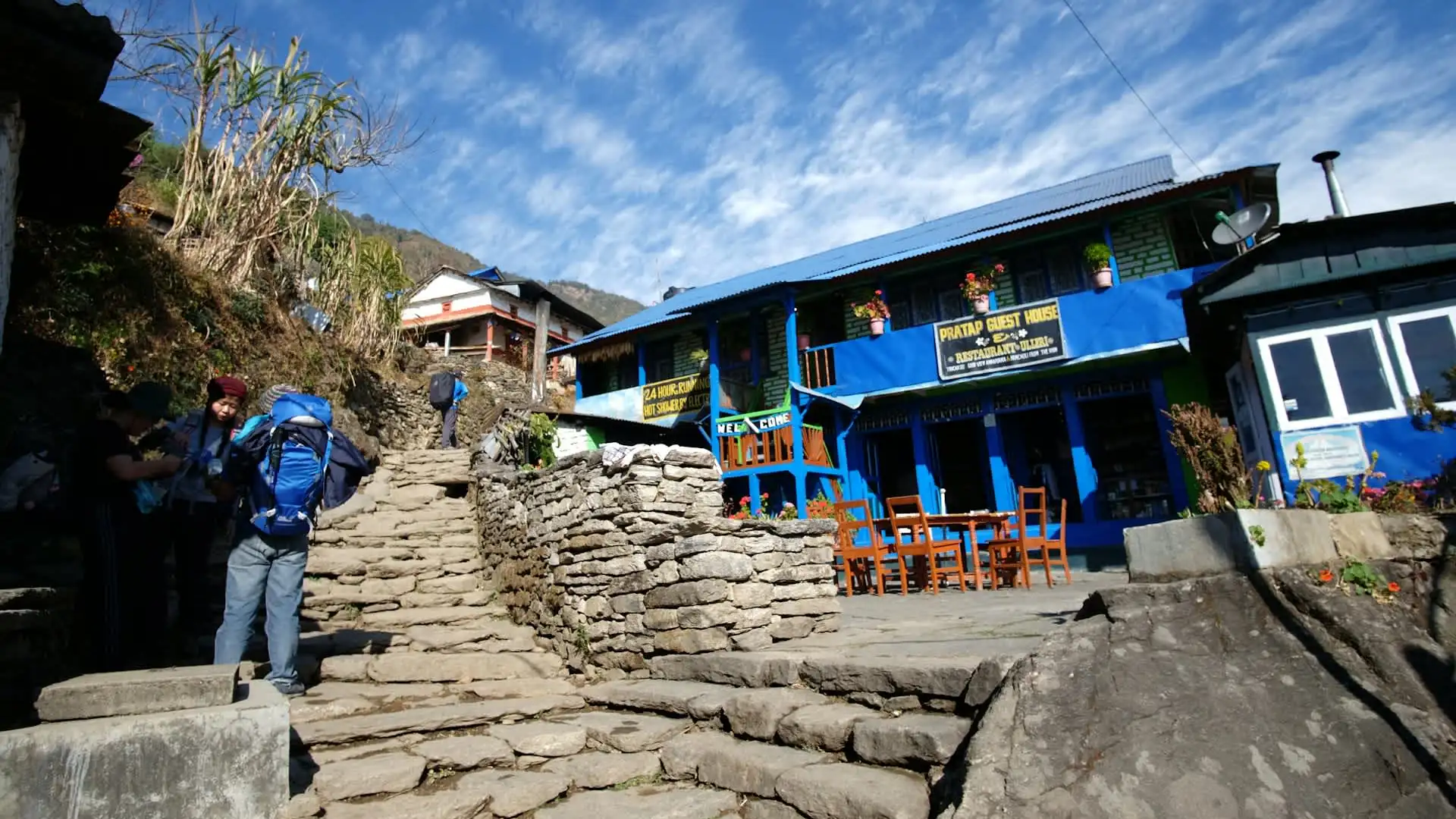
Teahouses along the ABC route typically charge USD 3-15 per night for a basic twin room, with prices increasing at higher elevations due to the difficulty of supplying remote, high-altitude villages.
Location/Zone | Typical room price (per night) |
|---|---|
Lower villages (Nayapul, Ghandruk) | Roughly USD 3-6 |
Mid-elevation villages (Chhomrong, Sinuwa) | Roughly USD 5-10 |
Higher elevation (Deurali, MBC, ABC) | Roughly USD 8-15 |
The Meal-Inclusive Discount
As with most Nepali teahouse trekking routes, many lodges offer significantly discounted or entirely free rooms if you commit to eating all your meals at that same teahouse — since teahouses earn most of their income from food sales rather than room charges. This arrangement is standard on most guided treks and effectively baked into package pricing.
Food and Drink Costs
Meal Prices
Item | Typical price |
|---|---|
Standard meal (dal bhat, noodles, fried rice) | Roughly USD 5-10 per meal, increasing with elevation |
Dal bhat specifically | Best value on the trail, and comes with unlimited refills at most teahouses |
Tea/coffee | Roughly USD 1-3 |
Bottled/boiled drinking water | Roughly USD 1-3 per liter |
Daily Food Budget
Most sources converge on a daily food budget of roughly USD 15-30 per day for an independent trekker managing their own meals, with the lower end achievable by sticking to dal bhat (the best value option, given free refills) and the higher end reflecting more varied Western-style menu choices and additional hot drinks, which many trekkers find themselves wanting constantly at altitude.
For an 8-day trail stretch, this translates to roughly USD 120-240 in total food costs if arranging independently — a figure typically already folded into guided package pricing.
Commonly Overlooked Extra Costs
These are the expenses that don't always appear in headline package prices, and are worth budgeting for separately even on a guided trek.
Extra | Typical cost |
|---|---|
Hot shower | USD 3-5 per shower (water heated over wood or gas) |
WiFi | USD 2-5 per day, card-based connection; signal gets patchy or drops entirely past Machhapuchhre Base Camp |
Device charging | USD 2-4 per device per hour in remote teahouses |
Bottled/purified drinking water | USD 1-3 per liter |
Snacks (chocolate, energy bars purchased on-trail) | Variable, generally increasing with elevation |
Alcoholic drinks | Available at lower teahouses, generally not recommended at altitude given AMS risk, and priced at a premium |
A realistic allowance for these combined extras across a 7-10 day trek runs roughly USD 50-100 total, depending on your personal habits around showers, connectivity, and snacking.
Transportation Costs
Kathmandu to Pokhara
Most trekkers fly or take a tourist bus between Kathmandu and Pokhara before beginning the trek. This, along with ground transport to the trailhead (Nayapul or Jhinu Danda) and back, typically costs roughly USD 50-100 per person if arranged independently, and is usually included in guided packages.
Trailhead Transport
Jeep or bus transport from Pokhara to Nayapul (the standard trailhead) and back is generally short and inexpensive relative to other trip costs, typically bundled into package pricing or costing a modest amount if arranged separately.
Optional Helicopter Return
Premium packages sometimes offer a helicopter return option from Annapurna Base Camp directly to Pokhara, skipping the multi-day descent — a genuinely different cost tier, generally reflected in the "USD 1,200+" premium package range rather than standard budgets.
Travel Insurance
Travel insurance is effectively mandatory for the Annapurna Base Camp trek given the genuine altitude exposure and potential need for emergency evacuation in case of injury or altitude sickness.
Coverage type | Why it matters |
|---|---|
High-altitude trekking coverage | Standard travel insurance sometimes excludes activities above a certain altitude threshold; verify coverage extends to at least 4,130m |
Emergency medical evacuation | Should include helicopter evacuation given the terrain |
Medical treatment coverage | For injury or illness requiring treatment in Nepal |
Typical cost: roughly USD 50-150 for a trip of this length, depending on provider, age, and coverage level — a worthwhile expense relative to the potentially far higher cost of an uninsured emergency evacuation.
Tipping: A Real, Budgeted Cost
Tipping guides and porters is customary in Nepal's trekking industry and should be factored into your budget as a real line item rather than an afterthought.
Guideline | Typical amount |
|---|---|
Daily tip guideline (combined guide/porter) | Roughly USD 5-10 per day per trekker |
Total tip budget for a 7-10 day trek | Roughly USD 60-100 total, often given as a lump sum at the end of the trek |
Some cost breakdowns build this in as a specific line item — for example, a sample all-in budget for a roughly week-long trek might allocate around USD 80 specifically for tips within an overall total near USD 970-1,000.
Gear Costs: Buy vs. Rent
This is a variable cost depending heavily on what you already own.
Approach | Typical cost implication |
|---|---|
Renting gear in Kathmandu/Pokhara (sleeping bag, down jacket, trekking poles) | Roughly USD 1-3 per item per day — a genuinely economical option for a single trip |
Buying new gear | Highly variable, from budget options to premium branded gear; represents a larger upfront cost but becomes reusable for future trips |
Using gear you already own | No additional cost, though quality and appropriateness for this specific climate should be checked against the layering needs outlined in a dedicated packing guide |
Many trekking packages explicitly note trekking gear support (sleeping bag, down jacket) as available on request or rental, sometimes bundled into mid-range and premium package pricing.
Full Package Price Tiers
Budget Package
Component | Typical inclusion |
|---|---|
Price range | Roughly USD 450-700 per person |
Accommodation | Basic teahouses, twin-sharing |
Transport | Shared jeep or public bus |
Guide/Porter | Often a combined guide-porter role, or basic group-shared guide |
Meals | Included but simple, mostly dal bhat and standard trail menu |
Best suited for | Budget-conscious, flexible trekkers comfortable with basic conditions |
Standard Package
Component | Typical inclusion |
|---|---|
Price range | Roughly USD 650-970 per person (varies with duration; a 13-day all-inclusive trek often runs around USD 970) |
Accommodation | Standard teahouses, twin-sharing, generally reliable |
Transport | Private or shared jeep to trailhead |
Guide/Porter | Separate licensed guide and porter |
Meals | Full board included, standard trail menu |
Best suited for | The majority of international trekkers — the most common package tier booked |
Mid-Range/Premium Package
Component | Typical inclusion |
|---|---|
Price range | Roughly USD 800-1,200 per person |
Accommodation | Upgraded lodges where available, sometimes attached bathrooms |
Transport | Private vehicle throughout |
Guide/Porter | Senior/experienced guide, dedicated porter, lower client-to-staff ratio |
Meals | Full board, broader menu choice |
Best suited for | Trekkers prioritizing comfort and a smoother logistical experience |
Luxury Package
Component | Typical inclusion |
|---|---|
Price range | USD 1,200+ per person |
Accommodation | Best available lodges, gourmet food options |
Transport | Fully private throughout, including airport transfers |
Guide/Porter | Personal guide and porter, highest service ratio |
Special options | Helicopter return option from ABC, skipping the multi-day descent |
Best suited for | Trekkers with limited time or those prioritizing comfort and speed over budget |
Sample Cost Breakdown: A Realistic 7-Day Budget
Using a mid-range, standard guided package as an example, here's how a total cost might realistically break down:
Category | Estimated cost |
|---|---|
Package base rate (group rate) | ~USD 650 |
Permits (if not included, or as a reference line item) | ~USD 37 |
Additional food/snacks beyond package meals | ~USD 100-120 |
Nepal visa | ~USD 30 |
Travel insurance | ~USD 60 |
Tips for guide/porter | ~USD 80 |
Approximate total | ~USD 950-980 |
This kind of breakdown illustrates why headline package prices ("$650!") can understate the real total trip cost — visa, insurance, tips, and personal extras genuinely add up, typically bringing a "$650 package" trek closer to a $950-1,000 total experience once everything is accounted for.
Sample Cost Breakdown: A Budget-Focused Independent Approach
Category | Estimated cost |
|---|---|
Permits (ACAP + TIMS) | ~USD 40 |
Guide-porter (combined role, ~7-8 days) | ~USD 160-240 |
Accommodation (7-8 nights) | ~USD 40-80 |
Food (7-8 days) | ~USD 120-200 |
Transport (Pokhara-trailhead-Pokhara) | ~USD 30-60 |
Visa | ~USD 30 |
Travel insurance | ~USD 50 |
Extras (showers, WiFi, charging) | ~USD 40-60 |
Approximate total | ~USD 510-760 |
This is a genuinely achievable budget-conscious approach for trekkers comfortable with basic conditions and willing to manage some logistics themselves — though it's worth noting that "independent" today still means hiring a required guide, just arranged directly rather than through a full-service package.
Annapurna Base Camp vs. Everest Base Camp: A Cost Comparison
ABC is consistently cited as meaningfully more affordable than Everest Base Camp, generally by roughly 40-50%, for a few structural reasons:
Factor | ABC | EBC |
|---|---|---|
Flight requirement | None — accessible by road/jeep from Pokhara | Requires a Kathmandu-Lukla flight, typically USD 280+ per person round trip, weather-dependent and prone to delays |
Typical duration | 7-12 days | 12-16 days |
Maximum altitude | 4,130m | 5,364m |
Food/accommodation cost trend | Lower — shorter supply chains and lower elevations mean cheaper teahouse goods | Higher — extreme altitude and remoteness increase supply costs significantly |
Permit costs | Lower overall | Somewhat higher given the Khumbu region's permit structure |
Typical total cost | Roughly USD 500-1,200 | Generally notably higher across comparable package tiers |
For budget-conscious trekkers or those with limited time, this cost gap is a genuine practical factor in choosing between the two routes, beyond the differences in altitude and difficulty covered in other guides.
Group Size and Its Effect on Cost
Group size | Cost implication |
|---|---|
Solo trekker | Highest per-person cost, since guide and porter fees, transport, and sometimes accommodation aren't shared |
Small group (2-4) | Meaningfully reduced per-person cost through shared guide/porter and transport costs |
Larger group (5+) | Generally the most cost-efficient per-person rate, particularly for transport and guide services |
As a general rule of thumb, group ABC treks run roughly 20% cheaper per person than solo treks, since solo trekkers absorb guide, porter, transport, and sometimes accommodation costs individually rather than splitting them across a group.
Seasonal Cost Variation
Season | Cost trend | Why |
|---|---|---|
Spring (March-May) | Generally the most expensive | Peak demand, more competition for teahouse rooms and guide availability |
Autumn (September-November) | Often the best value | Stable weather combined with generally competitive permit-season pricing, though still a popular season |
Winter (December-February) | Can be cheaper on package pricing | Lower demand, though cold-weather gear needs may add some cost |
Monsoon (June-August) | Generally cheapest package pricing | Lowest demand, though generally not recommended for most trekkers given weather conditions |
Permit costs themselves stay the same year-round — seasonal cost variation comes from package pricing, guide/porter availability and demand, and accommodation competition, not from permit fee changes.
Independent vs. Guided: A Direct Cost-Value Comparison
Factor | Independent | Guided package |
|---|---|---|
Upfront cost | Generally lower on paper | Higher upfront, but often better overall value once all costs are tallied |
Logistics management | Managed personally — permits, teahouse booking, daily cash payments | Handled by the operator |
Altitude/pacing decisions | Your own responsibility, or a directly-hired guide's | Built into the guided experience |
Cost predictability | More variable, dependent on daily choices | Fixed and predictable |
Best suited for | Trekkers comfortable managing logistics who want maximum cost control | First-time trekkers or those who prioritize predictability and reduced logistical burden |
Since a licensed guide is now effectively required for trekking in the Annapurna region, "independent trekking" today generally means arranging your own guide and porter directly rather than trekking entirely without support — a nuance worth understanding when comparing "independent" cost figures against fully bundled packages.
How to Reduce Costs Without Cutting Safety Corners
Trek in a group rather than solo, sharing guide, porter, and transport costs
Choose autumn over spring if flexible, often offering the best balance of stable weather and competitive pricing
Stick to dal bhat for meals — it's the best value option on the trail and comes with unlimited refills
Limit paid extras like hot showers, WiFi, and device charging to what you genuinely need, rather than using them daily out of habit
Consider a shorter itinerary (7-9 days rather than 12-13) if your schedule and fitness comfortably support it, reducing total accommodation and meal nights
Rent rather than buy bulky cold-weather gear you won't reuse frequently
Book directly with a local Nepali operator rather than through an international intermediary, which typically adds a commission layer without proportionally more value
What NOT to Cut Corners On
Travel insurance — the cost of an uninsured emergency evacuation vastly outweighs the modest premium of proper coverage
A licensed, experienced guide — this is both a regulatory requirement and a genuine safety asset, not merely a cost center
Proper footwear and cold-weather gear — false savings here often lead to a worse (or aborted) trekking experience
Adequate trek duration for acclimatization — an overly compressed itinerary to save a few nights' accommodation cost increases altitude sickness risk
A Complete Cost Category Checklist
Category | Budget estimate | Standard estimate | Premium estimate |
|---|---|---|---|
Permits (ACAP + TIMS) | $37-50 | $37-50 (often included) | $37-50 (included) |
Visa | $30-50 | $30-50 | $30-50 |
Guide/Porter (7-9 days) | $160-280 | Included in package | Included, higher service ratio |
Accommodation | $30-80 | Included in package | Included, upgraded lodges |
Food | $100-200 | Included in package | Included, broader menu |
Transport (Kathmandu/Pokhara-trailhead) | $50-100 | Included in package | Fully private, included |
Travel insurance | $50-150 | $50-150 | $50-150 |
Tips | $60-100 | $60-100 | $80-150 |
Extras (showers, WiFi, charging) | $40-100 | $40-100 | Often included |
Rough total | $500-800 | $700-1,200 | $1,200+ |
Booking With a Local Nepal Operator
A meaningful part of getting good value on this trek comes down to who you book with, not just which package tier you choose. Working with a locally based operator like Adventure Life Nepal means the guide and porter team on the trail is the same team you're actually paying — without an added layer of international agency commission that some booking routes carry.
This generally translates to more competitive pricing at the same or better service standard, along with direct, current knowledge of teahouse conditions, permit requirements, and seasonal factors that shape what a realistic, well-planned budget for your specific trek dates should actually look like.
Frequently Asked Questions
1. How much does the Annapurna Base Camp trek cost in 2026?
Most trekkers spend between USD 500 and USD 1,200 per person, depending on trek duration, guided vs. independent style, group size, season, and personal spending on extras.
2. What permits do I need, and how much do they cost?
The Annapurna Conservation Area Permit (ACAP, roughly USD 22-30) and the TIMS card (roughly USD 15, or discounted for group treks), together totaling roughly USD 37-50 for international trekkers.
3. Is a guide mandatory for the ABC trek?
Current regulations effectively require a licensed guide for trekking in the Annapurna region, making this a standard, non-optional cost component of any properly arranged trek.
4. How much do guides and porters cost?
A licensed guide typically costs USD 25-40 per day, and a porter USD 15-30 per day, or roughly USD 20-30 per day for a combined guide-porter role.
5. Is ABC cheaper than Everest Base Camp?
Yes, generally by roughly 40-50%, mainly because ABC doesn't require an expensive Kathmandu-Lukla flight, has a shorter typical duration, reaches a lower maximum altitude, and benefits from shorter, cheaper supply chains for food and accommodation.
6. How much should I budget per day for food and accommodation?
Roughly USD 25-40 per day if trekking independently, covering meals (roughly USD 15-30) and a basic teahouse room (roughly USD 3-15, increasing with elevation).
7. What extra costs are often overlooked?
Hot showers (USD 3-5), WiFi (USD 2-5/day), device charging (USD 2-4/hour), and bottled or purified water (USD 1-3/liter) — none of these are always included in headline package prices.
8. Does travel insurance add much to the total cost?
Roughly USD 50-150 depending on coverage and provider — a modest cost relative to the potentially very high expense of an uninsured emergency evacuation, and effectively mandatory given the trek's altitude exposure.
9. How much should I budget for tips?
A common guideline is roughly USD 5-10 per day per trekker for guide and porter services combined, often totaling USD 60-100 for a standard 7-10 day trek.
10. Is it cheaper to trek in a group?
Yes — group treks typically run roughly 20% cheaper per person than solo treks, since guide, porter, and transport costs are shared across the group rather than absorbed individually.
11. Which season offers the best value?
Autumn (September-November) is often cited as offering the best overall value, combining stable weather with generally competitive pricing, though permit costs themselves remain fixed year-round regardless of season.
12. Should I buy or rent trekking gear?
Renting bulkier items (sleeping bags, down jackets, trekking poles) in Kathmandu or Pokhara, typically USD 1-3 per item per day, is a cost-effective option for trekkers who won't reuse this gear frequently.
13. What's included in a standard guided package?
Typically permits, transportation, licensed guide, porter, teahouse accommodation, and meals during the trek — generally not included: international flights, Nepal visa fee, travel insurance, personal gear, tips, and paid extras like hot showers or WiFi.
14. Is booking directly with a local Nepal operator cheaper than an international agency?
Generally yes — a local operator like Adventure Life Nepal typically offers more competitive pricing at the same service standard, since there's no added international agency commission layer between the booking and the actual ground services provided.
Final Thoughts
The real cost of the Annapurna Base Camp trek isn't a single number — it's a range shaped by genuine, controllable choices: how long you trek, whether you go guided or arrange things yourself, how many people you're splitting costs with, which season you choose, and how much comfort you want to pay for along the way. What's consistent across every budget tier is the fixed baseline — permits, a required guide, and the basic realities of teahouse trekking — and what's flexible is everything layered on top of that.
Build your budget from the actual categories above rather than a single headline figure, decide honestly where you want to spend more (insurance, guide quality, proper gear) and where you're comfortable spending less (basic accommodation, simpler meals), and the number you land on will be a realistic one — not a marketing figure that quietly assumes you'll skip half the trip's actual costs.