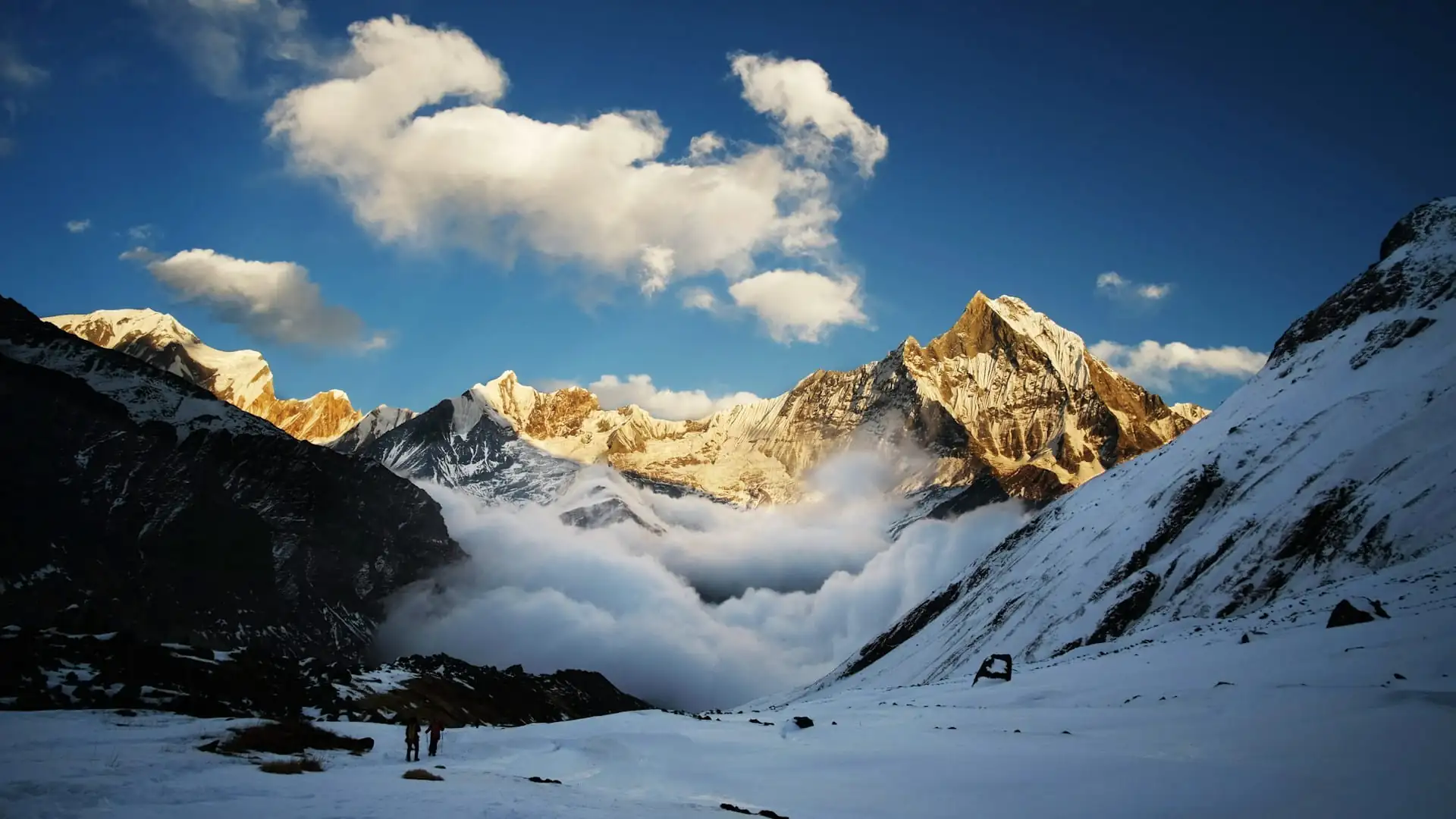
Annapurna Base Camp Trek – 14 Days | Guided Sanctuary Trek in Nepal
Trip Duration: 14 Days
Trip Grade: Moderate
Group Size: Min 1 person- Max 12 person
Meals: Breakfast in cities; all meals during the trek
Best Season: Spring (March–May) and Autumn (September–November)
Start Point: Kathmandu
Accomodation: Hotels in Kathmandu and Pokhara; mountain teahouses on the trail
Ending Point: Kathmandu
Max Altitude: 4,130 m
Transportation: Private vehicle, tourist coach, and optional domestic flight
Permits Required: ACAP and licensed guide arranged and included
Overview
The Annapurna Base Camp Trek leads into a place few mountain trails can match: a glacial amphitheatre ringed almost entirely by peaks above 7,000 metres, sitting at the heart of the Annapurna Sanctuary. You walk in from terraced farmland and Gurung villages, follow a river gorge upward through rhododendron and bamboo forest, and finish standing on a moraine where the mountains close in on nearly every side. That sense of arrival — of the valley narrowing and then suddenly opening into the Sanctuary — is what makes this trek feel different from a straightforward march to a viewpoint.
This 14-day version is built for travellers who want to reach Base Camp without rushing the trail or the country around it. The route runs through the western foothills of the Annapurna range, north of Pokhara, inside the Annapurna Conservation Area. Rather than climbing a single ridge, the trail threads the Modi Khola valley, gaining and losing height between villages before making the final push into the Sanctuary itself.
The Annapurna Sanctuary is a high glacial basin, historically regarded as sacred by the local Gurung communities and long protected from grazing and hunting. Reaching it on foot means passing through several distinct worlds in a matter of days. The lower trail is warm and green, with paddy terraces, mule trains and stone-paved village lanes. Higher up, the forest thickens and the air cools; waterfalls drop from the valley walls, and the trail tightens into the gorge below Machhapuchhre. Above the tree line, the landscape turns to open moraine and glacier, and the peaks that were glimpsed between ridges finally surround you.
The mountains here are not distant scenery. Machhapuchhre (6,993 m), the fishtail peak that has never been officially summited, dominates the approach and towers directly above Machhapuchhre Base Camp. From Annapurna Base Camp itself, the wall of the Sanctuary includes Annapurna I (8,091 m) — the tenth-highest mountain on earth and the first eight-thousander ever climbed — along with Annapurna South (7,219 m), Hiunchuli (6,441 m), and Gangapurna (7,455 m). Standing at 4,130 m in the centre of this ring, with glaciers underfoot and the summits catching first light, you understand why the Sanctuary draws trekkers back to Nepal again and again.
Culturally, the trek passes through the homeland of the Gurung and Magar communities, whose villages — Ghandruk and Chhomrong especially — remain living settlements rather than trailside service points. You share the path with farmers, porters and schoolchildren, eat in family-run lodges, and see traditional stone architecture that predates tourism by generations.
This trek suits travellers who want a real Himalayan experience with a moderate difficulty level: no technical climbing, no permanently extreme altitude, but several consecutive days of genuine hill walking. The 14-day format adds breathing room in Kathmandu and Pokhara and a steady, well-spaced trail schedule — a good fit for those who value a comfortable rhythm over the shortest possible route.
Why Choose This 14-Day Annapurna Base Camp Trek?
The Annapurna Sanctuary can be reached on shorter schedules, but the 14-day itinerary is designed for travellers who would rather arrive at Base Camp feeling strong than exhausted. The extra days are used deliberately, not added as filler.
A steadier daily pace. Trekking stages are spaced so that most days involve four to six hours of walking rather than long forced marches. This makes the consecutive trekking days more sustainable, especially on the steep stone staircases the Annapurna region is known for.
A better-spaced ascent profile. Overnight stops are arranged so that sleeping altitude climbs gradually toward the Sanctuary. Responsible pacing is the single most useful thing a trekker can do to enjoy the higher sections of the trail.
A sunrise at the Sanctuary. The schedule builds in an overnight at Annapurna Base Camp itself (conditions permitting), so you experience both sunset and first light on the surrounding peaks rather than a quick midday visit.
Time in Kathmandu and Pokhara. A full day in the Kathmandu Valley and a recovery day in Pokhara mean the trip works as a complete Nepal holiday, with margin for jet lag, sightseeing and rest rather than an airport-to-trailhead sprint.
Built-in logistical margin. Mountain weather and road conditions in Nepal are unpredictable. A well-spaced itinerary leaves room to absorb a delayed flight or a slow travel day without derailing the whole trip.
A hot-springs finish. The descent routes through Jhinu Danda, where natural hot springs beside the river offer a fitting way to ease tired legs before the journey back to Pokhara.
The result is a trek that feels complete and unhurried — a stronger fit for first-time Himalayan trekkers who have prepared, and for experienced walkers who simply prefer not to rush.
Trek Highlights
Walking into the Annapurna Sanctuary, where the valley narrows through a gorge and then opens into a glacial basin encircled by peaks above 7,000 metres.
Standing at Annapurna Base Camp (4,130 m) beneath the south face of Annapurna I, the first 8,000-metre peak ever climbed.
Sunrise over the Sanctuary, watching first light move across Annapurna South, Hiunchuli and the surrounding wall from Base Camp.
The fishtail summit of Machhapuchhre rising directly above Machhapuchhre Base Camp — one of Nepal's most recognisable and still-unclimbed peaks.
Ghandruk village, a large traditional Gurung settlement with stone houses, mountain views across the valley, and a strong sense of local life.
Chhomrong, the gateway village to the upper Sanctuary, perched on a hillside with open views toward Annapurna South and Machhapuchhre.
The changing forest of the Modi Khola valley, from rhododendron and oak lower down to dense bamboo groves in the gorge, alive with birdlife.
Stone staircases and suspension bridges that define the character of the trail, descending to river crossings and climbing back up the valley walls.
The hot springs at Jhinu Danda, a short walk below the village beside the Modi Khola, ideal for soaking after the high days.
Lakeside Pokhara, with the Annapurna and Machhapuchhre skyline reflected in Phewa Lake — the classic start and finish point for Annapurna treks.
A cultural day in the Kathmandu Valley, taking in centuries-old temples and squares before heading to the mountains.
The Trekking Experience and Route
The Annapurna Base Camp Trek is best understood as a journey up a single river valley — the Modi Khola — and back down again, with the Sanctuary as its high point. The route does not climb steadily; instead it rises and falls between villages, so your legs work on both ascents and descents throughout.
The lower trail, from Ghandruk to Chhomrong, is the cultural section: terraced hillsides, Gurung villages, and open views across the valley to Annapurna South and Machhapuchhre. From Chhomrong the character changes. The trail commits to the gorge, dropping to river crossings and climbing back up through forest that grows denser as you gain height. This middle stretch — Bamboo, Dovan, Himalaya — is quieter and greener, defined by stone steps, bamboo groves and waterfalls.
Above Deurali the landscape opens. The forest gives way to shrub and then open moraine, and the valley walls close in before releasing you into the Sanctuary. The final approach through Machhapuchhre Base Camp to Annapurna Base Camp is the shortest section of the ascent but the most striking, as the ring of peaks assembles around you.
The return follows the same valley in reverse. Because so much of the trail is built from stone staircases, the descent is quicker but places real load on the knees, which is worth preparing for. The detour through Jhinu Danda and its hot springs breaks the descent and adds a restful note before the road back to Pokhara.
Learn more: [Annapurna Base Camp Trek Distance and Walking Hours]
How Difficult Is This Trek? — Brief Summary
The Annapurna Base Camp Trek is generally graded moderate. There is no technical climbing and no glacier travel for trekkers, but the trail demands sustained effort over several consecutive days.
The main challenges are:
Consecutive trekking days, typically four to six hours of walking, with a longer descent day from the Sanctuary.
Steep stone staircases, both up and down, which are a defining feature of the route and can be tiring on the legs and knees.
Altitude, reaching 4,130 m at Base Camp, which most reasonably fit trekkers manage well on a well-spaced schedule.
Variable weather, from warm lower valleys to cold mornings and nights in the upper Sanctuary.
Reasonable cardiovascular fitness and some prior hill walking make a significant difference to how much you enjoy the trail. First-time trekkers who prepare sensibly complete this trek successfully every season.
Learn more: [How Difficult Is the Annapurna Base Camp Trek?]
Altitude and Acclimatization — Brief Summary
The highest point of this trek is Annapurna Base Camp at 4,130 m. While this is lower than several other Himalayan treks, altitude still deserves respect, and mild symptoms can occur.
The 14-day schedule is arranged so that sleeping altitude increases gradually as you approach the Sanctuary, which supports natural acclimatisation. On the trail, the most important habits are simple: walk at a steady pace, stay well hydrated, and tell your guide promptly about any persistent headache, nausea or unusual tiredness. Guides on this trek are experienced in recognising altitude-related symptoms and adjusting plans when needed.
This is general guidance, not medical advice. Travellers with existing health conditions should consult a doctor before booking.
Learn more: [Annapurna Base Camp Trek Altitude and Acclimatization Guide]
Best Time to Trek — Short Overview
Spring (March–May): Warm, stable weather and rhododendron forests in bloom on the lower trail. One of the two most popular windows, with clear mountain views on most days.
Autumn (September–November): Crisp air, settled skies and excellent visibility after the monsoon. The busiest and generally most reliable season for views.
Winter (December–February): Cold, quiet trails with clear skies possible, though snow can affect the upper Sanctuary and some higher lodges may be closed. Suited to prepared trekkers who don't mind the cold.
Monsoon (June–August): Warm but wet, with cloud, leeches in the forest, and reduced visibility. The least favoured window, though the landscape is lush and trails are quiet.
Learn more: [Best Time for Annapurna Base Camp Trek]
Accommodation — Package Summary
In Kathmandu and Pokhara you stay in comfortable hotels with private rooms and en-suite bathrooms. On the trail, accommodation is in teahouses — locally run mountain lodges that are the standard for this route.
Teahouse rooms are simple, usually twin-share with basic bedding, and shared bathroom facilities are common as you climb higher. Each lodge has a communal dining area, typically the warmest room in the building and the natural gathering place in the evenings. Facilities become more basic and prices for extras such as hot showers and device charging rise as you approach the Sanctuary. This package covers your teahouse accommodation throughout the trek.
Learn more: [Annapurna Base Camp Trek Accommodation Guide]
Food and Meals — Package Summary
All meals are included during the trek, and breakfast is provided in Kathmandu and Pokhara. Teahouse menus are broader than many first-time trekkers expect.
The staple is dal bhat — rice, lentil soup, vegetables and pickles — which is filling, freshly cooked and usually comes with refills, making it a reliable choice for long trekking days. Menus also feature noodles, pasta, potatoes, soups, eggs and Tibetan bread, with vegetarian options available everywhere. Staying well hydrated matters at altitude, so drinking plenty of water and warm drinks throughout the day is encouraged.
Learn more: [Food on the Annapurna Base Camp Trek]
Permits — Package-Relevant Summary
The Annapurna Base Camp Trek runs inside the Annapurna Conservation Area, so an Annapurna Conservation Area Permit (ACAP) is required and is checked at several points along the trail. Since April 2023, foreign trekkers in the Annapurna region are also required to trek with a licensed guide booked through a registered Nepali agency; independent solo trekking is no longer permitted on these routes.
Adventure Life Nepal arranges the ACAP and provides your licensed guide as part of this package, so the paperwork is handled for you. Permit rules and fees in Nepal can change from season to season, and we keep our arrangements current with the latest regulations.
Learn more: [Annapurna Base Camp Trek Permits Guide]
Essential Packing Summary
You do not need specialist mountaineering equipment for this trek, but good layered clothing and reliable footwear make a real difference. A practical starting point includes:
Layered clothing: moisture-wicking base layers, an insulating mid-layer (fleece or similar), and warm layers for the upper Sanctuary
Insulated jacket for cold mornings, evenings and the higher altitudes
Waterproof and windproof outer layer (jacket and, ideally, trousers)
Broken-in trekking boots with ankle support, plus comfortable socks
Daypack for the items you carry yourself during the day
Water bottles or a hydration system, plus a way to purify water
Sun protection: sunglasses, sunscreen, lip balm and a sun hat
Headlamp with spare batteries
Personal medication and a small personal first-aid kit
Important documents: passport, permit copies, insurance details and passport photos
Requirements shift with the season, so cold-weather gear becomes more important in winter and early spring.
Learn more: [Complete Annapurna Base Camp Trek Packing List]
Fitness and Preparation — Brief Summary
You do not need to be an athlete for this trek, but arriving fit makes it far more enjoyable. The most useful preparation targets endurance and the specific demands of the trail.
Build general cardiovascular fitness through regular walking, hiking, running, cycling or swimming in the months before your trip.
Practise uphill and downhill walking, ideally on stairs or hills, since the trail's stone staircases work both directions hard.
Include some longer walks to get used to several hours on your feet on consecutive days.
Break in your trekking boots well before departure to avoid blisters on the trail.
Learn more: [How to Prepare for the Annapurna Base Camp Trek]
Is This Trek Right for You?
This trek is a good fit if you:
Want a genuine Himalayan trekking experience without technical climbing
Are comfortable walking four to six hours a day for several consecutive days
Have reasonable fitness, or are willing to prepare in the months beforehand
Enjoy combining mountain scenery with village culture and local hospitality
Prefer a comfortable, well-spaced pace and have the time for a fuller Nepal itinerary
Are a first-time Himalayan trekker who has trained sensibly, or an experienced walker who doesn't want to rush
You should think carefully, prepare more thoroughly, or discuss alternatives with us if you have limited experience with multi-day hill walking, a health condition affected by altitude or exertion, or very tight time constraints. We're happy to talk through whether this itinerary or a different one suits you best.
Itinerary
Your guide or a company representative meets you at Tribhuvan International Airport and transfers you to your hotel in Kathmandu. The rest of the day is free to rest after your flight. Depending on your arrival time, this is a good moment to settle in around the Thamel district and get your bearings. Overnight: Hotel in Kathmandu.
A guided visit to key sites in the Kathmandu Valley — which may include Kathmandu Durbar Square, the Boudhanath stupa or the Swayambhunath temple complex — gives you a first taste of Nepal's cultural depth before the trail begins. In the afternoon, your trekking guide runs a full briefing: route, daily distances, gear check, and any last-minute equipment purchases in Thamel. Permits are finalised on your behalf. Overnight: Hotel in Kathmandu.
Travel west to Pokhara, the lakeside city that serves as the launch point for Annapurna treks. The overland journey runs roughly six to seven hours along the river valleys, with mountain glimpses on clear days; a short domestic flight (about 25 minutes) is available as an upgrade. Evening is free along Phewa Lake, with the Annapurna skyline visible to the north in good weather. Overnight: Hotel in Pokhara.
A morning drive of roughly two hours takes you from Pokhara to the trailhead near Kimche, from where you begin walking. The first day on foot is a manageable climb of around three to four hours through terraced fields and forest to Ghandruk, one of the largest Gurung villages in the region. Its stone houses and slate roofs sit against a backdrop of Annapurna South and Machhapuchhre. Trek: ~3–4 hours. Overnight: Teahouse in Ghandruk.
The trail contours the valley before descending to a river crossing and climbing again toward Chhomrong. Today involves a real taste of Annapurna's terrain — steep descents into side valleys followed by sustained ascents on stone steps. Chhomrong is the last permanent village before the upper Sanctuary and marks the point where the trail turns decisively toward Base Camp. Trek: ~5–6 hours. Overnight: Teahouse in Chhomrong.
A long stone staircase drops from Chhomrong to the Chhomrong Khola, then climbs to Sinuwa on the far side. From there the trail enters the forested upper valley, descending gradually through rhododendron and bamboo to the small settlement of Bamboo, set beside the river. The day mixes steep steps with quieter forest walking. Trek: ~5–6 hours. Overnight: Teahouse in Bamboo.
The valley tightens as you climb through dense forest, passing Dovan and continuing up toward the hamlet of Himalaya. Waterfalls stripe the valley walls, and the air begins to cool noticeably. Keeping the sleeping altitude gain moderate today helps prepare your body for the higher stages ahead. Trek: ~4–5 hours. Overnight: Teahouse at Himalaya.
Above Himalaya the forest thins and the trail crosses more open ground, passing Deurali before entering the upper gorge. This is often the most dramatic stretch of the approach, with the valley walls rising sheer on both sides. You emerge at Machhapuchhre Base Camp, set directly beneath the fishtail summit, with the first full sense of being inside the mountains. Trek: ~4–5 hours. Overnight: Teahouse at Machhapuchhre Base Camp.
A shorter walk of roughly two hours brings you into the Sanctuary itself and to Annapurna Base Camp. Arriving with time to spare lets you settle in, acclimatise gently, and take in the surroundings across the afternoon. As the light fades, the peaks encircling the basin — Annapurna I, Annapurna South, Hiunchuli and the others — catch the last of the sun. Conditions permitting, you overnight here for the full Sanctuary experience. Trek: ~2 hours ascent. Overnight: Teahouse at Annapurna Base Camp.
Early risers are rewarded with sunrise on the surrounding wall of peaks before breakfast. You then begin the long descent, retracing the route down through Deurali, Dovan and back into the forest to Bamboo. Descending is faster than climbing but demanding on the knees; trekking poles are useful on the steeper sections. Trek: ~6–7 hours. Overnight: Teahouse in Bamboo.
You climb back to Sinuwa and cross toward the Chhomrong area before descending to Jhinu Danda. A short walk below the village leads to natural hot springs beside the Modi Khola — a welcome soak after the high days. This is one of the more relaxed afternoons of the trek. Trek: ~4–5 hours. Overnight: Teahouse in Jhinu Danda.
A short morning walk brings you to the road head, from where you drive back to Pokhara — roughly two to three hours depending on conditions. The afternoon is free to rest by the lake, wander the lakeside streets, or arrange a boat trip on Phewa Lake. Trek: ~1–2 hours to road head. Overnight: Hotel in Pokhara.
Return to Kathmandu by tourist coach along the river valleys (about six to seven hours) or by short domestic flight. The evening is free for last-minute shopping in Thamel or a relaxed farewell dinner. Overnight: Hotel in Kathmandu.
A company representative transfers you to Tribhuvan International Airport for your onward flight. If your schedule allows, the morning can be kept free for any final sightseeing or shopping before you leave. Note: This itinerary can shift slightly to accommodate weather, trail conditions, or your group's pace. Any adjustments are made in the field with your guide, always with safety as the priority.
What's Included
Included
- Airport transfers on arrival and departure in Kathmandu
- Hotel accommodation in Kathmandu and Pokhara as per the itinerary
- Guided sightseeing in the Kathmandu Valley on Day 2
- Ground transportation between Kathmandu, Pokhara and the trailheads as per the itinerary
- Annapurna Conservation Area Permit (ACAP)
- Teahouse accommodation throughout the trek
- All meals (breakfast, lunch and dinner) during the trek
- Breakfast in Kathmandu and Pokhara
- An experienced, licensed, English-speaking trekking guide
- Porter support to carry trekking luggage (shared basis)
- Meals, accommodation, transport, insurance and equipment for all trekking staff
- A basic first-aid kit carried by the guide
- All applicable government taxes and service charges
Excluded
- International flights to and from Nepal
- Nepal entry visa fees
- Travel insurance (mandatory; must include high-altitude trekking and emergency evacuation)
- Lunch and dinner in Kathmandu and Pokhara
- Optional domestic flights between Kathmandu and Pokhara (available as an upgrade)
- Personal trekking gear and equipment
- Drinks, snacks, hot showers, device charging and Wi-Fi where charged at teahouses
- Personal expenses, laundry and telephone calls
- Tips for guide and porter
- Any costs arising from delays or changes beyond our control (weather, road conditions, flight cancellations)
- Anything not specifically listed under "What's Included"
Frequently Asked Questions
The full trip is 14 days from arrival in Kathmandu to departure, including two travel days to and from Pokhara, a sightseeing day, a recovery day, and nine days on the trail.
The highest point is Annapurna Base Camp at 4,130 m (13,549 ft).
Yes, for beginners who prepare. It involves no technical climbing, and the moderate grade and well-spaced schedule suit first-time trekkers with reasonable fitness. Some prior hill walking is a real advantage.
Most trekking days involve around four to six hours of walking. The descent day from the Sanctuary is longer, at roughly six to seven hours.
Hotels in Kathmandu and Pokhara, and locally run teahouse lodges on the trail. Teahouse rooms are simple and usually twin-share, with shared bathrooms common at higher elevations.
All meals during the trek and breakfast in Kathmandu and Pokhara. Lunches and dinners in the cities are not included, giving you freedom to explore local restaurants.
Yes. The Annapurna Conservation Area Permit (ACAP) is arranged and included, and we provide the licensed guide now required for foreign trekkers in the region.
Yes. An experienced, licensed, English-speaking trekking guide accompanies your group throughout.
Yes. Porter support to carry your trekking luggage is included, typically on a shared basis between trekkers.
Yes. Comprehensive travel insurance is mandatory and must cover high-altitude trekking and emergency evacuation. Please carry your policy details with you.
Yes. Start dates, pace, city time and route variations can often be adjusted. Contact us with your preferences and we'll advise what's practical.
The 14-day schedule includes some margin for the delays that are common in Nepal. Your guide adjusts the plan in the field as needed, always prioritising safety. Costs from circumstances beyond our control are not included, so good insurance is important.
Yes. Solo travellers are welcome and can join a small group or book a private trip. A licensed guide is included either way, as now required in the Annapurna region.
Yes, and this itinerary is built around it, conditions permitting. Sleeping at Base Camp lets you experience both sunset and sunrise on the surrounding peaks.
Booking a few months ahead is advisable for the peak spring and autumn seasons, when trails and lodges are busiest. Off-season trips can often be arranged on shorter notice.
Yes. A short domestic flight is available as an upgrade in place of the overland journey in either direction.
Customer Reviews
Loading reviews...