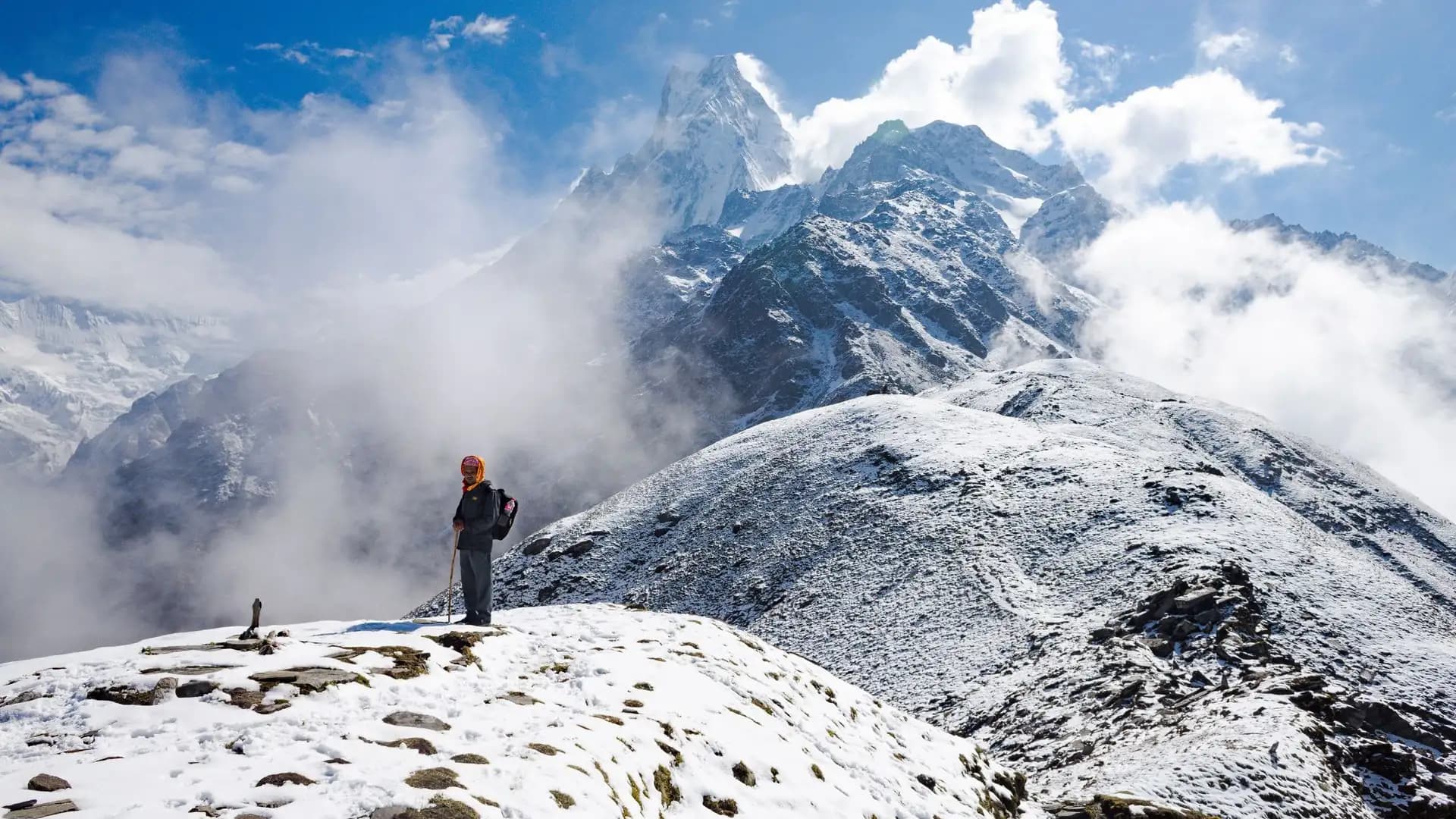
Mardi Himal Trek Distance: Total KM, Miles & Daily Breakdown
Introduction to Mardi Himal Trek Distance
The Mardi Himal trek typically takes 4 to 7 days on the trail, with total trip length — including arrival and departure in Pokhara — often running 5 to 8 days depending on the exact itinerary chosen. Genuine "3-day" versions exist but are heavily compressed and generally only suitable for very fit, experienced trekkers with excellent acclimatization, while 7-day itineraries add buffer days, a Low Camp overnight, or a side extension for a more comfortable, lower-risk pace.
This guide breaks down exactly what each duration option looks like day by day, who each length actually suits, and what trade-offs come with compressing or extending the standard itinerary.
Mardi Himal Duration Options at a Glance
Itinerary length | Trail days | Total trip days (incl. Pokhara transfers) | Best suited for |
|---|---|---|---|
Compressed (often marketed as "3-day" or "4-day") | 3–4 days | 4–5 days | Very fit, experienced, well-acclimatized trekkers |
Standard | 5 days | 5–6 days | The most common choice — balanced pace and time commitment |
Extended | 6–7 days | 7–8 days | Trekkers wanting extra buffer, better acclimatization, or a side stop |
Combined with another trek (e.g., Khopra Danda) | 12–14 days | 13–15 days | Trekkers with significant time wanting two distinct routes in one trip |
Why Mardi Himal's Duration Varies So Much
Unlike longer treks such as the Annapurna Circuit or Everest Base Camp, where the itinerary length is fairly standardized around a well-established acclimatization schedule, Mardi Himal's duration genuinely varies more between operators and trekkers because of three factors:
The trek's total elevation gain (roughly 2,700–2,860 m) is modest enough that it can be compressed into a short window by fit trekkers, unlike routes crossing 5,000-plus-meter passes where compression becomes genuinely dangerous regardless of fitness.
Multiple viable starting points (Kande vs. Dhampus) and multiple viable descent routes (Landruk vs. via Ghandruk) mean the same core trek can be packaged in slightly different day-counts depending on exactly which trailheads and connector stages an operator uses.
The trek can be extended relatively easily by combining it with neighboring routes (Khopra Danda in particular) via shared trail junctions at Landruk and Ghandruk, meaning "how long is Mardi Himal" sometimes really means "how long is Mardi Himal plus whatever else you attach to it."
The Core Route Structure
Regardless of how many days a specific itinerary uses, every Mardi Himal trek follows the same basic geographic structure — what changes between duration options is how these stages are grouped and paced.
Stage | Elevation | Appears in every itinerary? |
|---|---|---|
Pokhara to Kande/Dhampus (drive) | 1,640–1,770 m | Yes |
Trailhead to Forest Camp | 2,600 m | Yes |
Forest Camp to High Camp | 3,600–3,900 m | Yes |
High Camp to Base Camp (day visit) | 4,500 m | Yes |
Descent to Low Camp/Landruk | 3,050 m → 1,565 m | Yes |
Landruk to Pokhara (drive) | 822 m | Yes |
Every version of this trek — 3-day, 5-day, or 7-day — passes through these same fundamental stages. The difference between duration options is entirely about pacing: how many overnight stops are used to cover this same ground, and how much buffer time is built in for weather, acclimatization, or rest.
The 3-to-4 Day Option: Compressed and Demanding
A genuinely compressed Mardi Himal itinerary, sometimes marketed as a "3-day" or "4-day" trek, combines several of the standard stages into fewer, longer days. This is the most physically demanding version of the trek and is generally recommended only for very fit trekkers with prior high-altitude experience.
Sample 4-day itinerary
Day | Route | Elevation (end of day) | Walking time |
|---|---|---|---|
Day 1 | Pokhara to Kande (drive), trek to Forest Camp | 2,600 m | 5–6 hours |
Day 2 | Forest Camp to High Camp | 3,600–3,900 m | 5–7 hours |
Day 3 | High Camp to Base Camp (pre-dawn) and back to High Camp, then descend to Low Camp | 3,050 m (overnight) | 7–9 hours |
Day 4 | Low Camp to Landruk, drive to Pokhara | 822 m | 5–6 hours |
What makes this version demanding:
Day 1 combines what a longer itinerary would split into two separate stages (trailhead to an intermediate stop, then intermediate stop to Forest Camp).
Day 3 combines the entire Base Camp excursion with a substantial descent to Low Camp in a single day — a genuinely long, tiring day involving a pre-dawn start, a summit push, and several thousand meters of net elevation change.
Minimal buffer exists for weather delays, fatigue, or mild altitude symptoms.
Who this suits: Trekkers with limited vacation time (a long weekend plus travel days), strong prior hiking or trekking experience, and confidence in their ability to handle compressed elevation gain without acclimatization issues. This is not the recommended default for first-time trekkers or anyone with a history of altitude sickness.
A note on true "3-day" marketing: Some operators market an even more compressed 3-day version by using vehicle access partway up the route (where road conditions allow) or by pushing exceptionally long single days. Trekkers considering a genuinely 3-day itinerary should discuss the specific day-by-day plan in detail with their agency, since compressing this much elevation gain into three days leaves very little margin for anything to go differently than planned.
The 5-Day Option: The Standard, Most Common Choice
Five days is the most frequently used itinerary length for Mardi Himal, and represents a genuine balance between time efficiency and sensible pacing.
Sample 5-day itinerary
Day | Route | Elevation (end of day) | Walking time |
|---|---|---|---|
Day 1 | Pokhara to Kande (drive), trek to Deurali/Pothana | 1,900–2,100 m | 4–5 hours |
Day 2 | Deurali/Pothana to Forest Camp | 2,600 m | 4–5 hours |
Day 3 | Forest Camp to High Camp | 3,600–3,900 m | 5–6 hours |
Day 4 | High Camp to Base Camp (pre-dawn) and back, descend to Low Camp | 3,050 m | 6–8 hours |
Day 5 | Low Camp to Landruk, drive to Pokhara | 822 m | 4–5 hours |
Why this length works well for most trekkers:
The trailhead-to-Forest-Camp stage is split across two more manageable days rather than combined into one, reducing the compressed feel of the shorter option.
The Base Camp excursion day still involves significant elevation change but isn't stacked with as long a subsequent descent as the 4-day version.
There's slightly more natural buffer for trekkers who find themselves moving a bit slower than average, without requiring a full extra day.
Who this suits: The majority of reasonably fit trekkers without significant prior high-altitude experience, and anyone wanting a genuine taste of high-altitude Himalayan trekking within a realistic one-week vacation window (accounting for arrival and departure days in Kathmandu/Pokhara).
The 7-Day Option: Extended, With Genuine Buffer
A 6-to-7-day or more Mardi Himal itinerary adds meaningful buffer time, typically through one or both of two additions: an overnight stop at Low Camp (breaking the demanding Forest Camp to High Camp stage into two days), or a dedicated rest/acclimatization day.
Sample 7-day itinerary
Day | Route | Elevation (end of day) | Walking time |
|---|---|---|---|
Day 1 | Pokhara to Dhampus (drive), trek to Pothana | 1,900 m | 3–4 hours |
Day 2 | Pothana to Forest Camp | 2,600 m | 4–5 hours |
Day 3 | Forest Camp to Low Camp | 3,050 m | 4–5 hours |
Day 4 | Low Camp to High Camp | 3,600–3,900 m | 3–5 hours |
Day 5 | High Camp to Base Camp (pre-dawn) and back to High Camp | 3,600–3,900 m | 5–7 hours |
Day 6 | High Camp/Low Camp to Landruk | 1,565 m | 5–6 hours |
Day 7 | Landruk to Pokhara (drive) | 822 m | — |
Why this length is worth considering:
Breaking the Forest Camp to High Camp stage into two separate days (via a Low Camp overnight) directly addresses the trek's single biggest difficulty factor — the roughly 1,000-to-1,300-meter single-day gain that the 4-and-5-day versions combine into one push.
The Base Camp excursion day (Day 5) doesn't require an immediate long descent afterward, since the return to Landruk happens the following day.
This structure offers meaningfully better acclimatization pacing, particularly valuable for trekkers without significant prior high-altitude experience.
Who this suits: Trekkers prioritizing comfort and reduced altitude risk over time efficiency, first-time high-altitude trekkers, and anyone with slightly more vacation time available who'd rather have genuine buffer than risk a compressed, fatiguing itinerary.
Comparing All Three Standard Options Side by Side
Factor | 3–4 Day | 5 Day | 6–7 Day |
|---|---|---|---|
Total elevation gain | Same (~2,700–2,860 m) | Same | Same |
Average daily elevation gain | Highest | Moderate | Lowest |
Acclimatization buffer | Minimal | Some | Meaningful |
Physical demand per day | High | Moderate–high | Moderate |
Suitable for first-timers | Not recommended | Generally yes | Yes, best option |
Suitable for very fit/experienced trekkers | Yes | Yes | Yes (more relaxed) |
Total trip cost | Lowest | Moderate | Highest |
Flexibility for weather delays | Very limited | Limited | Reasonable |
How Total Trip Length Differs From Trail Days
A genuinely important distinction: "how long is Mardi Himal" as a trail-days question (4–7 days) differs from the total time commitment of the full trip, once Kathmandu-to-Pokhara transfers and any pre/post-trek buffer days are included.
Component | Typical duration |
|---|---|
Kathmandu to Pokhara (flight or bus) | Same day, either direction |
Pokhara to trailhead and back | Included in trek day count |
Trek itself | 4–7 days (as detailed above) |
Recommended buffer day in Pokhara before/after | 1 day (optional but sensible) |
Realistic total trip time from Kathmandu, round trip | 6–10 days |
Trekkers planning a trip specifically around Mardi Himal should budget for the trek itself plus at least one buffer day in Pokhara on either end — partly for logistics, and partly because legs are often fatigued after the descent, particularly given the trek's steep final drop to Landruk.
Combining Mardi Himal With Other Routes: How Duration Changes
Because Mardi Himal shares trail junctions with the broader Annapurna Conservation Area trail network at Landruk and Ghandruk, it's commonly extended into a longer combined itinerary rather than kept as a standalone trip.
Combination | Total duration | Structure |
|---|---|---|
Mardi Himal alone | 4–7 days | As detailed above |
Mardi Himal + Khopra Danda | 12–14 days | Mardi Himal first, descend via Ghandruk, cross to Khopra Ridge via Tadapani and Dobato, finish via Ghorepani and Poon Hill |
Mardi Himal + partial ABC extension | 10–14 days | Mardi Himal first, descend via Ghandruk, continue into the ABC trail network via Chhomrong |
For trekkers with two weeks or more available, combining Mardi Himal with Khopra Danda is a genuinely popular option specifically because it delivers two distinct mountain panoramas — Mardi Himal's close-up eastern-facing view of Machhapuchhre, and Khopra Danda's wider western-facing panorama toward Dhaulagiri — without repeating any of the same trail on the return leg.
Factors That Genuinely Change How Long Your Trek Will Take
Beyond simply choosing an itinerary length in advance, several real-world factors can extend or compress your actual time on the trail, regardless of the plan you started with.
Factors that can extend the trek
Weather delays, particularly cloud cover or poor visibility that leads a guide to recommend waiting an extra day for a clearer Base Camp morning
Mild altitude symptoms that warrant an additional rest day rather than pushing forward on schedule
Trail conditions, particularly in winter when snow on the upper ridge sections can slow progress or require additional caution
Group pace, since guided group treks generally move at the pace of the slowest comfortable member rather than the fastest
Factors that can compress the trek
Strong prior acclimatization (from a recent previous high-altitude trek) allowing faster-than-average pacing without added risk
Exceptional fitness level, allowing longer daily distances to be covered comfortably
Starting from Kande rather than Dhampus, which shaves a small amount of distance and time off the approach
Factor | Typical effect on total duration |
|---|---|
Weather delay at High Camp/Base Camp | +1 day |
Additional rest day for mild AMS symptoms | +1 day |
Winter snow conditions | +0.5–1 day, depending on severity |
Strong prior acclimatization | Can enable the shorter end of standard ranges |
Choosing Kande over Dhampus | Marginal time savings, not a full day |
Duration and Difficulty: Why Length and Difficulty Are Linked
It's worth restating a point that directly affects the "how long" question: because Mardi Himal's total elevation gain (roughly 2,700–2,860 m) stays the same regardless of which itinerary length you choose, a shorter itinerary doesn't reduce the total physical work required — it simply compresses the same amount of climbing into fewer days. This is the core trade-off underlying every duration decision on this trek.
Itinerary length | Total elevation gain | Average gain per day |
|---|---|---|
4 days | ~2,700–2,860 m | ~675–715 m/day |
5 days | ~2,700–2,860 m | ~540–570 m/day |
7 days | ~2,700–2,860 m | ~385–410 m/day |
This table makes the trade-off concrete: choosing a shorter itinerary means accepting a meaningfully higher average daily elevation gain, not a genuinely easier trek overall. Trekkers weighing duration options should think of this less as "shorter equals easier" and more as "shorter equals more compressed effort per day."
How Adventure Life Nepal Structures Duration Options
Given how much genuine flexibility exists in Mardi Himal's itinerary length, Adventure Life Nepal offers all three standard duration options — compressed 4-day, standard 5-day, and extended 6-to-7-day — and helps trekkers choose based on an honest conversation about available time, fitness level, and altitude experience, rather than defaulting every booking to the shortest marketable option.
For trekkers without significant prior high-altitude trekking experience, the 6-to-7-day version with a Low Camp overnight is generally the recommended starting point, with the shorter options reserved for trekkers who can genuinely demonstrate the fitness and experience to handle the more compressed pacing safely.
FAQs about Mardi Himal Trek Distance
How many days does the Mardi Himal trek actually take? Most itineraries run 4 to 7 days on the trail, with 5 days being the most commonly booked standard option.
Is a 3-day Mardi Himal trek realistic? Genuinely compressed 3-to-4-day versions exist and are physically possible for very fit, experienced trekkers, but they leave minimal buffer for weather, fatigue, or altitude symptoms and aren't recommended as a default choice for first-time high-altitude trekkers.
What's the difference between a 5-day and 7-day itinerary? The extra days in a 7-day itinerary are typically used to add a Low Camp overnight (breaking up the demanding Forest Camp to High Camp stage) and/or a dedicated buffer day, resulting in a lower average daily elevation gain and better acclimatization pacing.
Does a shorter itinerary make the trek easier? No — the total elevation gain stays the same regardless of itinerary length, so a shorter trek means a higher average daily elevation gain, not less overall physical effort.
How long should I budget for the full trip, including travel to and from Pokhara? A realistic total time commitment from Kathmandu, round trip, including the trek itself and reasonable buffer, is 6 to 10 days.
Do I sleep at Mardi Himal Base Camp on any itinerary length? No, on any standard itinerary. Base Camp (4,500 m) is reached as a day excursion from High Camp on every duration option, not an overnight stop.
Can I extend the Mardi Himal trek into a longer combined itinerary? Yes — it's commonly combined with Khopra Danda via shared trail junctions at Landruk and Ghandruk, extending the total trip to 12–14 days.
Which itinerary length is best for a first-time high-altitude trekker? The 6-to-7-day extended version, given its lower average daily elevation gain and better acclimatization buffer.
What could cause my trek to take longer than planned? Weather delays (particularly cloud cover affecting the Base Camp visibility window), mild altitude symptoms warranting an extra rest day, or winter snow conditions slowing progress on the upper ridge.
Is the compressed 4-day version cheaper than the 5-or-7-day options? Generally yes, since total cost scales with guide-days, porter-days, and teahouse nights — fewer days on the trail typically means a lower total package price.
Does starting from Kande or Dhampus change the total trek length? Only marginally — Kande offers a slightly more direct route, but the difference isn't significant enough to change which overall duration option (4, 5, or 7 days) is appropriate for a given trekker.
How long is the descent portion of the trek? Typically 1 to 2 days, covering the steep descent from High Camp or Low Camp down to Landruk (over 1,400 meters of elevation loss), followed by a drive back to Pokhara.
Is it possible to do Mardi Himal in a single very long day, without overnight stops on the ridge? No — this isn't a realistic or safe option given the total elevation gain and the altitude reached (4,500 m); every standard itinerary involves multiple overnight teahouse stops.
Which duration option does Adventure Life Nepal recommend most often? The 5-day standard itinerary for trekkers with reasonable fitness and no major altitude concerns, and the 6-to-7-day extended version for first-timers or anyone prioritizing comfort and acclimatization buffer over time efficiency.
Conclusion on Mardi Himal Trek Distance
The honest answer to "how long is the Mardi Himal trek" is a genuine range rather than a single number: 4 to 7 days on the trail, with the same core route and total elevation gain (roughly 2,700–2,860 m) simply distributed across more or fewer overnight stops depending on the itinerary chosen.
A compressed 3-to-4-day version suits very fit, experienced trekkers with limited time; the 5-day standard option remains the most popular, balanced choice for the majority of reasonably fit trekkers; and a 6-to-7-day extended itinerary offers genuinely better acclimatization pacing for first-timers or anyone prioritizing comfort.
Whichever length fits your schedule and experience level, understanding that shorter doesn't mean easier — only more compressed — is the single most useful thing to know before booking. Adventure Life Nepal builds each of these duration options with that trade-off in mind, matching the itinerary length to the trekker rather than the other way around.