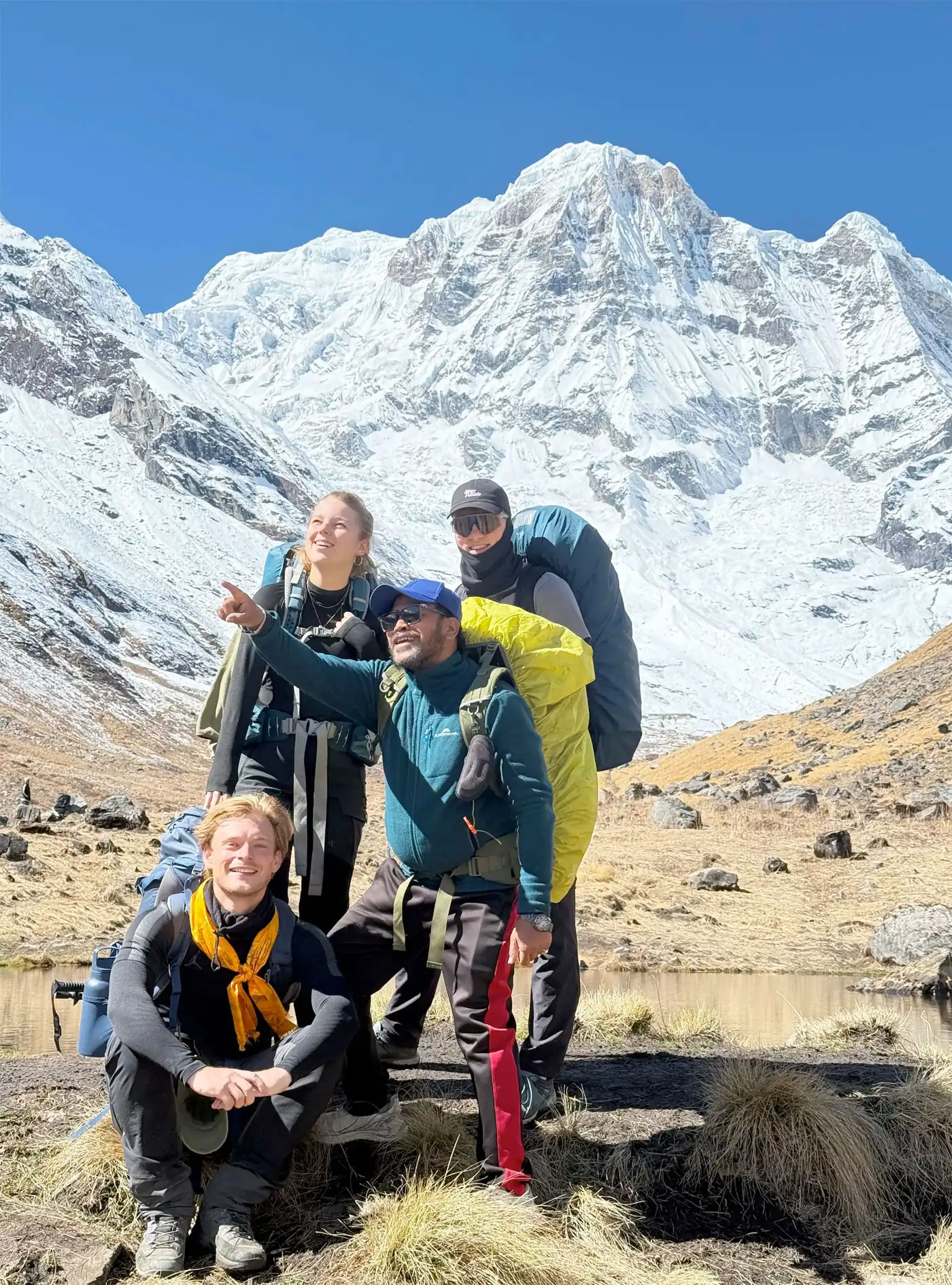
Annapurna Circuit with Tilicho Lake Trek - 12 days
Trip Duration: 12 Days
Trip Grade: Moderate
Group Size: Min 2 Person - Max 12 Person
Meals: Breakfast, Lunch, Dinner
Best Season: Spring (March–May) and autumn (late September–November)
Start Point: 1,400 m
Ending Point: 1,400 m
Max Altitude: 4,919m
Overview
The Annapurna Circuit with Tilicho Lake adds one of the world's highest lakes to Nepal's most famous trekking route. Over 12 days you follow the Marsyangdi valley into the dry, Tibetan-style landscape of Manang. From there you detour west to the turquoise water of Tilicho Lake, then cross the 5,416 m Thorong La Pass to the sacred temples of Muktinath.
A jeep ride to Chame skips the lower road sections, so you spend your walking days where the scenery is best. An acclimatization day in Manang and a gradual climb to the pass give your body time to adjust. After the pass you drive down the Kali Gandaki gorge, the deepest in the world, and rest beside Phewa Lake in Pokhara before returning to Kathmandu.
This trek suits fit walkers who are ready for long days at high altitude. You don't need technical climbing experience, but previous multi-day hiking helps.
Highlights
Itinerary
Drive time: 9–10 hours We leave Kathmandu early and drive west to Besisahar. From there the road climbs the Marsyangdi valley through Jagat, Dharapani and Timang to Chame, the headquarters of Manang district. Views of Lamjung Himal and Annapurna II begin along the way.
Trek time: 5–6 hours The trail runs through pine forest and past the huge curved rock face of Paungda Danda. Here the valley opens into the drier landscape of upper Manang, with views of Annapurna II and Pisang Peak.
Trek time: 5–6 hours You can take the upper trail through Ghyaru and Ngawal for wide Annapurna views, or the easier lower route past Humde. Both end in Manang, a Tibetan-style village with stone houses, prayer wheels and monasteries.
This rest day helps your body adjust to the altitude. Short hikes to Gangapurna Lake, the Ice Lake viewpoint or Praken Gompa are a good way to spend it. Climbing high and sleeping low prepares you for the days ahead.
Trek time: 6–7 hours We leave the main Circuit trail and head west through Khangsar and Shree Kharka. The last stretch crosses a dramatic landslide area with loose scree slopes, so we take it slowly and carefully.
Trek time: 7–8 hours We start before sunrise and climb steeply to Tilicho Lake. Its turquoise water sits beneath the ice walls of Tilicho Peak, and the scenery is the highlight of the trip. After time at the lake, we walk back down past base camp to Shree Kharka.
Trek time: 5–6 hours A quieter trail crosses high pastures and rejoins the main Circuit route. Yaks graze in the meadows, with Gangapurna and the Chulu peaks in view.
Trek time: 4–6 hours A short but steady climb takes us to Thorong Phedi. If the group is feeling strong, we continue another hour up to High Camp, which shortens the pass day.
Trek time: 8–10 hours This is the big day. We start very early and climb to Thorong La, the highest point of the trek. The pass is marked with prayer flags and has huge Himalayan views. A long descent follows to Muktinath, a sacred pilgrimage site for both Hindus and Buddhists.
Drive time: 8–9 hours We drive down the Kali Gandaki gorge, the deepest gorge in the world, passing Jomsom, Marpha and Tatopani on the way to Pokhara. The evening is free for a walk beside Phewa Lake.
Drive time: 6–7 hours by tourist bus or private vehicle A scenic drive along the Trishuli River brings us back to Kathmandu. The evening is free for shopping or a farewell dinner.
We transfer you to Tribhuvan International Airport for your onward flight.
Elevation Profile
Altitude Variation Chart
What's Included
Included
- Airport transfer on departure day
- Jeep from Kathmandu to Chame and from Muktinath to Pokhara
- Tourist bus from Pokhara to Kathmandu (private vehicle on request, at extra cost)
- One night in a hotel in Pokhara and one night in a hotel in Kathmandu, with breakfast
- Three meals a day during the trek (breakfast, lunch and dinner)
- Annapurna Conservation Area Project (ACAP) permit, plus a TIMS card if checkpoints require one
- Experienced, government-licensed English-speaking trekking guide
- Porter service (one porter for every two trekkers)
Excluded
- International flights and Nepal visa fees
- Hotel nights and meals in Kathmandu before the trek starts
- Travel insurance with cover for high-altitude trekking and helicopter evacuation
- Personal expenses such as hot showers, battery charging, Wi-Fi, laundry and snacks
- Bottled water, soft drinks and alcohol
- Extra nights caused by bad weather, landslides, illness or early return
- Tips for guide, porter and driver
- Personal trekking gear
Frequently Asked Questions
It is a strenuous trek. You walk 5–10 hours on most days. The Tilicho Lake climb (Day 6) and the Thorong La crossing (Day 9) are long, steep days above 4,500 m. You don't need technical climbing skills.
It isn't required, but it helps. Good fitness matters most. We recommend regular hiking, running, cycling or stair climbing for at least 6–8 weeks before the trip.
Spring (March–May) and autumn (late September–November) bring the most stable weather and clearest views. In winter, snow can close Thorong La and the Tilicho trail. In the monsoon (June–August), landslides and leeches are common on the lower sections.
Yes. Above 3,000 m anyone can get altitude sickness, however fit they are. The itinerary includes an acclimatization day in Manang and a gradual climb, and your guide checks on you every day. Tell them at once if you have a headache, nausea, dizziness or trouble sleeping. If symptoms get worse, the only cure is to go down.
Your guide will help you descend safely. In an emergency, a helicopter evacuation can be arranged. This is why you need travel insurance that covers high-altitude rescue.
Yes. You can follow the standard Annapurna Circuit from Manang to Yak Kharka instead, which shortens the trek by about two days. Let us know when you book.
You need the Annapurna Conservation Area Project (ACAP) permit. We arrange all permits for you. Just bring your passport and passport photos.
Most villages up to Manang have Wi-Fi, usually for a small fee. Mobile signal is patchy higher up. Expect little or no connection at Tilicho Base Camp, High Camp and on the pass.
One porter carries the bags of two trekkers, so please keep your main bag to about 10–12 kg. You can leave extra luggage at your hotel in Kathmandu.
Yes, at most teahouses for a small fee. Charging costs more the higher you go, and the cold drains batteries quickly. Bring a power bank and keep it warm at night.
Customer Reviews
Loading reviews...